


Macrophages in trigeminal ganglion contribute to ectopic mechanical hypersensitivity following inferior alveolar nerve injury in rats
- PMID: 29246259
- PMCID: PMC5732495
- DOI: 10.1186/s12974-017-1022-3
Macrophages in trigeminal ganglion contribute to ectopic mechanical hypersensitivity following inferior alveolar nerve injury in rats
Abstract
Background: Accidental mandibular nerve injury may occur during tooth extraction or implant procedures, causing ectopic orofacial pain. The exact mechanisms underlying ectopic orofacial pain following mandibular nerve injury is still unknown. Here, we investigated the role of macrophages and tumor necrosis factor alpha (TNFα) in the trigeminal ganglion (TG) in ectopic orofacial pain following inferior alveolar nerve transection (IANX).
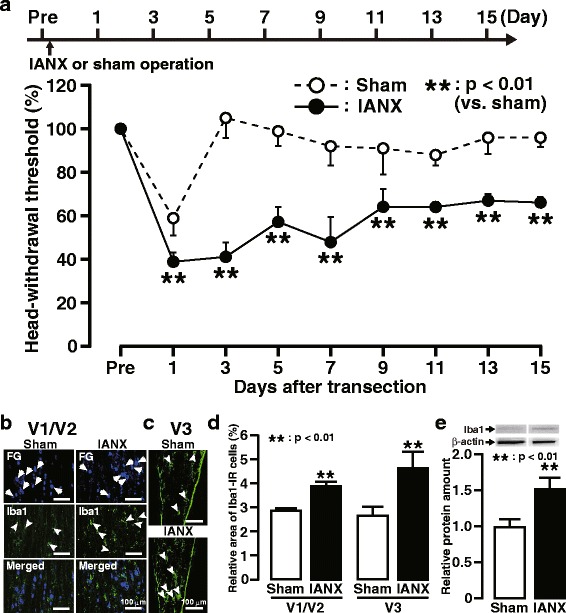
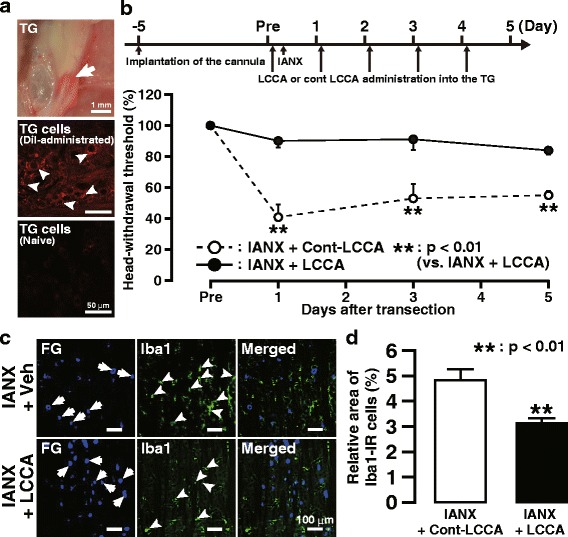
Methods: IANX was performed and the mechanical head-withdrawal threshold (MHWT) in the whisker pad skin ipsilateral to IANX was measured for 15 days. Expression of Iba1 in the TG was examined on day 3 after IANX, and the MHWT in the whisker pad skin ipsilateral to IANX was measured following successive intra-ganglion administration of the macrophage depletion agent liposomal clodronate Clophosome-A (LCCA). TNFα expression in the TG and the MHWT in the whisker pad skin ipsilateral to IANX following successive intra-ganglion administration of the TNFα blocker etanercept were measured on day 3 after IANX, and tumor necrosis factor receptor-1 (TNFR1) immunoreactive (IR) cells in the TG were analyzed immunohistochemically on day 3.
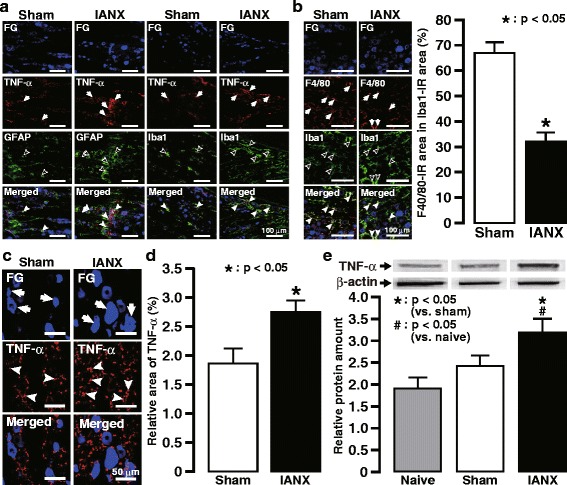
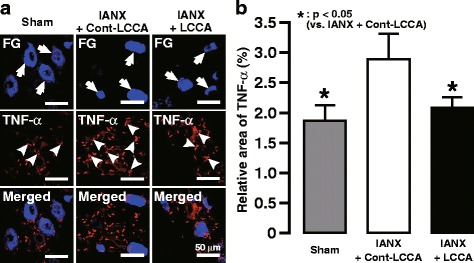
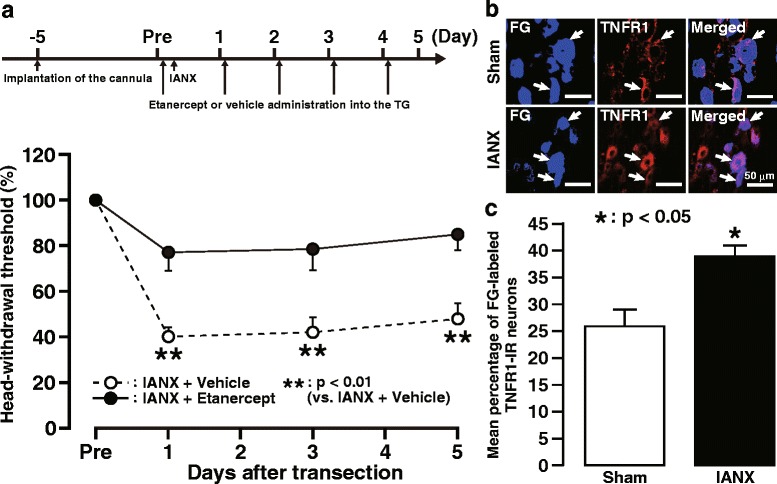
Results: The MHWT in the whisker pad skin was significantly decreased for 15 days, and the number of Iba1-IR cells was significantly increased in the TG on day 3 after IANX. Successive intra-ganglion administration of the macrophage depletion agent LCCA significantly reduced the increased number of Iba1-IR cells in the TG and reversed the IANX-induced decrease in MHWT in the whisker pad skin. TNFα expression was increased in the TG on day 3 after IANX and was reduced following successive intra-ganglion administration of the TNFα inhibitor etanercept. The decreased MHWT was also recovered by etanercept administration, and TNFR1-IR cells in the TG were increased on day 3 following IANX.
Conclusions: These findings suggest that signaling cascades resulting from the production of TNFα by infiltrated macrophages in the TG contributes to the development of ectopic mechanical allodynia in whisker pad skin following IANX.
Keywords: Ectopic orofacial pain; Inferior alveolar nerve transection; Macrophage; Mechanical allodynia; Trigeminal ganglion; Tumor necrosis factor alpha.
Conflict of interest statement
Ethics approval
The experimental protocols including all the surgical procedures and animal usages conformed to the guidelines for the care and use of laboratory animals by the National Institutes of Health Guide for the Care and Use of Laboratory Animals and the guidelines of the International Association for the Study of Pain. This study was approved by the Animal Experimentation Committee at Nihon University (AP16D010).
Consent for publication
Not applicable.
Competing interests
The authors declare that they have no competing interests.
Publisher’s Note
Springer Nature remains neutral with regard to jurisdictional claims in published maps and institutional affiliations.
Figures
References
MeSH terms
Substances
Grants and funding
LinkOut - more resources
Full Text Sources
Other Literature Sources
Miscellaneous
