


A Randomized Controlled Trial Evaluating the Impact of Web-Based Information on Breast Cancer Patients' Knowledge of Surgical Treatment Options
- PMID: 29246705
- PMCID: PMC6295317
- DOI: 10.1016/j.jamcollsurg.2017.10.024
A Randomized Controlled Trial Evaluating the Impact of Web-Based Information on Breast Cancer Patients' Knowledge of Surgical Treatment Options
Abstract
Background: Previous research suggests that providing information to women newly diagnosed with breast cancer, during the gap between cancer diagnosis and their first surgeon consultation, may support decision making. Our objective was to compare patients' knowledge after the pre-consultation delivery of standard websites vs a web-based decision aid (DA).
Study design: We randomized women with stage 0 to III breast cancer, within an academic and community breast clinic, to be emailed a link to selected standard websites (National Cancer Institute, American Cancer Society, Breastcancer.org,) vs the Health Dialog DA (Clinicaltrials.govNCT03116035). Patients seeking second opinions, diagnosed by excisional biopsy, or without an email address, were ineligible. Pre-consultation knowledge was assessed using the Breast Cancer Surgery Decision Quality Instrument. We compared differences in knowledge using t-test.
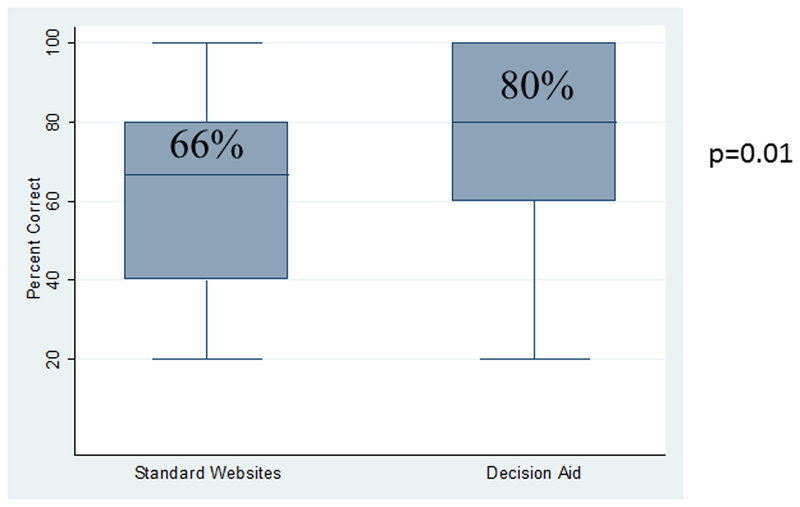
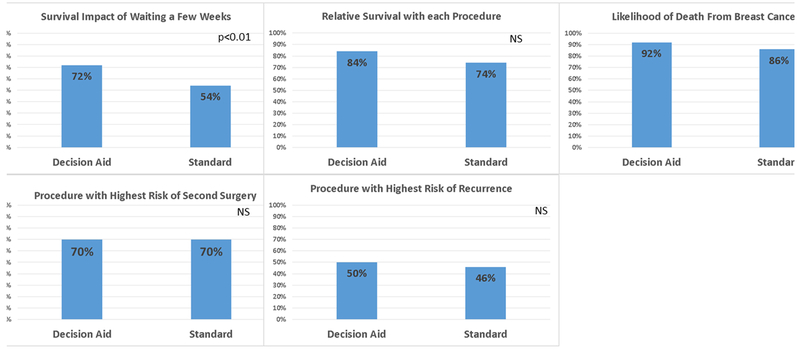
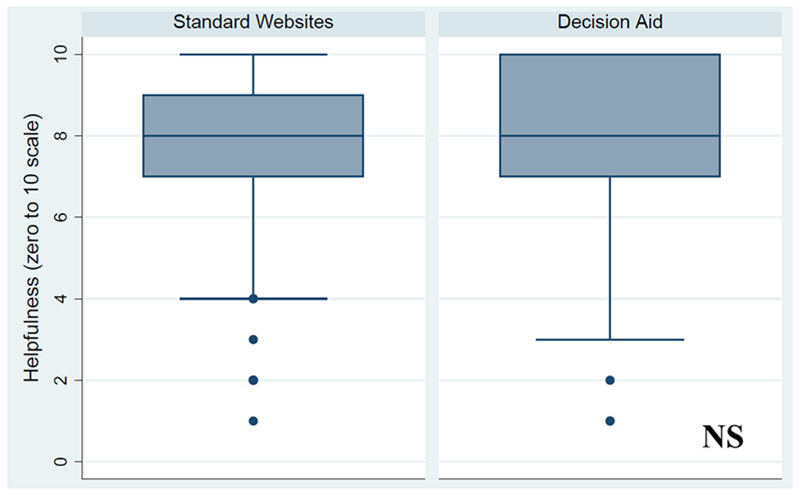
Results: Median patient age was 59 years, 99% were white, and 65% had a college degree or higher, with no differences in demographics between study arms. Knowledge was higher in patients who received the DA (median 80% vs 66% correct, p = 0.01). Decision-aid patients were more likely to know that waiting a few weeks to make a treatment decision would not affect survival (72% vs 54%, p < 0.01). Patients in both arms found the information helpful (median score 8 of 10).
Conclusions: Although patients found receipt of any pre-consultation information helpful, the DA resulted in improved knowledge over standard websites and effectively conveyed that there is time to make a breast cancer surgery decision. Decreasing the urgency patients feel may improve the quality of patient-surgeon interactions and lead to more informed decision-making.
Copyright © 2017 American College of Surgeons. Published by Elsevier Inc. All rights reserved.
Figures
References
-
- Mandelblatt J, Kreling B, Figeuriedo M, Feng S. What is the impact of shared decision making on treatment and outcomes for older women with breast cancer? Journal of clinical oncology : official journal of the American Society of Clinical Oncology. October 20 2006;24(30):4908–4913. - PubMed
-
- Ashraf AA, Colakoglu S, Nguyen JT, et al. Patient involvement in the decision-making process improves satisfaction and quality of life in postmastectomy breast reconstruction. The Journal of surgical research. September 2013;184(1):665–670. - PubMed
-
- Molenaar S, Sprangers MA, Rutgers EJ, et al. Decision support for patients with early-stage breast cancer: effects of an interactive breast cancer CDROM on treatment decision, satisfaction, and quality of life. Journal of clinical oncology : official journal of the American Society of Clinical Oncology. March 15 2001;19(6):1676–1687. - PubMed
-
- Joseph-Williams N, Elwyn G, Edwards A. Knowledge is not power for patients: a systematic review and thematic synthesis of patient-reported barriers and facilitators to shared decision making. Patient education and counseling. March 2014;94(3):291–309. - PubMed
-
- Hack TF, Degner LF, Parker PA. The communication goals and needs of cancer patients: a review. Psycho-oncology. October 2005;14(10):831–845; discussion 846–837. - PubMed
Publication types
MeSH terms
Associated data
Grants and funding
LinkOut - more resources
Full Text Sources
Other Literature Sources
Medical
Miscellaneous
