Review
. 2018 Jan;70(1):68-141.
doi: 10.1124/pr.117.013896.

WNT Signaling in Cardiac and Vascular Disease

Affiliations
Review

WNT Signaling in Cardiac and Vascular Disease

Sébastien Foulquier et al. Pharmacol Rev. 2018 Jan.

Abstract

WNT signaling is an elaborate and complex collection of signal transduction pathways mediated by multiple signaling molecules. WNT signaling is critically important for developmental processes, including cell proliferation, differentiation and tissue patterning. Little WNT signaling activity is present in the cardiovascular system of healthy adults, but reactivation of the pathway is observed in many pathologies of heart and blood vessels. The high prevalence of these pathologies and their significant contribution to human disease burden has raised interest in WNT signaling as a potential target for therapeutic intervention. In this review, we first will focus on the constituents of the pathway and their regulation and the different signaling routes. Subsequently, the role of WNT signaling in cardiovascular development is addressed, followed by a detailed discussion of its involvement in vascular and cardiac disease. After highlighting the crosstalk between WNT, transforming growth factor-β and angiotensin II signaling, and the emerging role of WNT signaling in the regulation of stem cells, we provide an overview of drugs targeting the pathway at different levels. From the combined studies we conclude that, despite the sometimes conflicting experimental data, a general picture is emerging that excessive stimulation of WNT signaling adversely affects cardiovascular pathology. The rapidly increasing collection of drugs interfering at different levels of WNT signaling will allow the evaluation of therapeutic interventions in the pathway in relevant animal models of cardiovascular diseases and eventually in patients in the near future, translating the outcomes of the many preclinical studies into a clinically relevant context.


Figures

Fig. 1.
Fig. 1.
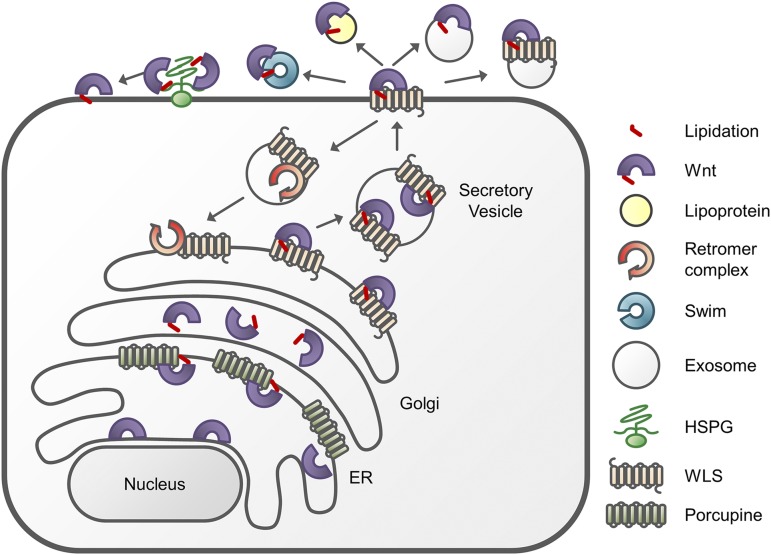
Synthesis, posttranslational modification, and exporting of WNT proteins. After translation of WNT proteins, a palmitoleate group is attached by Porcupine in the endoplasmic reticulum (ER). This promotes the binding to Wntless (WLS), a chaperone protein that facilitates the migration of WNT through the Golgi complex. When WNT has reached the plasma membrane, it can either be secreted in exosomes or be attached to lipoproteins or Swim proteins; this is required to shield the large lipophilic moiety and increase the water solubility of the WNT protein. WNT can also attach to the plasma membrane of the producing cell by forming a complex with heparin sulfate proteoglycan (HSPG). Upon delivery of WNT to the plasma membrane, WLS is recycled via the retromer complex to the Golgi apparatus.
Fig. 2.
Fig. 2.
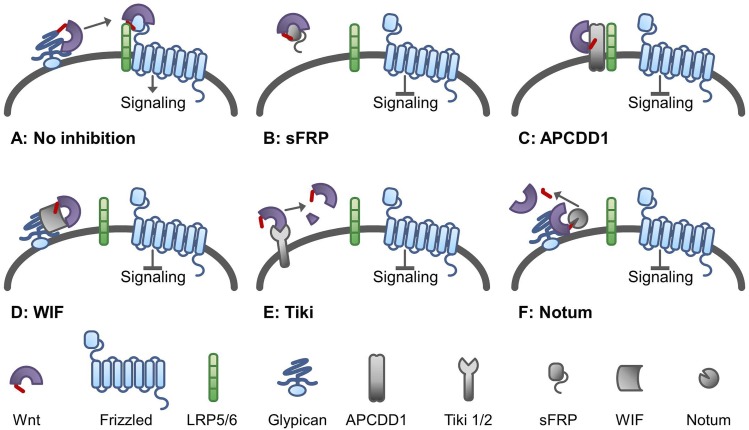
Mechanisms of regulating WNT signaling activity. (A) In the absence of regulating mechanisms, WNT can bind to the FZD/LRP5/6 complex and activate signaling. (B) In the classic view, soluble frizzled-related proteins (sFRPs) can bind WNT and prevent its interaction with the receptor complex. However, sFRPs can modulate Wnt signaling in different ways, as described in the text (C). Adenomatous polyposis coli downregulated-1 (APCDD1) is a membrane-bound glycoprotein that can bind WNT and prevent its interaction with the receptor complex. (D) WNT-inhibitory factor (WIF) is a secreted protein shown to attenuate WNT signaling by binding the protein that prevents the association with the receptor complex. (E) Tiki is a transmembrane protein with proteolytic activity, cleaving an peptide of 8–20 amino acids from the N-terminal part of WNT proteins. This causes the formation of oligomers of WNT proteins that are inactive in signal transduction. (F) Notum is a carboxylesterase capable of removing the palmitoleic acid residue from WNT, making the protein biologically inactive.
Fig. 3.
Fig. 3.
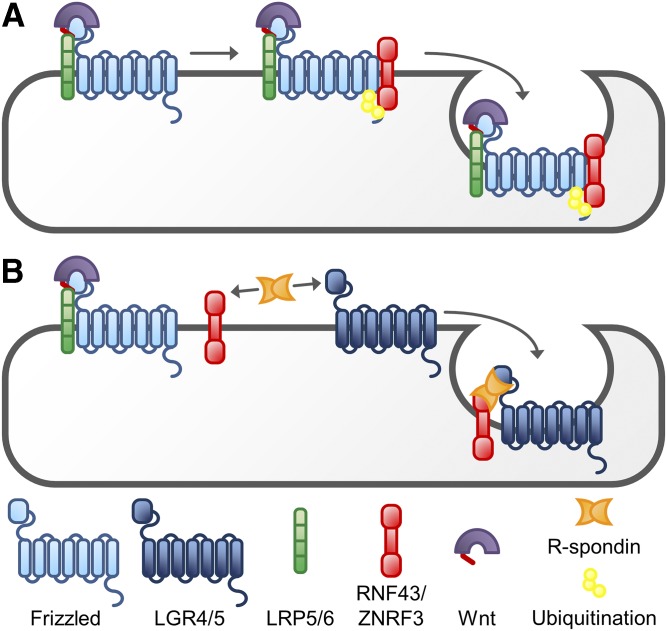
Regulation of the amount of FZD protein on the plasma membrane. (A) Association of the transmembrane E3 ligases RNF43 and/or ZNRF3 with the FZD receptor complex induces its ubiquitination and leads to internalization of the receptor complex, making it unavailable for stimulation with WNT. (B) R-spondin is capable of redirecting the E3 ligases toward LGR4 or -5, inducing the internalization of this transmembrane protein rather than the FZD/LRP5/6 complex. This effectively leaves more FZD receptors at the plasma membrane, available for stimulation with WNT proteins.
Fig. 4.
Fig. 4.
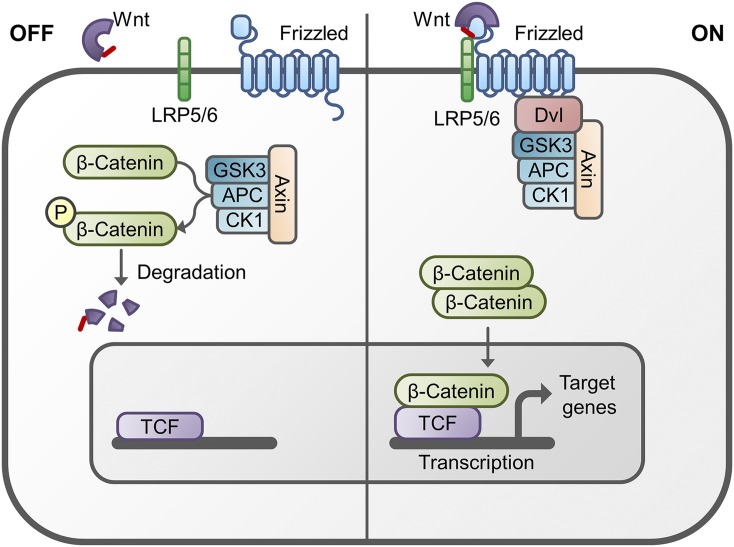
Schematic representation of the WNT/β-catenin signal transduction pathway. (Left) In the “Off” state, β-catenin is bound in a so-called β-catenin destruction complex containing glycogen synthase kinase 3β (GSK3β), axin, adenomatous polyposis coli (APC) and casein kinase-1 (CK-1). The kinases in this complex phosphorylate β-catenin, thereby targeting it for degradation by the ubiquitin proteasome system. (Right) In the “On” state, the receptor complex consisting of frizzled and LRP5/6 bind WNT, which recruits the disheveled (DVL) protein to the plasma membrane. Subsequently, several components of the β-catenin destruction complex are recruited to the membrane, which prevents the phosphorylation of β-catenin. Therefore, this protein can now accumulate in the cytoplasm and translocate to the nucleus to associate with transcription factors and stimulate the transcription of WNT target genes such as cycline-D1, c-myc, and axin2.
Fig. 5.
Fig. 5.
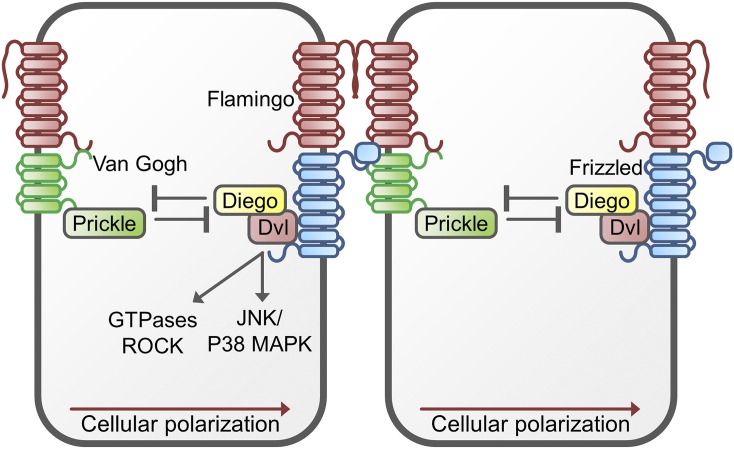
Schematic representation of the planar cell polarity pathway. In this pathways two receptor complexes are formed at the opposite sides of a cell: On one side, frizzled forms a complex with Flamingo/Celsr, disheveled (Dvl), and Diego/Diversin, whereas the other side the complex consists of Flamingo/Celsr, Van Gogh/Vang, and Prickle. The extracellular parts of these complexes interact, thereby controlling the cellular polarization via activation of JNK/p38 MAPK, small GTPase and Rho-associated kinase (ROCK) signaling. Although the role of Wnt in this signal transduction cascade is only partially understood, this protein may interfere with the Vangl1-FZD interaction. This could subsequently disturb the balance between the signaling of the Vang1/Prickle/Celsr complex and the FZD/DVL/Diego/Celsr complex.
Fig. 6.
Fig. 6.
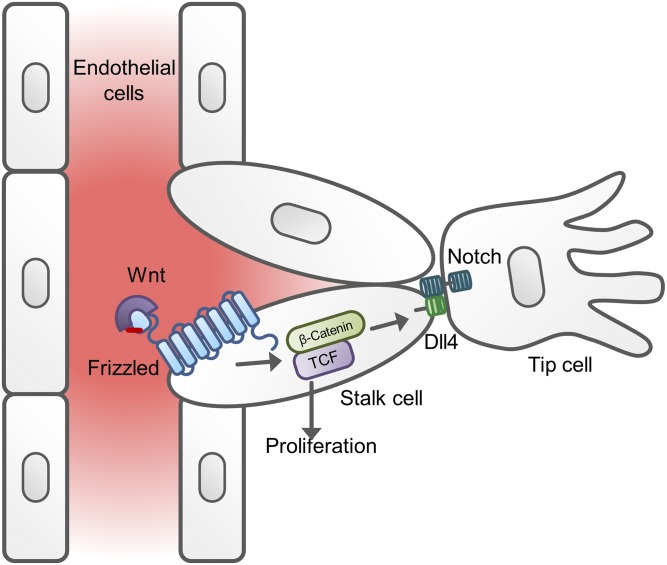
The role of WNT signaling in sprouting angiogenesis. In this process, tip cells provide directional cues to the sprout cells that can proliferate and initiate the formation of a new vessel. WNT signaling can contribute to the proliferation and tube formation of the stalk cells. The effect of WNT signaling on the tip cells is likely to be indirect via the expression of delta-like ligand-4 (Dll4) in the stalk cells, which activates Notch signaling in the tip cells.
Fig. 7.
Fig. 7.
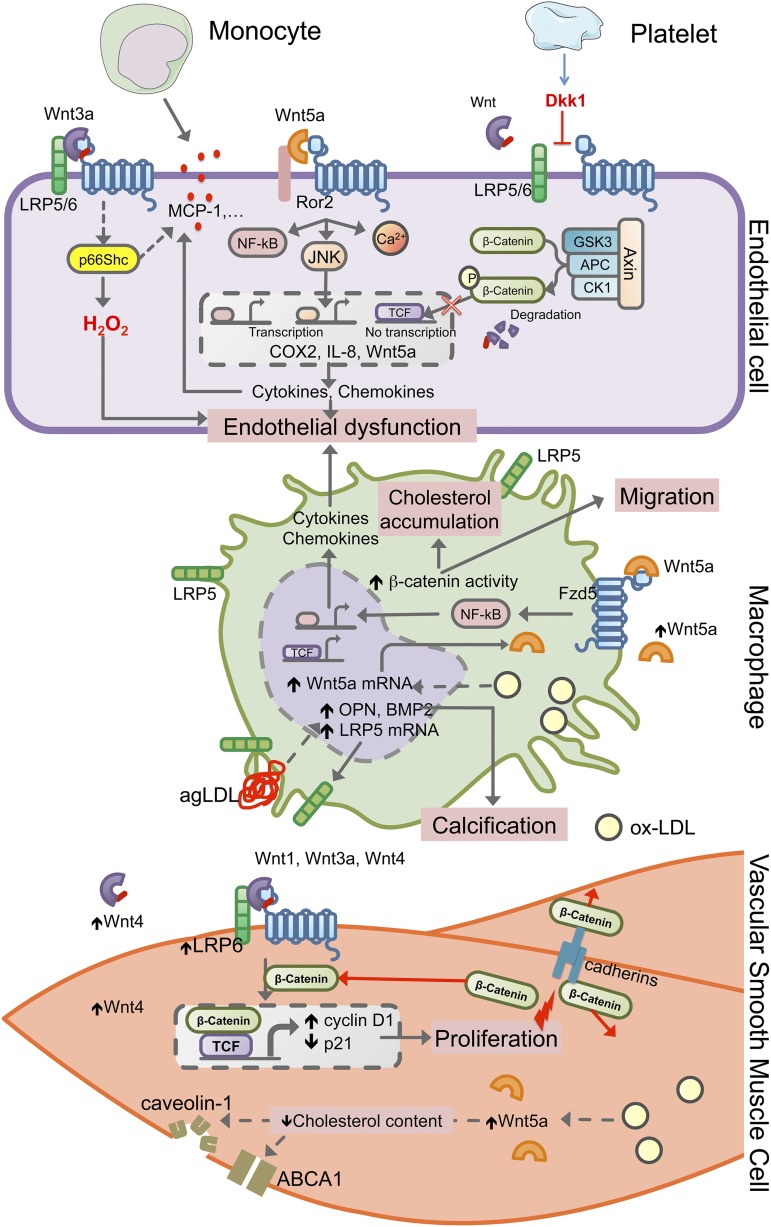
WNT signaling in atherosclerosis. The contribution of WNT signaling to the development and progression of atherosclerosis is described at the intima and media levels with a central role for the contribution of monocytes/macrophages (section VII.A). ABCA1, ATP-binding cassette transporter 1; agLDL, aggregated LDL; ox-LDL, oxidized LDL; MCP-1, monocyte chemotactic protein-1.
Fig. 8.
Fig. 8.
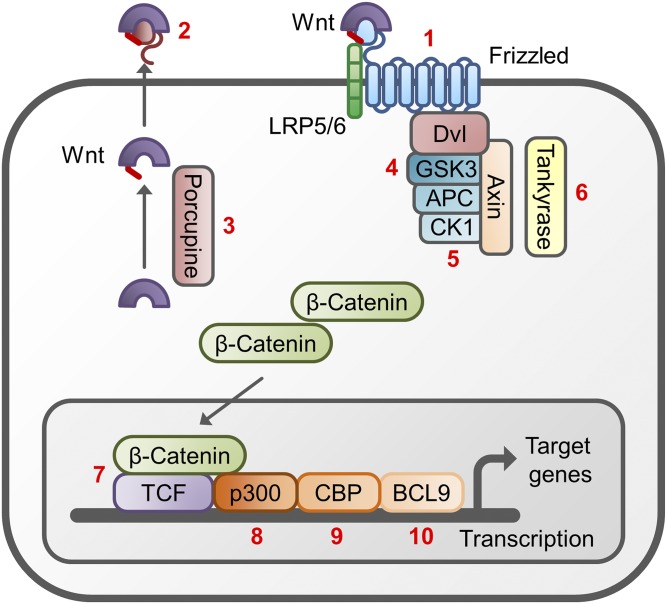
Different sites of pharmacological intervention in WNT signaling. Details are provided in section XI. (1) Targeting of FZD proteins (e.g., vantictumab or UM206); (2) WNT scavengers (e.g., ipafricept); (3) Porcupine inhibitors (e.g., LGK974 or IWP-2); (4) Glycogen synthase kinase-3β (GSK3β) inhibitors (e.g., LiCl, valproic acid, 6-BIO); (5) Casein kinase-1 (CK1) inhibitors (e.g., pyrvinium); (6) Tankyrase inhibitors (e.g., XAV939, IWR-1); (7) Inhibitors of the interaction between β-catenin and the TCF transcription factors (e.g., ICRT3, -5, and -14, nonsteroid anti-inflammatory drugs); (8, 9, 10) Inhibitors of the interaction of the transcription complex with the cofactors p300, CBP, and BCL9 (e.g., windorphen, ICG-001, and SAH-BCL9).

References

    1. Abbott NJ, Patabendige AA, Dolman DE, Yusof SR, Begley DJ. (2010) Structure and function of the blood-brain barrier. Neurobiol Dis 37:13–25. - PubMed
    1. Adler PN. (2012) The frizzled/stan pathway and planar cell polarity in the Drosophila wing. Curr Top Dev Biol 101:1–31. - PMC - PubMed
    1. Ahmad F, Lal H, Zhou J, Vagnozzi RJ, Yu JE, Shang X, Woodgett JR, Gao E, Force T. (2014) Cardiomyocyte-specific deletion of Gsk3α mitigates post-myocardial infarction remodeling, contractile dysfunction, and heart failure. J Am Coll Cardiol 64:696–706. - PMC - PubMed
    1. Ahn J, Lee H, Kim S, Ha T. (2010) Curcumin-induced suppression of adipogenic differentiation is accompanied by activation of Wnt/beta-catenin signaling. Am J Physiol Cell Physiol 298:C1510–C1516. - PubMed
    1. Ahn VE, Chu ML, Choi HJ, Tran D, Abo A, Weis WI. (2011) Structural basis of Wnt signaling inhibition by Dickkopf binding to LRP5/6. Dev Cell 21:862–873. - PMC - PubMed

MeSH terms