. 2017 Dec 15;7(1):17683.
doi: 10.1038/s41598-017-17713-3.

Cellulose long fibers fabricated from cellulose nanofibers and its strong and tough characteristics

Affiliations

Cellulose long fibers fabricated from cellulose nanofibers and its strong and tough characteristics

Abdullahil Kafy et al. Sci Rep. .

Abstract

Cellulose nanofiber (CNF) with high crystallinity has great mechanical stiffness and strength. However, its length is too short to be used for fibers of environmentally friendly structural composites. This paper presents a fabrication process of cellulose long fiber from CNF suspension by spinning, stretching and drying. Isolation of CNF from the hardwood pulp is done by using (2, 2, 6, 6-tetramethylpiperidine-1-yl) oxidanyl (TEMPO) oxidation. The effect of spinning speed and stretching ratio on mechanical properties of the fabricated fibers are investigated. The modulus of the fabricated fibers increases with the spinning speed as well as the stretching ratio because of the orientation of CNFs. The fabricated long fiber exhibits the maximum tensile modulus of 23.9 GPa with the maximum tensile strength of 383.3 MPa. Moreover, the fabricated long fiber exhibits high strain at break, which indicates high toughness. The results indicate that strong and tough cellulose long fiber can be produced by using ionic crosslinking, controlling spinning speed, stretching and drying.


Conflict of interest statement

The authors declare that they have no competing interests.

Figures
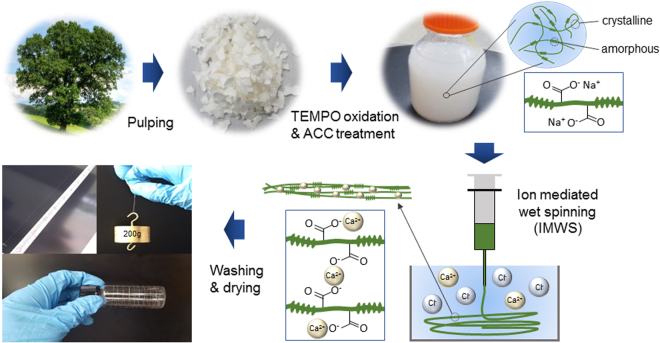
Figure 1
Figure 1
Schematic of cellulose long fiber fabrication process including spinning, crosslinking, washing, drying and stretching.
Figure 2
Figure 2
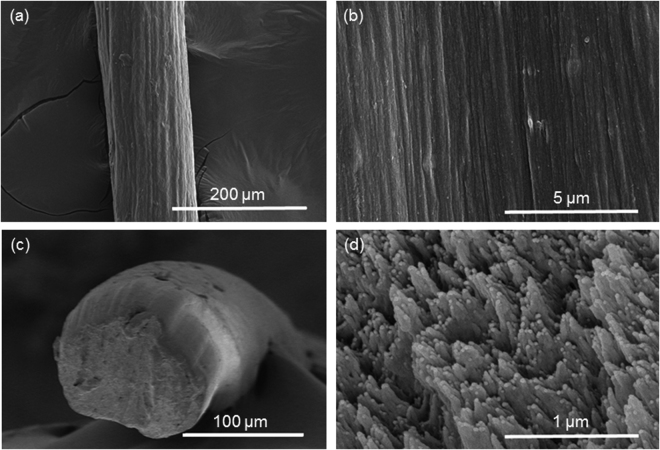
SEM Images of fabricated fibers of 2.0 ml/min spinning speed without stretching: (a) surface image, (b) surface images with different magnification, (c) cross-sectional image and (d) cross-sectional image with different magnification.
Figure 3
Figure 3
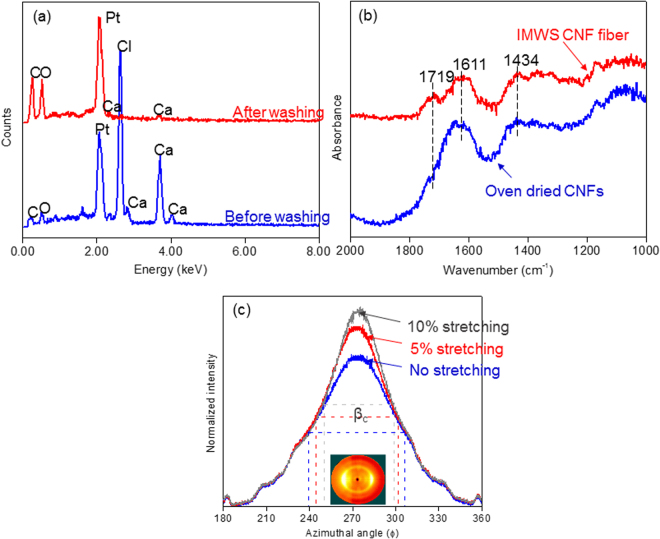
(a) EDX Spectra of cellulose long fiber before and after washing, (b) FTIR spectra of oven-dried CNFs and crosslinked long fiber and (c) 2D-XRD spectra of the fabricated fibers with different stretching ratios.
Figure 4
Figure 4
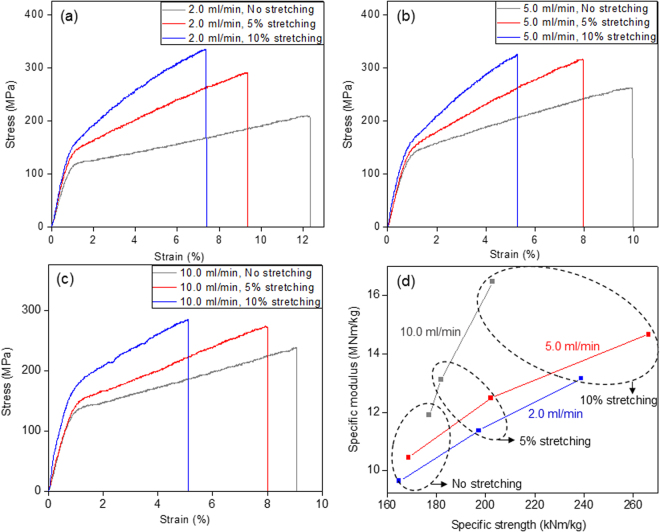
Stress-strain curves of the fabricated long fiber with different stretching ratio and spinning speed of: (a) 2.0 mil/min (b) 5.0 ml/min (c) 10 ml/min; (d) specific strength vs specific modulus curves for the fabricated long fibers.
Figure 5
Figure 5
Comparison of mechanical properties of the fabricated long fibers with other materials.

References

    1. Balashov V, Preston RD. Fine Structure of Cellulose and other Microfibrillar Substances. Nature. 1955;176:64–65. doi: 10.1038/176064a0. - DOI
    1. Colvin JR. The Size of the Cellulose Microfibril. J. Cell. Biol. 1963;17:105–109. doi: 10.1083/jcb.17.1.105. - DOI - PMC - PubMed
    1. Preston RD. Cellulose-Microfibril-Orienting Mechanisms in Plant Cells Walls. Planta. 1988;174:67–74. doi: 10.1007/BF00394875. - DOI - PubMed
    1. Syverud K, Kirsebom H, Hajizadeh S, Chinga-Carrasco G. Cross-linking Cellulose Nanofibrils for Potential Elastic Cryo-Structured Gels. Nanoscale Res. Lett. 2011;6:626. doi: 10.1186/1556-276X-6-626. - DOI - PMC - PubMed
    1. Kim J, Yun S, Ounaies Z. Discovery of Cellulose as a Smart Material. Macromolecules. 2006;39:4202–4206. doi: 10.1021/ma060261e. - DOI

Publication types