


Overview of the IL-1 family in innate inflammation and acquired immunity
- PMID: 29247995
- PMCID: PMC5756628
- DOI: 10.1111/imr.12621
Overview of the IL-1 family in innate inflammation and acquired immunity
Abstract
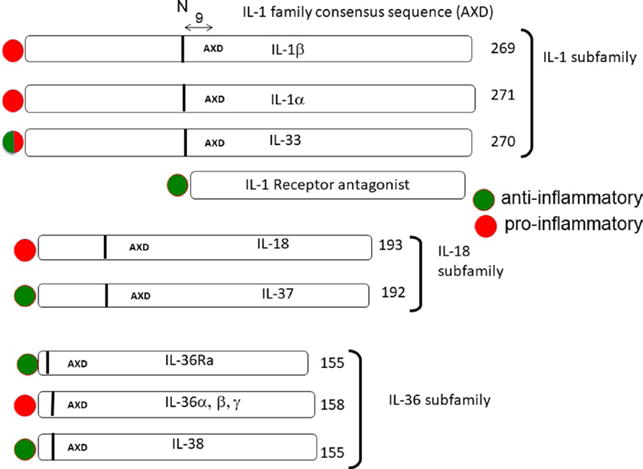
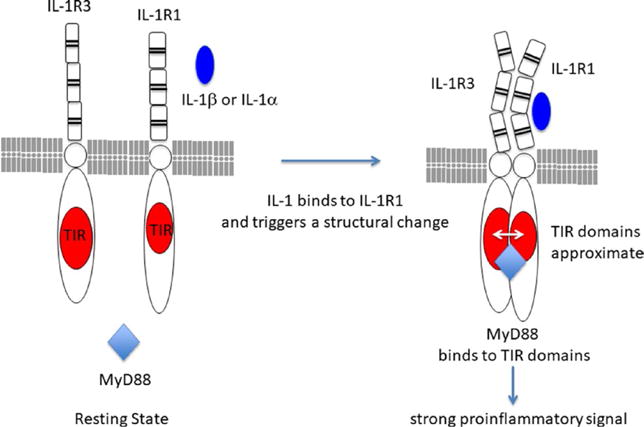
The interleukin-1 (IL-1) family of cytokines and receptors is unique in immunology because the IL-1 family and Toll-like receptor (TLR) families share similar functions. More than any other cytokine family, the IL-1 family is primarily associated with innate immunity. More than 95% of living organisms use innate immune mechanisms for survival whereas less than 5% depend on T- and B-cell functions. Innate immunity is manifested by inflammation, which can function as a mechanism of host defense but when uncontrolled is detrimental to survival. Each member of the IL-1 receptor and TLR family contains the cytoplasmic Toll-IL-1-Receptor (TIR) domain. The 50 amino acid TIR domains are highly homologous with the Toll protein in Drosophila. The TIR domain is nearly the same and present in each TLR and each IL-1 receptor family. Whereas IL-1 family cytokine members trigger innate inflammation via IL-1 family of receptors, TLRs trigger inflammation via bacteria, microbial products, viruses, nucleic acids, and damage-associated molecular patterns (DAMPs). In fact, IL-1 family member IL-1a and IL-33 also function as DAMPs. Although the inflammatory properties of the IL-1 family dominate in innate immunity, IL-1 family member can play a role in acquired immunity. This overview is a condensed update of the IL-1 family of cytokines and receptors.
Keywords: acquired immunity; cytokines; host defense; immunity; inflammation; innate immunity.
© 2017 John Wiley & Sons A/S. Published by John Wiley & Sons Ltd.
Conflict of interest statement
The author declares no conflict of interest.
Figures
References
-
- Gay NJ, Keith FJ. Drosophila Toll and IL-1 receptor. Nature. 1991;351:355–356. - PubMed
-
- Heguy A, Baldari CT, Macchia G, Telford JL, Melli M. Amino acids conserved in interleukin-1 receptors (IL-1Rs) and the Drosophila toll protein are essential for IL-1R signal transduction. J Biol Chem. 1992;267:2605–2609. - PubMed
Publication types
MeSH terms
Substances
Grants and funding
LinkOut - more resources
Full Text Sources
Other Literature Sources
Medical
