


Review
doi: 10.1016/j.micinf.2017.11.014.
Epub 2017 Dec 15.
Immunological bases of increased susceptibility to invasive nontyphoidal Salmonella infection in children with malaria and anaemia
Affiliations
- PMID: 29248635
- PMCID: PMC6250906
- DOI: 10.1016/j.micinf.2017.11.014
Item in Clipboard
Review
Immunological bases of increased susceptibility to invasive nontyphoidal Salmonella infection in children with malaria and anaemia
Microbes Infect.
2018 Oct-Nov.
Abstract
Malaria and anaemia are key underlying factors for iNTS disease in African children. Knowledge of clinical and epidemiological risk-factors for iNTS disease has not been paralleled by an in-depth knowledge of the immunobiology of the disease. Herein, we review human and animal studies on mechanisms of increased susceptibility to iNTS in children.
Keywords: Anaemia; Children; Immunity; Malaria; Salmonella; Susceptibility.
Copyright © 2017 The Authors. Published by Elsevier Masson SAS.. All rights reserved.
Figures
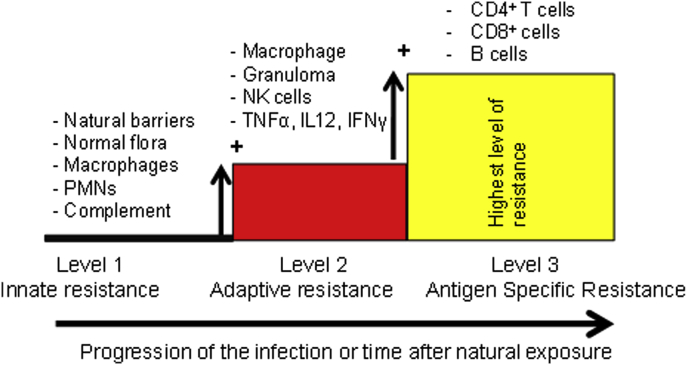
Key players of host resistance to Salmonella: Lessons from humans and mice. Immunity to Salmonella builds up gradually during primary infection or subclinical exposure to the pathogens. Each level of resistance adds to the previous one. Therefore, full protection relies on the activity of the immune mechanisms from each one of the levels of resistance. Co-morbidities that undermine any of these levels of resistance would result in impaired overall resistance to iNTS disease.
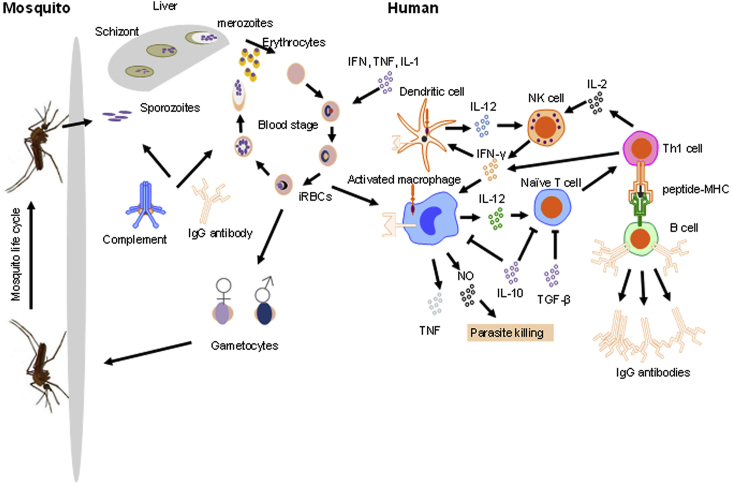
The Plasmodium falciparum life cycle and human host immunity Macrophages, DCs, T cells, and humoral immunity (antibody and complement) are involved in mounting stage-specific immune responses against the Plasmodium parasite. These are usually divided into either pre-erythrocytic immune responses directed against sporozoites in the skin and liver-stage parasites, or erythrocytic immune responses, directed against merozoites and intra-erythrocytic parasites.
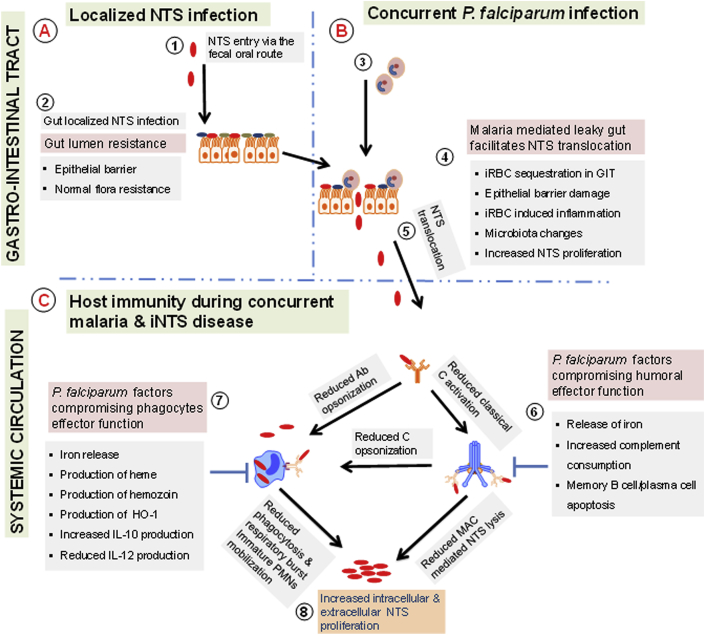
Malaria and anaemia increase susceptibility to iNTS in children. Healthy children are capable of restricting NTS colonisation and invasion within the gastro-intestinal tract (GIT) through due to their normal flora and efficient epithelial barrier (Fig. 3A). Malaria can impair the gut-epithelial barrier, thus favouring NTS translocation to the blood stream (Fig. 3B). Humoral (antibody and complement) and cellular (monocytes and neutrophils) immunity to NTS can be compromised due to malaria-induced anaemia, products from malaria parasites and also immune responses to malaria parasites which concomitantly favour the proliferation and dissemination of NTS (Fig. 3C).
References
-
- Gordon M.A., Graham S.M., Walsh A.L., Wilson L., Phiri A., Molyneux E. Epidemics of invasive Salmonella enterica serovar enteritidis and Salmonella enterica serovar typhimurium infection associated with multidrug resistance among adults and children in Malawi. Clin Infect Dis. 2008;46:963–969. - PubMed
-
- Molyneux E.M., Mankhambo L.A., Phiri A., Graham S.M., Forsyth H., Phiri A. The outcome of non-typhoidal Salmonella meningitis in Malawian children, 1997–2006. Ann Trop Paediatr. 2009;29:13–22. - PubMed
-
- Bronzan R.N., Taylor T.E., Mwenechanya J., Tembo M., Kayira K., Bwanaisa L. Bacteremia in Malawian children with severe malaria: prevalence, etiology, HIV coinfection, and outcome. J Infect Dis. 2007;195:895–904. - PubMed
Publication types
MeSH terms
Grants and funding
LinkOut - more resources
Full Text Sources
Other Literature Sources
Medical
Molecular Biology Databases
