


Stratified prevention: opportunities and limitations. Report on the 1st interdisciplinary cardiovascular workshop in Augsburg
- PMID: 29248989
- PMCID: PMC5847039
- DOI: 10.1007/s00392-017-1186-y
Stratified prevention: opportunities and limitations. Report on the 1st interdisciplinary cardiovascular workshop in Augsburg
Abstract
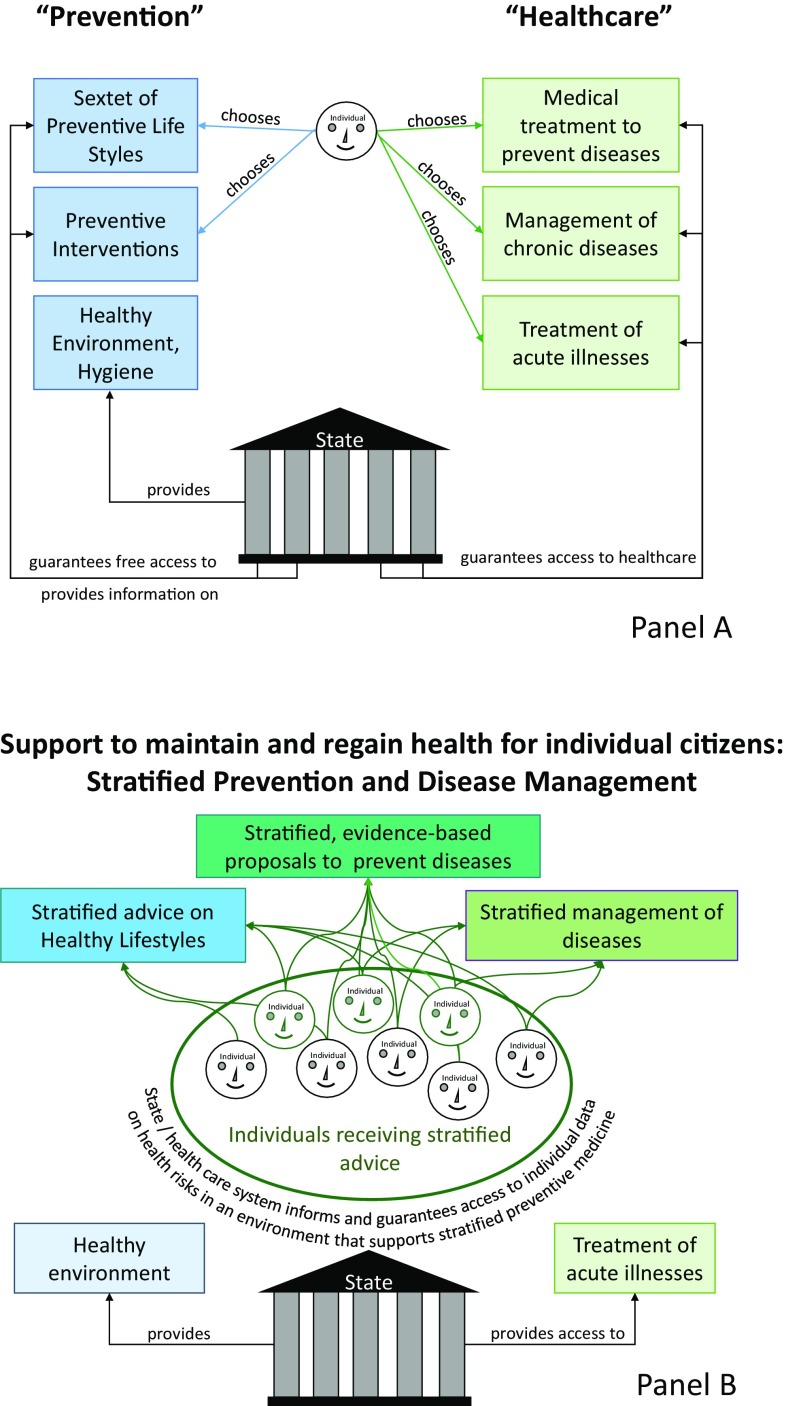
Sufficient exercise and sleep, a balanced diet, moderate alcohol consumption and a good approach to handle stress have been known as lifestyles that protect health and longevity since the Middle Age. This traditional prevention quintet, turned into a sextet by smoking cessation, has been the basis of the "preventive personality" that formed in the twentieth century. Recent analyses of big data sets including genomic and physiological measurements have unleashed novel opportunities to estimate individual health risks with unprecedented accuracy, allowing to target preventive interventions to persons at high risk and at the same time to spare those in whom preventive measures may not be needed or even be harmful. To fully grasp these opportunities for modern preventive medicine, the established healthy life styles require supplementation by stratified prevention. The opportunities of these developments for life and health contrast with justified concerns: A "surveillance society", able to predict individual behaviour based on big data, threatens individual freedom and jeopardises equality. Social insurance law and the new German Disease Prevention Act (Präventionsgesetz) rightly stress the need for research to underpin stratified prevention which is accessible to all, ethical, effective, and evidence based. An ethical and acceptable development of stratified prevention needs to start with autonomous individuals who control and understand all information pertaining to their health. This creates a mandate for lifelong health education, enabled in an individualised form by digital technology. Stratified prevention furthermore requires the evidence-based development of a new taxonomy of cardiovascular diseases that reflects disease mechanisms. Such interdisciplinary research needs broad support from society and a better use of biosamples and data sets within an updated research governance framework.
Keywords: Atrial fibrillation; Genomics; Health economics; Heart failure; Payor; Personalised medicine; Prevention; Stratified medicine.
Figures
References
-
- Eberbach WH (2014) Personalisierte Prävention: Wirkungen und Auswirkungen. Med R:449
-
- Keil M. Rechtsfragen der individualisierten Medizin. Berlin: Springer; 2015.
-
- Authors/Task Force M. Piepoli MF, Hoes AW, Agewall S, Albus C, Brotons C, Catapano AL, Cooney MT, Corra U, Cosyns B, Deaton C, Graham I, Hall MS, Hobbs FD, Lochen ML, Lollgen H, Marques-Vidal P, Perk J, Prescott E, Redon J, Richter DJ, Sattar N, Smulders Y, Tiberi M, van der Worp HB, van Dis I, Verschuren WM, Simone B, Document R, De Backer G, Roffi M, Aboyans V, Bachl N, Bueno H, Carerj S, Cho L, Cox J, De Sutter J, Egidi G, Fisher M, Fitzsimons D, Franco OH, Guenoun M, Jennings C, Jug B, Kirchhof P, Kotseva K, Lip GY, Mach F, Mancia G, Bermudo FM, Mezzani A, Niessner A, Ponikowski P, Rauch B, Ryden L, Stauder A, Turc G, Wiklund O, Windecker S, Zamorano JL. 2016 European Guidelines on cardiovascular disease prevention in clinical practice: the Sixth Joint Task Force of the European Society of Cardiology and Other Societies on Cardiovascular Disease Prevention in Clinical Practice (constituted by representatives of 10 societies and by invited experts): developed with the special contribution of the European Association for Cardiovascular Prevention and Rehabilitation (EACPR) Eur J Prev Cardiol. 2016;23(11):NP1NP96. - PubMed
-
- Frobose I, Wallmann-Sperlich B (2016) Der DKV report “Wie gesund lebt Deutschland” 2016. http://www.ergo.com/de/Presse/Overview/Pressemappen/DKV-Report/Publikati.... Accessed 7 Apr 2017
-
- Thaler RH, Sunstein CR. Nudge: improving decisions about health, wealth and happiness. New Haven: Yale University Press; 2008.
Publication types
MeSH terms
LinkOut - more resources
Full Text Sources
Other Literature Sources
Medical
