Review
. 2018 Feb;34(2):142-157.
doi: 10.1016/j.tig.2017.11.005. Epub 2018 Feb 7.

Nuclear Long Noncoding RNAs: Key Regulators of Gene Expression

Affiliations
Review

Nuclear Long Noncoding RNAs: Key Regulators of Gene Expression

Qinyu Sun et al. Trends Genet. 2018 Feb.

Abstract

A significant portion of the human genome encodes genes that transcribe long nonprotein-coding RNAs (lncRNAs). A large number of lncRNAs localize in the nucleus, either enriched on the chromatin or localized to specific subnuclear compartments. Nuclear lncRNAs participate in several biological processes, including chromatin organization, and transcriptional and post-transcriptional gene expression, and also act as structural scaffolds of nuclear domains. Here, we highlight recent studies demonstrating the role of lncRNAs in regulating gene expression and nuclear organization in mammalian cells. In addition, we update current knowledge about the involvement of the most-abundant and conserved lncRNA, metastasis-associated lung adenocarcinoma transcript 1 (MALAT1), in gene expression control.


Figures

Figure 1
Figure 1
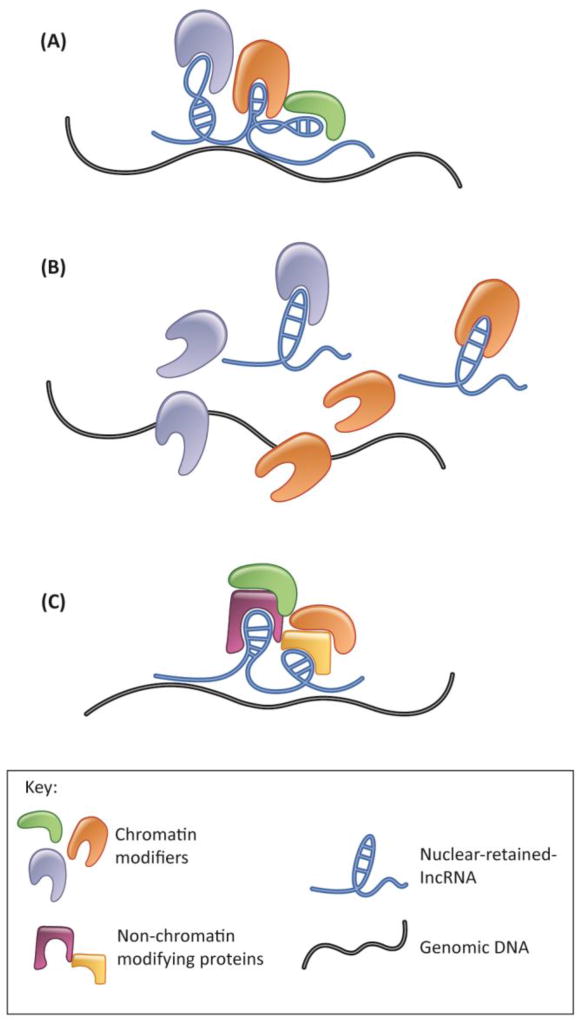
Role of nuclear-retained lncRNAs in chromatin organization. (A) Nuclear-retained lncRNAs modulate chromatin by recruiting chromatin-modulating proteins to chromatin. (B) Nuclear-retained lncRNAs can decoy chromatin-associated proteins away from chromatin. (C) Nuclear-retained lncRNAs can form indirect interaction with chromatin modulators through other kinds of proteins and finally modulate chromatin.
Figure 2
Figure 2
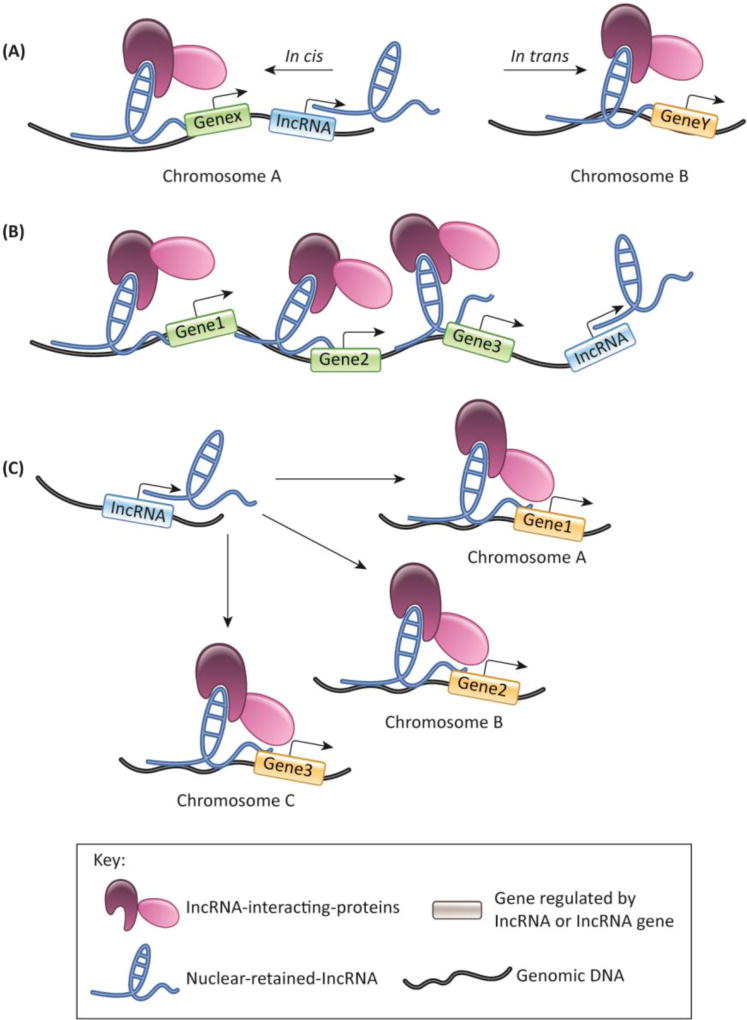
Nuclear-retained lncRNAs act as transcriptional regulators. (A) Nuclear-retained lncRNAs modulate transcription in cis (left) or in trans (right). (B) Nuclear-retained lncRNAs regulate the expression of multiple genes (gene 1,2, and 3 in the model) that are in close proximity. (C) Nuclear-retained lncRNAs regulate transcription of several distally located genes (gene 1, 2, and 3 on different chromosomes in the model).
Figure 3
Figure 3
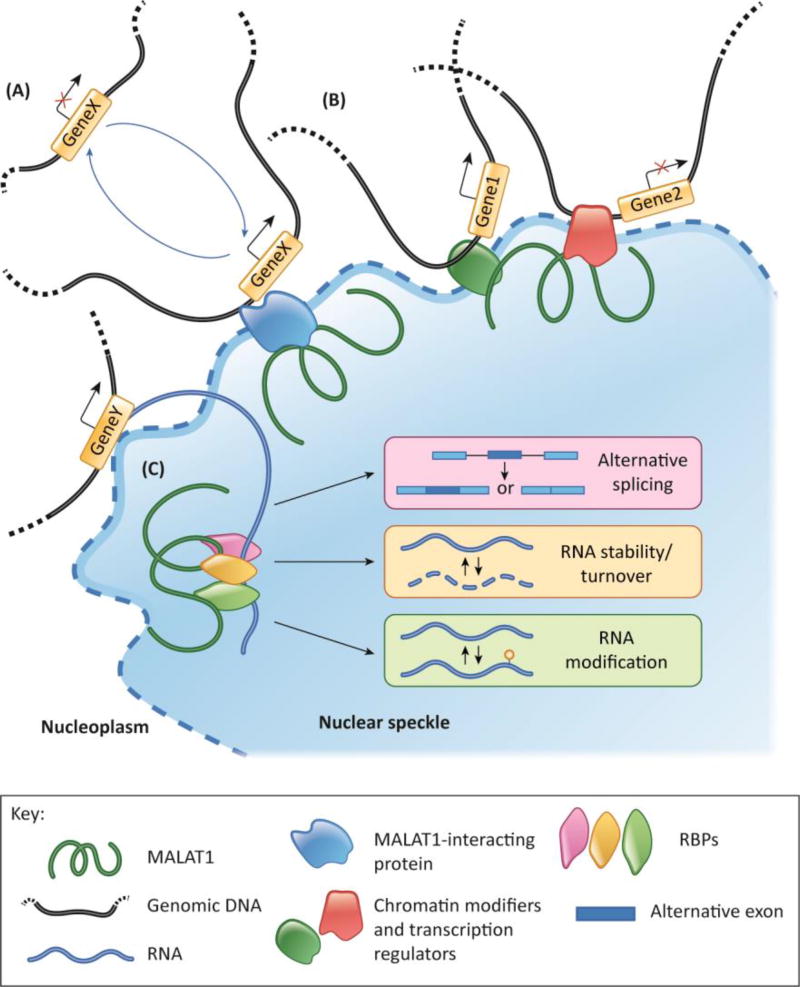
Model depicting potential mode of action of MALAT1. (A) MALAT1 along with MALAT1-interacting proteins such as unmethylated Pc2 relocates genomic loci from nucleoplasm or other nuclear domains to nuclear speckle periphery and promotes the activation of corresponding genes. (B) MALAT1 interacts with multiple chromatin modifiers and transcription factors to modulate transcription. (C) MALAT1 serves as a scaffold in nuclear speckles for RBPs and influences various co- and post-transcriptional processes.

References

    1. Wang KC, Chang HY. Molecular mechanisms of long noncoding RNAs. Mol Cell. 2011;43(6):904–14. - PMC - PubMed
    1. Quinn JJ, Chang HY. Unique features of long non-coding RNA biogenesis and function. Nat Rev Genet. 2016;17(1):47–62. - PubMed
    1. Wu H, et al. The Diversity of Long Noncoding RNAs and Their Generation. Trends Genet. 2017;33(8):540–552. - PubMed
    1. St Laurent G, et al. The Landscape of long noncoding RNA classification. Trends Genet. 2015;31(5):239–51. - PMC - PubMed
    1. Prasanth KV, et al. Nuclear organization and dynamics of 7SK RNA in regulating gene expression. Mol Biol Cell. 2010;21(23):4184–96. - PMC - PubMed

Publication types

MeSH terms

Substances