


Simulating the Impact of Sugar-Sweetened Beverage Warning Labels in Three Cities
- PMID: 29249555
- PMCID: PMC5783749
- DOI: 10.1016/j.amepre.2017.11.003
Simulating the Impact of Sugar-Sweetened Beverage Warning Labels in Three Cities
Abstract
Introduction: A number of locations have been considering sugar-sweetened beverage point-of-purchase warning label policies to help address rising adolescent overweight and obesity prevalence.
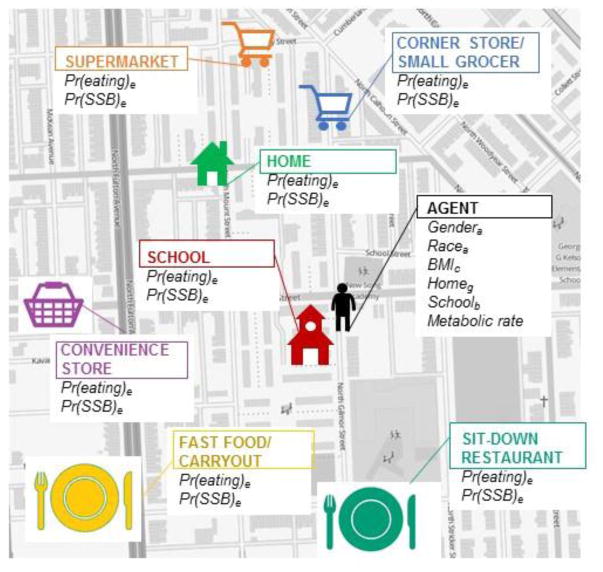
Methods: To explore the impact of such policies, in 2016 detailed agent-based models of Baltimore, Philadelphia, and San Francisco were developed, representing their populations, school locations, and food sources, using data from various sources collected between 2005 and 2014. The model simulated, over a 7-year period, the mean change in BMI and obesity prevalence in each of the cities from sugar-sweetened beverage warning label policies.
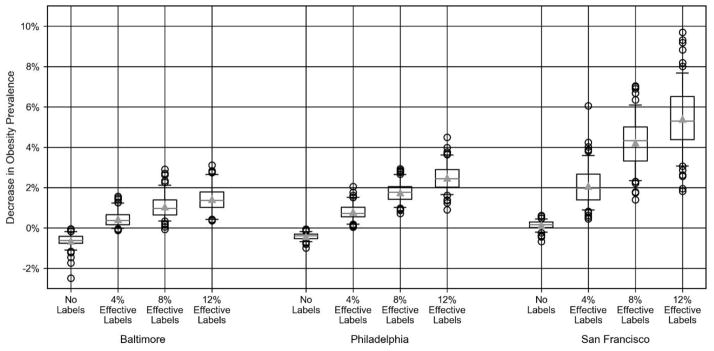
Results: Data analysis conducted between 2016 and 2017 found that implementing sugar-sweetened beverage warning labels at all sugar-sweetened beverage retailers lowered obesity prevalence among adolescents in all three cities. Point-of-purchase labels with 8% efficacy (i.e., labels reducing probability of sugar-sweetened beverage consumption by 8%) resulted in the following percentage changes in obesity prevalence: Baltimore: -1.69% (95% CI= -2.75%, -0.97%, p<0.001); San Francisco: -4.08% (95% CI= -5.96%, -2.2%, p<0.001); Philadelphia: -2.17% (95% CI= -3.07%, -1.42%, p<0.001).
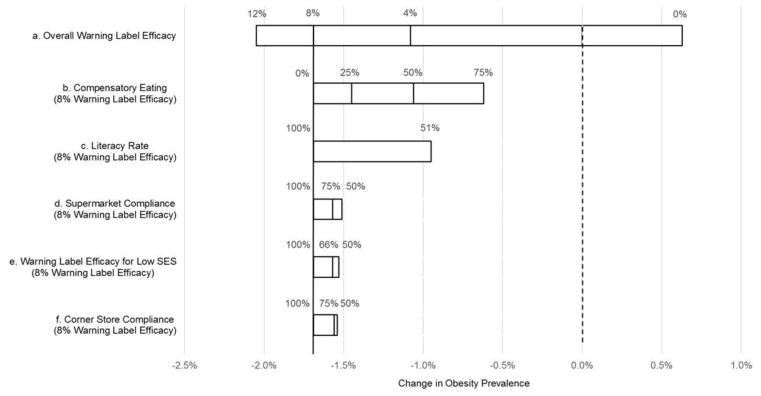
Conclusions: Agent-based simulations showed how warning labels may decrease overweight and obesity prevalence in a variety of circumstances with label efficacy and literacy rate identified as potential drivers. Implementing a warning label policy may lead to a reduction in obesity prevalence. Focusing on warning label design and store compliance, especially at supermarkets, may further increase the health impact.
Copyright © 2018 American Journal of Preventive Medicine. Published by Elsevier Inc. All rights reserved.
Figures
References
-
- Della Torre SB, Keller A, Depeyre JL, Kruseman M. Sugar-sweetened beverages and obesity risk in children and adolescents: a systematic analysis on how methodological quality may influence conclusions. J Acad Nutr Diet. 2016;116(4):638–659. https://doi.org/10.1016/j.jand.2015.05.020. - DOI - PubMed
-
- Stevens A, Hamel C, Singh K, et al. Do sugar-sweetened beverages cause adverse health outcomes in children? A systematic review protocol. Syst Rev. 2014;3:96. https://doi.org/10.1186/2046-4053-3-96. - DOI - PMC - PubMed
-
- Finkelstein EA, Graham WCK, Malhotra R. Lifetime direct medical costs of childhood obesity. Pediatrics. 2014;133(5):854–862. https://doi.org/10.1542/peds.2014-0063. - DOI - PubMed
-
- Pomeranz JL. Advanced policy options to regulate sugar-sweetened beverages to support public health. J Public Health Policy. 2012;33(1):75–88. https://doi.org/10.1057/jphp.2011.46. - DOI - PubMed
Publication types
MeSH terms
Substances
Grants and funding
LinkOut - more resources
Full Text Sources
Other Literature Sources
