Review
. 2018 Jan;43(1):7-25.
doi: 10.1503/jpn.170021. Epub 2017 Oct 2.

Mindfulness-based treatments for posttraumatic stress disorder: a review of the treatment literature and neurobiological evidence

Affiliations
Review

Mindfulness-based treatments for posttraumatic stress disorder: a review of the treatment literature and neurobiological evidence

Jenna E Boyd et al. J Psychiatry Neurosci. 2018 Jan.

Abstract

Mindfulness-based treatments for posttraumatic stress disorder (PTSD) have emerged as promising adjunctive or alternative intervention approaches. A scoping review of the literature on PTSD treatment studies, including approaches such as mindfulness-based stress reduction, mindfulness-based cognitive therapy and metta mindfulness, reveals low attrition with medium to large effect sizes. We review the convergence between neurobiological models of PTSD and neuroimaging findings in the mindfulness literature, where mindfulness interventions may target emotional under- and overmodulation, both of which are critical features of PTSD symptomatology. Recent emerging work indicates that mindfulness-based treatments may also be effective in restoring connectivity between large-scale brain networks among individuals with PTSD, including connectivity between the default mode network and the central executive and salience networks. Future directions, including further identification of the neurobiological mechanisms of mindfulness interventions in patients with PTSD and direct comparison of these interventions to first-line treatments for PTSD are discussed.


Conflict of interest statement

Competing interests: None declared.

Figures

Fig. 1
Fig. 1
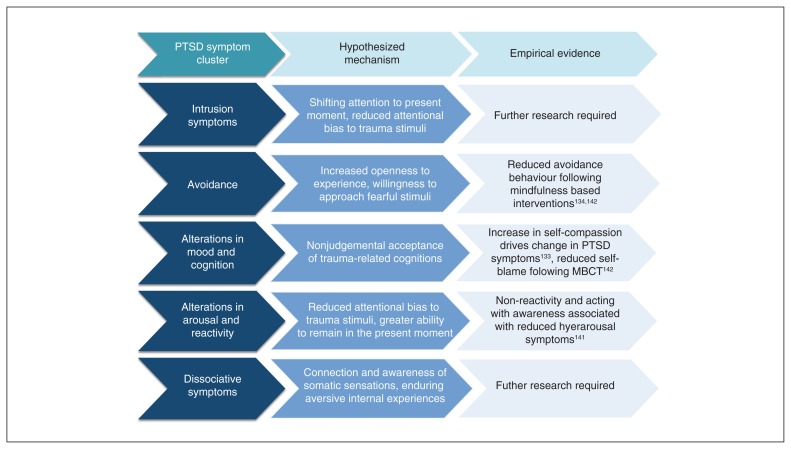
Hypothesized mechanisms by which mindfulness-based approaches may target posttraumatic stress disorder (PTSD) symptom clusters along with current evidence and indication of where further research is required. MBCT = mindfulness-based cognitive therapy.
Fig. 2
Fig. 2
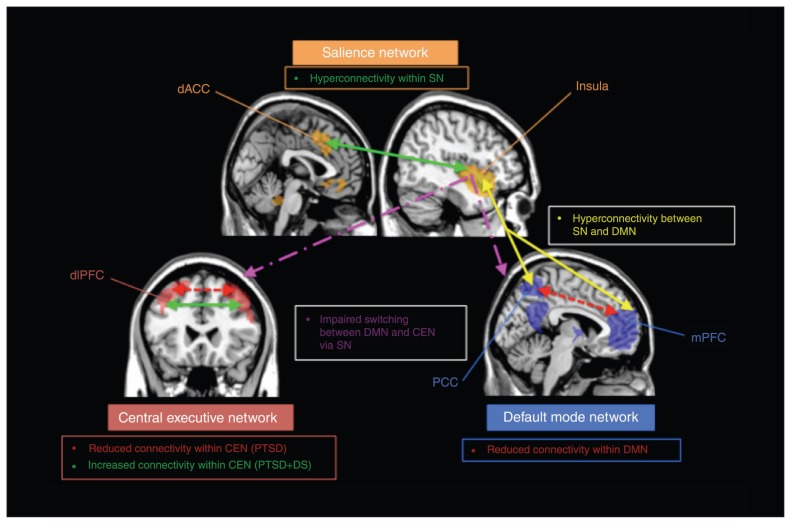
Summary of the current literature implicating alterations in functional connectivity within and between the salience network (SN; shown in orange), the central executive network (CEN; shown in red) and the default mode network (DMN; shown in blue) in individuals with posttraumatic stress disorder (PTSD). Reduced connectivity within networks is depicted by red dashed lines, increased connectivity within networks is depicted by solid green lines, reduced connectivity between networks is depicted by pink dashed lines, and increased connectivity between networks is depicted by solid yellow lines. Consistent findings indicate reduced functional connectivity within the DMN among those with PTSD, posited to underlie disruptions in self-referential processes, autobiographical memory and altered sense of self. Conversely, increased connectivity is reported within the SN, thought to underlie hyperarousal and increased threat sensitivity. Similarly, increased connectivity between the DMN and SN is thought to reflect hypersensitivity to threat at the expense of self-referential processing. Individuals with PTSD also show impaired ability to appropriately recruit relevant networks (e.g., activation of DMN rather than CEN during a working memory task), suggesting impaired switching between the DMN and CEN via the SN. Distinct patterns of connectivity within the CEN have emerged among those with PTSD and PTSD with dissociative symptoms (PTSD+DS); those with PTSD+DS showed increased connectivity within the CEN and those with PTSD showed decreased connectivity within the CEN. dACC = dorsal anterior cingulate cortex; dlPFC = dorsolateral prefrontal cortex; mPFC = medial prefrontal cortex; PCC = posterior cingulate cortex.
Fig. 3
Fig. 3
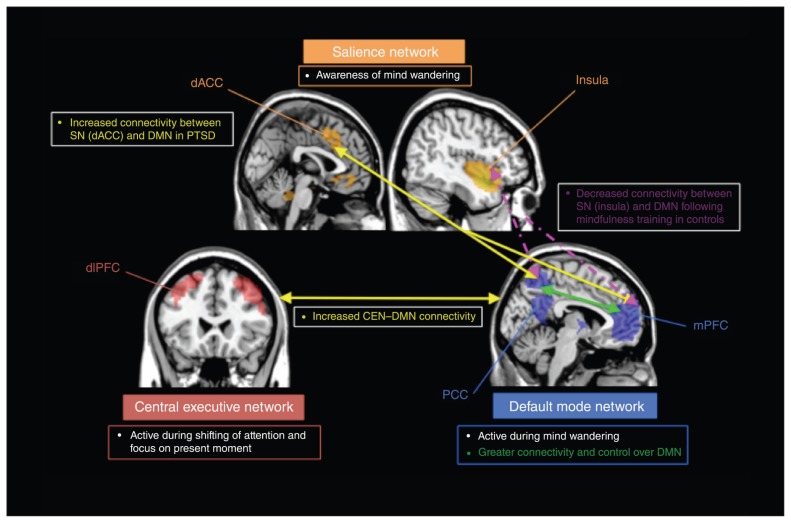
Summary of findings suggesting that mindfulness may lead to restoration of functioning of the salience network (SN; shown in orange), central executive network (CEN; shown in red) and defult mode network (DMN; shown in blue). Increased connectivity within networks is depicted by solid green lines, increased connectivity between networks is depicted by solid yellow lines, and reduced connectivity between networks is depicted by dashed pink lines. Emerging work has indicated greater functional connectivity within the DMN during rest among meditators when compared with controls and among veterans with posttraumatic stress disorder (PTSD) following mindfulness intervention, suggesting that it may restore DMN connectivity and appropriate self-referential processing in those with PTSD. Increased CEN–DMN connectivity was also reported and may reflect increased ability to shift between internal and external loci of attention. Mixed findings of both increased and decreased DMN–SN connectivity following mindfulness intervention have been reported, depending on the region of the SN. Increased dorsal anterior cingulate cortex (dACC)–DMN connectivity was reported following mindfulness intervention for PTSD, which may suggest increased capacity for attentional shifting from internal to external stimuli (dACC implicated in executive control). In contrast, reduced SN (insula)–DMN connectivity was reported among controls, which may result in reduced hyperarousal symptoms and increased self-referential processing if findings were replicated in individuals with PTSD. dlPFC = dorsolateral prefrontal cortex; mPFC = medial prefrontal cortex; PCC = posterior cingulate cortex.

References

    1. Kessler RC. Posttraumatic stress disorder: the burden to the individual and to society. J Clin Psychiatry. 2000;61:4–12. - PubMed
    1. Kessler RC, Sonnega A, Bromet E, et al. Posttraumatic stress disorder in the national comorbidity survey. Arch Gen Psychiatry. 1995;52:1048–60. - PubMed
    1. Van Ameringen M, Mancini C, Patterson B, et al. Post-traumatic stress disorder in Canada. CNS Neurosci Ther. 2008;14:171–81. - PMC - PubMed
    1. American Psychiatric Association. Diagnostic and Statistical Manual of Mental Disorders. 5th Ed. Washington (DC): APA; 2013.
    1. Armour C, Karstoft KI, Richardson JD. The co-occurrence of PTSD and dissociation: differentiating severe PTSD from dissociative-PTSD. Soc Psychiatry Psychiatr Epidemiol. 2014;49:1297–306. - PubMed

MeSH terms