


A pilot resting-state functional connectivity study of the kynurenine pathway in adolescents with depression and healthy controls
- PMID: 29254065
- PMCID: PMC5805652
- DOI: 10.1016/j.jad.2017.11.040
A pilot resting-state functional connectivity study of the kynurenine pathway in adolescents with depression and healthy controls
Abstract
Background: The neuroimmunological kynurenine pathway (KP) has been hypothesized to play a role in depressive/anhedonic symptoms and related CNS disturbances. Indoleamine 2,3-dioxygenase (IDO) is the rate limiting enzyme which leads to neurotrophic [kynurenic acid (KA)] and neurotoxic [Quinolinic acid (QUIN)] branches. In this pilot, we sought to examine associations between blood KP neuro-toxic/trophic measures and anhedonia/depression associated networks in youth with major depression (MDD) and healthy controls (HC).
Methods: Subjects were 14 psychotropic-medication free adolescents with MDD and 7 HC, ages 12-19 yo. All underwent resting-state functional magnetic resonance imagining (fMRI) scans. Voxel-wise maps were generated indicating correlation strengths among 4 bilateral seeds [(dorsal anterior cingulate cortex (dACC), perigenual ACC (pgACC), subgenual ACC (sgACC) and nucleus accumbens (NAc)] and remaining brain regions. FMRI analyses were family-wise error corrected. KP metabolites were measured using liquid chromatography-tandem mass spectrometry.
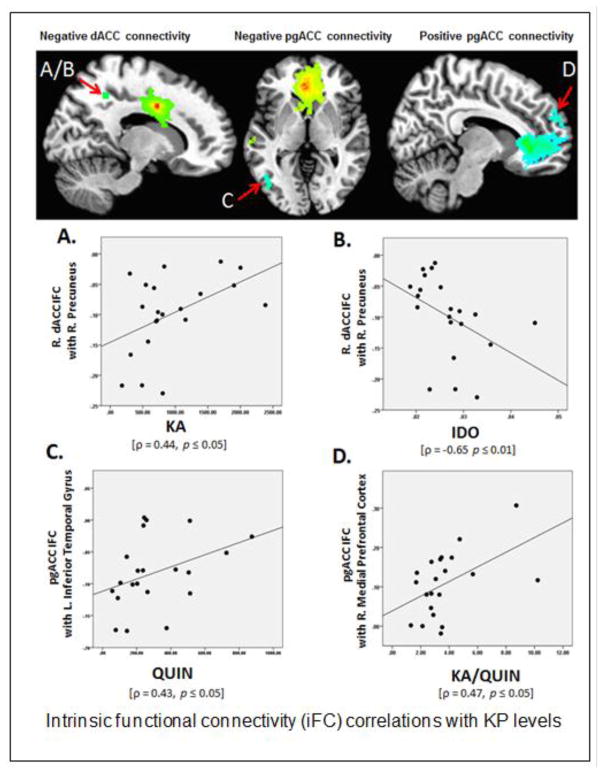
Results: Connectivity between the right dACC and the right precuneus was positively correlated with KA levels. This same cluster demonstrated an inverse correlation with IDO activity. Exploratory analysis at a more liberal clustering threshold showed the KA/QUIN ratio was positively correlated with connectivity between the pgACC and the right medial prefrontal cortex. Lastly, connectivity between the pgACC and the left inferior temporal gyrus was positively correlated with QUIN levels.
Limitations: Findings are preliminary due to the small sample size.
Conclusions: This pilot study is the first report in depressed adolescents demonstrating associations between the KP and anhedonia/depression-associated brain networks. This pilot adds evidence to the putative role of the KP in MDD.
Keywords: Adolescence; Anhedonia; Kynurenine pathway; Major depressive disorder; Resting state functional connectivity.
Copyright © 2017 Elsevier B.V. All rights reserved.
Conflict of interest statement
Conflicts of interest: none.
Figures
References
-
- Anderson IM, Parry-Billings M, Newsholme EA, Poortmans JR, Cowen PJ, et al. Decreased plasma tryptophan concentration in major depression: relationship to melancholia and weight loss. Journal of affective disorders. 1990;20:185–191. - PubMed
-
- Asarnow JR, Baraff LJ, Berk M, Grob C, Devich-Navarro M, Suddath R, Piacentini J, Tang L. Pediatric emergency department suicidal patients: two-site evaluation of suicide ideators, single attempters, and repeat attempters. Journal of the American Academy of Child and Adolescent Psychiatry. 2008;47:958–966. - PubMed
-
- Biswal BB, Van Kylen J, Hyde JS. Simultaneous assessment of flow and BOLD signals in resting-state functional connectivity maps. NMR in biomedicine. 1997;10:165–170. - PubMed
-
- Brundin L, Sellgren CM, Lim CK, Grit J, Palsson E, Landen M, Samuelsson M, Lundgren K, Brundin P, Fuchs D, Postolache TT, Traskman-Bendz L, Guillemin GJ, Erhardt S. An enzyme in the kynurenine pathway that governs vulnerability to suicidal behavior by regulating excitotoxicity and neuroinflammation. Translational psychiatry. 2016;6:e865. - PMC - PubMed
Publication types
MeSH terms
Substances
Grants and funding
LinkOut - more resources
Full Text Sources
Other Literature Sources
Research Materials
