


Rationale and Design of the Mechanistic Potential of Antihypertensives in Preclinical Alzheimer's (HEART) Trial
- PMID: 29254080
- PMCID: PMC8933850
- DOI: 10.3233/JAD-161198
Rationale and Design of the Mechanistic Potential of Antihypertensives in Preclinical Alzheimer's (HEART) Trial
Abstract
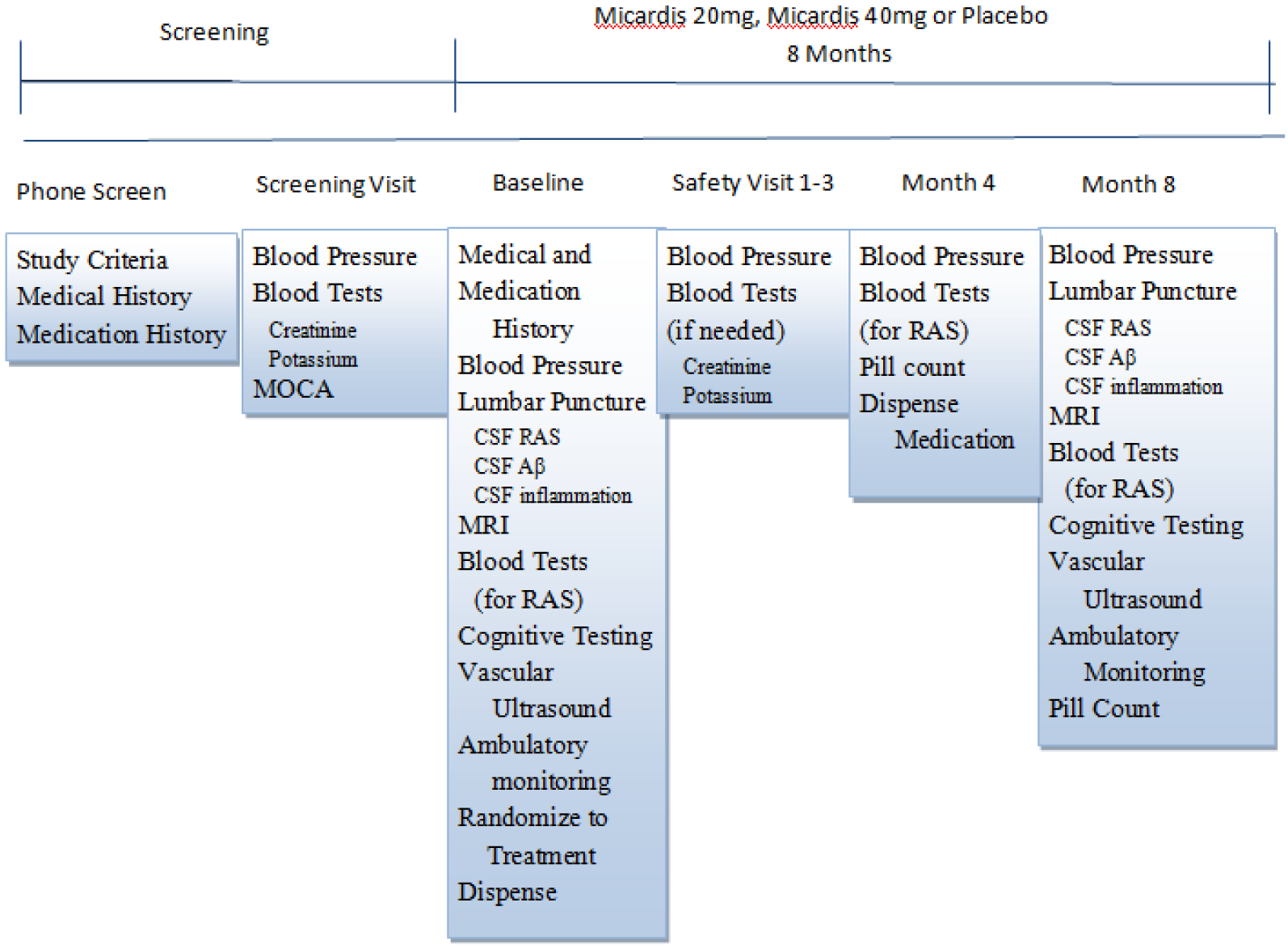
Research indicates that certain antihypertensive medications alter Alzheimer's disease (AD) biomarkers in Caucasians. The renin angiotensin system (RAS) regulates blood pressure (BP) in the body and the brain and may directly influence AD biomarkers, including amyloid-β (Aβ) neuropathology, cerebral blood flow (CBF), and inflammatory markers. This hypothesis is supported by studies, including ours, showing that antihypertensives targeting the RAS reduce the risk and slow the progression of AD in Caucasians. While mounting evidence supports a protective role of RAS medications in Caucasians, this mechanism has not been explored in African Americans. To assess the mechanism by which RAS medications modify the brain RAS, cerebrospinal fluid (CSF) Aβ, CBF, and inflammatory markers in African Americans, we are conducting an eight month, Phase Ib randomized, placebo controlled trial, enrolling 60 middle-aged (45-70 years), non-demented individuals, at risk for AD by virtue of a parental history. Participants include normotensive and treated hypertensives that have never been exposed to a RAS medication. Participants are randomized (1 : 1:1) by gender and BP medication use (yes/no) to one of three groups: placebo, or 20 mg, or 40 mg telmisartan (Micardis), to determine the dose required to penetrate the CNS. Our overarching hypothesis is that, compared to placebo, both doses of telmisartan will penetrate the CNS and produce salutary, dose dependent effects on the brain RAS as well as CSF Aβ, CBF, and CSF inflammatory markers in African Americans, over eight months. This manuscript describes the trial rationale and design.
Keywords: Alzheimer’s disease; clinical trial; hypertension; parental history; renin angiotensin system; vascular risk.
Figures
References
-
- Jiang T, Zhang YD, Zhou JS, Zhu XC, Tian YY, Zhao HD, Lu H, Gao Q, Tan L, Yu JT (2015) Angiotensin-(1–7) is Reduced and Inversely Correlates with Tau Hyperphosphorylation in Animal Models of Alzheimer’s Disease. Mol Neurobiol 53, 2489–2497. - PubMed
-
- Ashby EL, Kehoe PG (2013) Current status of renin-aldosterone angiotensin system-targeting anti-hypertensive drugs as therapeutic options for Alzheimer’s disease. Expert Opin Investig Drugs 22, 1229–1242. - PubMed
Publication types
MeSH terms
Substances
Grants and funding
LinkOut - more resources
Full Text Sources
Other Literature Sources
Medical
