Review
. 2017 Dec 15;144(24):4496-4509.
doi: 10.1242/dev.157404.

Mechanisms of gene regulation in human embryos and pluripotent stem cells

Affiliations
Review

Mechanisms of gene regulation in human embryos and pluripotent stem cells

Thorold W Theunissen et al. Development. .

Abstract

Pluripotent stem cells have broad utility in biomedical research and their molecular regulation has thus garnered substantial interest. While the principles that establish and regulate pluripotency have been well defined in the mouse, it has been difficult to extrapolate these insights to the human system due to species-specific differences and the distinct developmental identities of mouse versus human embryonic stem cells. In this Review, we examine genome-wide approaches to elucidate the regulatory principles of pluripotency in human embryos and stem cells, and highlight where differences exist in the regulation of pluripotency in mice and humans. We review recent insights into the nature of human pluripotent cells in vivo, obtained by the deep sequencing of pre-implantation embryos. We also present an integrated overview of the principal layers of global gene regulation in human pluripotent stem cells. Finally, we discuss the transcriptional and epigenomic remodeling events associated with cell fate transitions into and out of human pluripotency.

Keywords: Chromatin; Embryogenesis; Epigenetics; Pluripotency; Reprogramming; Transcription.


Conflict of interest statement

Competing interestsR.J. is co-founder of Fate Therapeutics, Fulcrum Therapeutics and Omega Therapeutics.

Figures
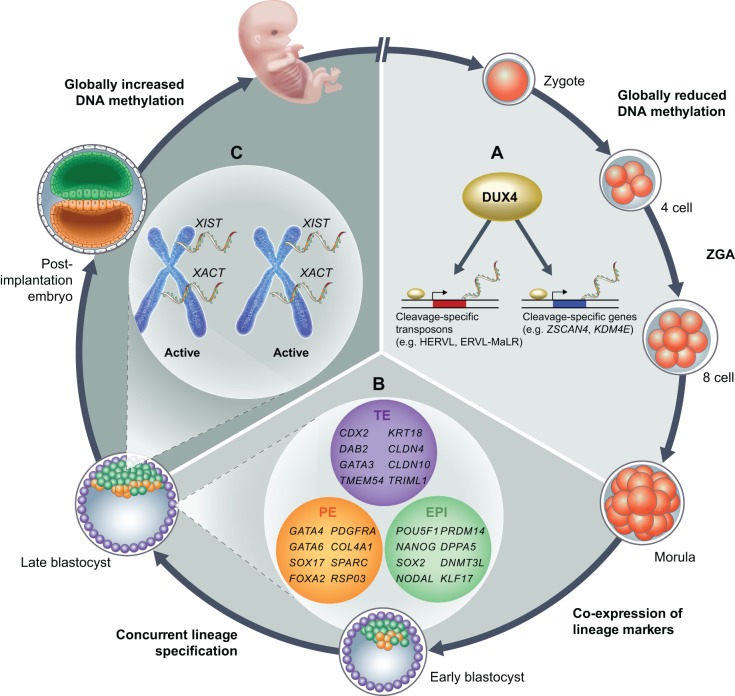
Fig. 1.
Fig. 1.
Insights into the transcriptional and epigenetic properties of human pluripotent cells in vivo. An overview of molecular events occurring during human pre-implantation development. (A) The transcription factor DUX4 activates cleavage-specific gene and transposon expression during zygotic genome activation (ZGA) (Hendrickson et al., 2017; De Iaco et al., 2017; Whiddon et al., 2017). (B) The three lineages of the human blastocyst – epiblast (EPI), primitive endoderm (PE) and trophectoderm (TE) – form concurrently and are associated with specific markers, as inferred from single-cell RNA-Seq analyses (Blakeley et al., 2015). (C) Both X chromosomes are actively transcribed in female blastocysts and show co-expression of the lncRNAs XIST and XACT in mutually exclusive nuclear domains (Okamoto et al., 2011; Petropoulos et al., 2016; Vallot et al., 2017). Human pre-implantation development is also marked by globally reduced levels of DNA methylation (Smith et al., 2014; Guo et al., 2014).
Fig. 2.
Fig. 2.
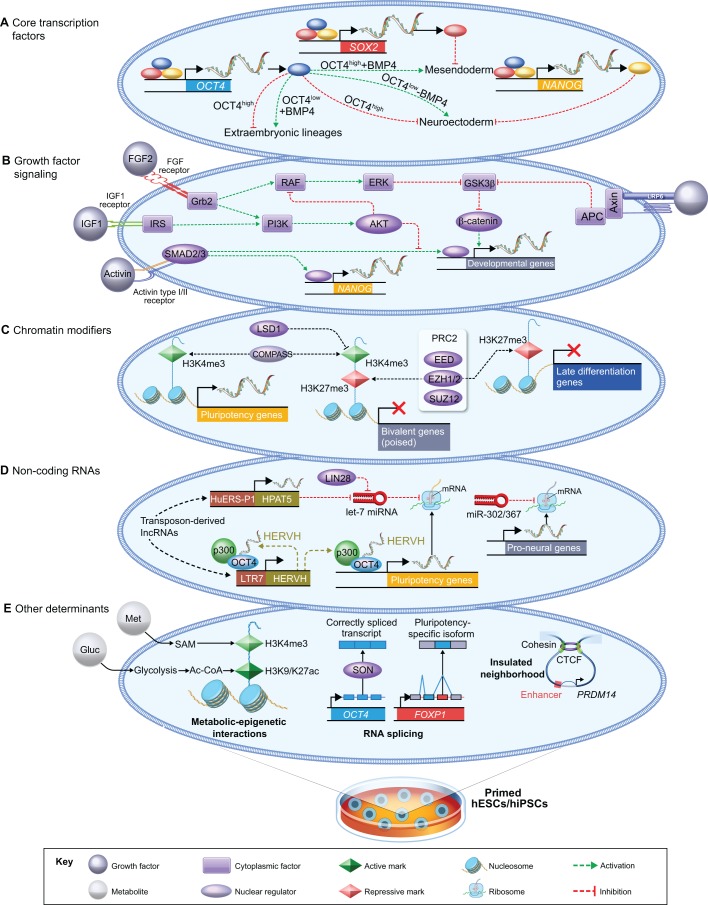
Layers of gene expression control in primed human PSCs. Overview of the major determinants of global gene expression in hPSCs cultured under conventional (primed) culture conditions. (A) The core transcription factors OCT4, SOX2 and NANOG form an autoregulatory network and repress distinct lineage fates in hESCs (Boyer et al., 2005; Wang et al., 2012). (B) Crosstalk among the major signaling pathways in hESCs as proposed by Singh et al. (2012). According to this model, activation of the PI3K/AKT pathway by IGF1 or FGF2 promotes the self-renewal of hESCs via two mechanisms. First, PI3K/AKT modulates the threshold of SMAD2/3 activity, allowing for the activation of NANOG but not mesendoderm-associated genes. As shown in A, the activation of NANOG stimulates the expression of core pluripotency genes and blocks neuroectoderm differentiation. Active PI3K/AKT also inhibits MEK/ERK and maintains GSK3β activity, which blocks β-catenin-mediated stimulation of pro-differentiation genes. Note that Wnt/β-catenin signaling has a distinct role in mESCs, where it functions to promote self-renewal instead of differentiation (ten Berge et al., 2011; Wray et al., 2011; Yi et al., 2011). (C) Chromatin-modifying enzymes with functional significance in hESC self-renewal include EZH1/2, which deposit H3K27me3 (Collinson et al., 2016; Shan et al., 2017), and enzymes that control the levels of H3K4me3 (Adamo et al., 2011; Bertero et al., 2015). (D) Various non-coding RNAs regulate the human pluripotent state. Transposon-derived lncRNAs, including HERVH and HPAT5, contribute to the self-renewal of hESCs (Lu et al., 2014; Durruthy-Durruthy et al., 2016a), as does miR-302/367 (Rosa et al., 2009; Lipchina et al., 2011; Rosa and Brivanlou, 2011). However, let-7 miRNA blocks the processing of pluripotency transcripts and is inhibited by LIN28 (Viswanathan et al., 2008; Newman et al., 2008; Rybak et al., 2008). (E) Other major determinants of gene expression in hPSCs. (Left) Metabolites, such as methionine (Met) and glucose (Gluc), generate substrates for histone modifications in hPSCs (Shiraki et al., 2014; Moussaieff et al., 2015). (Middle) The spliceosome produces a pluripotency-specific isoform of the transcription factor FOXP1, while SON ensures the accurate splicing of OCT4 and PRDM14 (Gabut et al., 2011; Lu et al., 2013). (Right) Insulated neighborhoods established by cohesion-associated CTCF loops constrain enhancer-promoter interactions at human pluripotency loci (Ji et al., 2016).
Fig. 3.
Fig. 3.
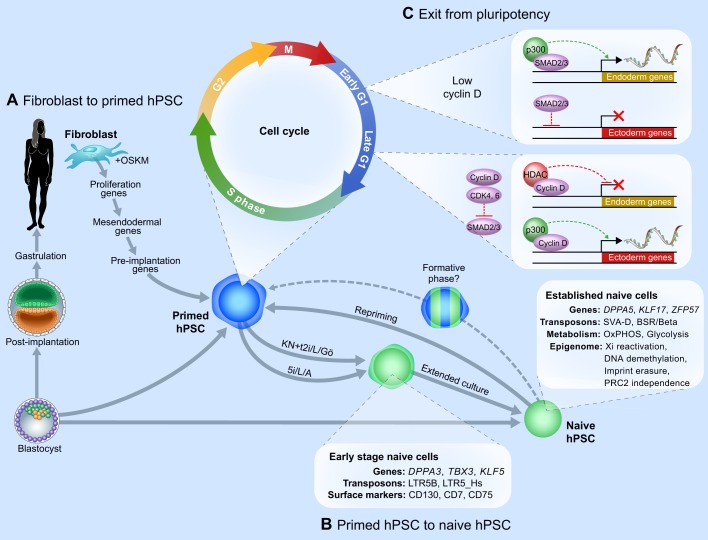
Molecular dynamics during the transitions into and out of human pluripotency. Summary of the transcriptional and epigenetic changes during cell fate transitions involving hPSCs. (A) Sequence of events occurring during the reprogramming of human somatic cells to pluripotency upon overexpression of OCT4, SOX2, KLF4 and c-MYC (OSKM) (Cacchiarelli et al., 2015). (B) Events occurring during the primed-to-naive PSC transition. Collier et al. (2017) assessed transcriptional dynamics at early and late stages of naive resetting upon overexpression of KLF2 and NANOG (KN) transgenes in primed hESCs and transfer to t2i/L+Gö medium (Takashima et al., 2014) or by switching primed hESCs to 5i/L/A medium (Theunissen et al., 2014). Note that the Smith laboratory recently showed that hPSCs can also be reset to naive pluripotency by transient histone deacetylase inhibition and transfer to t2i/L+Gö medium (Guo et al., 2017). The dynamics of X-chromosome reactivation during naive resetting were analyzed by Sahakyan et al. (2017). Naive hPSCs derived in t2i/L+Gö or 5i/L/A display globally reduced DNA methylation levels and erasure of most imprinted regions (Pastor et al., 2016; Theunissen et al., 2016). (C) The exit of human pluripotency, specifically the relationship between the cell cycle and lineage commitment of hPSCs (Pauklin and Vallier, 2013; Pauklin et al., 2016). The existence of a formative phase, during which PSCs acquire competence for multilineage and germ cell induction, has recently been proposed (Smith, 2017). OxPHOS, oxidative phosphorylation; Xi, inactive X.

References

    1. Adamo A., Sesé B., Boue S., Castaño J., Paramonov I., Barrero M. J. and Izpisua Belmonte J. C. (2011). LSD1 regulates the balance between self-renewal and differentiation in human embryonic stem cells. Nat. Cell Biol. 13, 652-659. 10.1038/ncb2246 - DOI - PubMed
    1. Anokye-Danso F., Trivedi C. M., Juhr D., Gupta M., Cui Z., Tian Y., Zhang Y., Yang W., Gruber P. J., Epstein J. A. et al. (2011). Highly efficient miRNA-mediated reprogramming of mouse and human somatic cells to pluripotency. Cell Stem Cell 8, 376-388. 10.1016/j.stem.2011.03.001 - DOI - PMC - PubMed
    1. Arduini B. L. and Brivanlou A. H. (2012). Modulation of FOXD3 activity in human embryonic stem cells directs pluripotency and paraxial mesoderm fates. Stem Cells 30, 2188-2198. 10.1002/stem.1200 - DOI - PubMed
    1. Azuara V., Perry P., Sauer S., Spivakov M., Jørgensen H. F., John R. M., Gouti M., Casanova M., Warnes G., Merkenschlager M. et al. (2006). Chromatin signatures of pluripotent cell lines. Nat. Cell Biol. 8, 532-538. 10.1038/ncb1403 - DOI - PubMed
    1. Bar M., Wyman S. K., Fritz B. R., Qi J., Garg K. S., Parkin R. K., Kroh E. M., Bendoraite A., Mitchell P. S., Nelson A. M. et al. (2008). MicroRNA discovery and profiling in human embryonic stem cells by deep sequencing of small RNA libraries. Stem Cells 26, 2496-2505. 10.1634/stemcells.2008-0356 - DOI - PMC - PubMed

MeSH terms

LinkOut - more resources