. 2018 Jan 2;115(1):168-173.
doi: 10.1073/pnas.1715471115. Epub 2017 Dec 18.

Conserved epitope on influenza-virus hemagglutinin head defined by a vaccine-induced antibody

Affiliations

Conserved epitope on influenza-virus hemagglutinin head defined by a vaccine-induced antibody

Donald D Raymond et al. Proc Natl Acad Sci U S A. .

Abstract

Circulating influenza viruses evade neutralization in their human hosts by acquiring escape mutations at epitopes of prevalent antibodies. A goal for next-generation influenza vaccines is to reduce escape likelihood by selectively eliciting antibodies recognizing conserved surfaces on the viral hemagglutinin (HA). The receptor-binding site (RBS) on the HA "head" and a region near the fusion peptide on the HA "stem" are two such sites. We describe here a human antibody clonal lineage, designated CL6649, members of which bind a third conserved site ("lateral patch") on the side of the H1-subtype, HA head. A crystal structure of HA with bound Fab6649 shows the conserved antibody footprint. The site was invariant in isolates from 1977 (seasonal) to 2012 (pdm2009); antibodies in CL6649 recognize HAs from the entire period. In 2013, human H1 viruses acquired mutations in this epitope that were retained in subsequent seasons, prompting modification of the H1 vaccine component in 2017. The mutations inhibit Fab6649 binding. We infer from the rapid spread of these mutations in circulating H1 influenza viruses that the previously subdominant, conserved lateral patch had become immunodominant for individuals with B-cell memory imprinted by earlier H1 exposure. We suggest that introduction of the pdm2009 H1 virus, to which most of the broadly prevalent, neutralizing antibodies did not bind, conferred a selective advantage in the immune systems of infected hosts to recall of memory B cells that recognized the lateral patch, the principal exposed epitope that did not change when pdm2009 displaced previous seasonal H1 viruses.

Keywords: B-cell memory; affinity maturation; hemagglutinin; influenza vaccine.


Conflict of interest statement

Conflict of interest statement: J.F., P.S., and E.C.S. are employees of Seqirus, which has research and development programs related to influenza vaccines. The other authors declare no conflict of interest.

Figures

Fig. 1.
Fig. 1.
Conservation of surface residues in H1 HAs (1977–2009). Conservation is shown on the surface of an HA monomer on a scale from beige (most variable) to dark blue (most conserved). The RBS and the conserved lateral patch are outlined in pink and green, respectively.
Fig. 2.
Fig. 2.
(A) Phylogenetic analysis of the CL6649 clonal antibody lineage. Antibody lineage members that were characterized further are underscored in red. (B) Neutralization of selected H1 influenza viruses by antibodies from the CL6649 clonal lineage. Neutralization titers (50%) for the indicated influenza viruses and mAbs are shown. All neutralization assays were carried out with a minimum of three replicates. Color-coding indicates arbitrary neutralization potency. (C) Direct competition ELISA of selected CL6649 lineage members, underlined in A, with a previously characterized RBS-binding Ab6639 (17). An unrelated antibody, Ab9147, served as a control.
Fig. 3.
Fig. 3.
Affinity measurements of Fab6649 and UCA. Fab fragments of 6649 and UCA were screened for binding with heads of seasonal H1, H3, H5, H7, and B influenza HAs that circulated during the donor’s lifetime. Color-coding indicates the apparent Kd, measured by BLI.
Fig. 4.
Fig. 4.
Structures of Fab6649 bound with an HA and of the unbound UCA of the lineage. (A) Overall structure of Fab6649 bound with A/Solomon Islands/03/2006. HA1 and HA2 are colored pink and purple, respectively. Fab6649 contacts the HA1 head with both its heavy (teal) and light (green) chains. (B) Blow-up of the Fab:HA complex. Interface residues are shown as sticks and their positions indicated; those on HA are underscored. (C) Structures of the UCA and Fab6649 superposed. The comparison shows no structural rearrangements. Four tyrosine residues in the UCA that mutated during the course of affinity maturation to phenylalanines in Fab6649 are labeled.
Fig. 5.
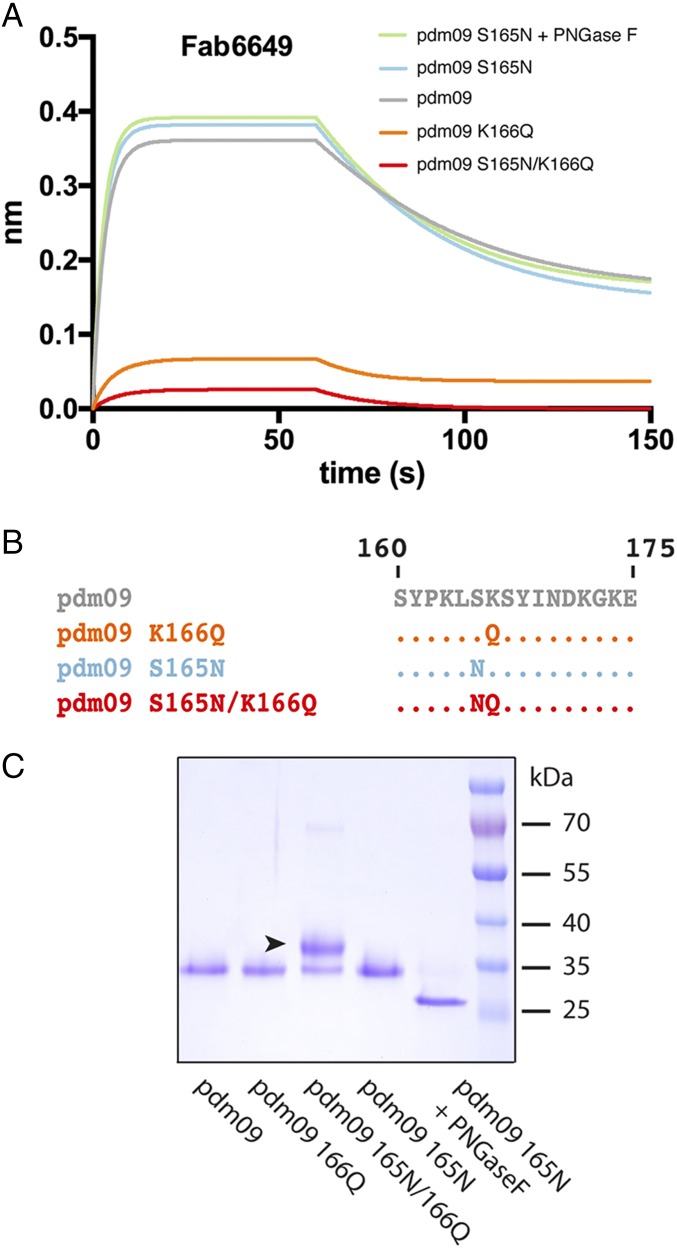
Fig. 5.
In vitro characterization of HAs of the newly emerged pdm2009-like H1N1 viral isolates. (A) BLI measurements. Representative Langmuir fits of the binding isotherms generated by BLI with immobilized Fab6649 and the indicated pdm2009 HA head variants as “single hit” analytes at 5 μM. (B) Amino acid sequence alignment of pdm2009-like HAs. Dots indicate identities. Color-coding is as in A. (C) SDS/PAGE of HEK293F cell produced HA head variants. The arrow indicates the lower mobility band at 37 kDa of the S165N/K166Q variant, indicating N165 glycosylation on most of the HA polypeptide chains.

References

    1. Knossow M, Skehel JJ. Variation and infectivity neutralization in influenza. Immunology. 2006;119:1–7. - PMC - PubMed
    1. Krammer F, Palese P. Advances in the development of influenza virus vaccines. Nat Rev Drug Discov. 2015;14:167–182. - PubMed
    1. Victora GD, Wilson PC. Germinal center selection and the antibody response to influenza. Cell. 2015;163:545–548. - PMC - PubMed
    1. Schmidt AG, et al. Viral receptor-binding site antibodies with diverse germline origins. Cell. 2015;161:1026–1034. - PMC - PubMed
    1. Whittle JR, et al. Broadly neutralizing human antibody that recognizes the receptor-binding pocket of influenza virus hemagglutinin. Proc Natl Acad Sci USA. 2011;108:14216–14221. - PMC - PubMed

Publication types

MeSH terms