. 2017 Dec 18;7(1):17742.
doi: 10.1038/s41598-017-18009-2.

Functional characterization of the circadian clock in the Antarctic krill, Euphausia superba

Affiliations

Functional characterization of the circadian clock in the Antarctic krill, Euphausia superba

Alberto Biscontin et al. Sci Rep. .

Abstract

Antarctic krill (Euphausia superba) is a key species in Southern Ocean ecosystem where it plays a central role in the Antarctic food web. Available information supports the existence of an endogenous timing system in krill enabling it to synchronize metabolism and behavior with an environment characterized by extreme seasonal changes in terms of day length, food availability, and surface ice extent. A screening of our transcriptome database "KrillDB" allowed us to identify the putative orthologues of 20 circadian clock components. Mapping of conserved domains and phylogenetic analyses strongly supported annotations of the identified sequences. Luciferase assays and co-immunoprecipitation experiments allowed us to define the role of the main clock components. Our findings provide an overall picture of the molecular mechanisms underlying the functioning of the endogenous circadian clock in the Antarctic krill and shed light on their evolution throughout crustaceans speciation. Interestingly, the core clock machinery shows both mammalian and insect features that presumably contribute to an evolutionary strategy to cope with polar environment's challenges. Moreover, despite the extreme variability characterizing the Antarctic seasonal day length, the conserved light mediated degradation of the photoreceptor EsCRY1 suggests a persisting pivotal role of light as a Zeitgeber.


Conflict of interest statement

The authors declare that they have no competing interests.

Figures
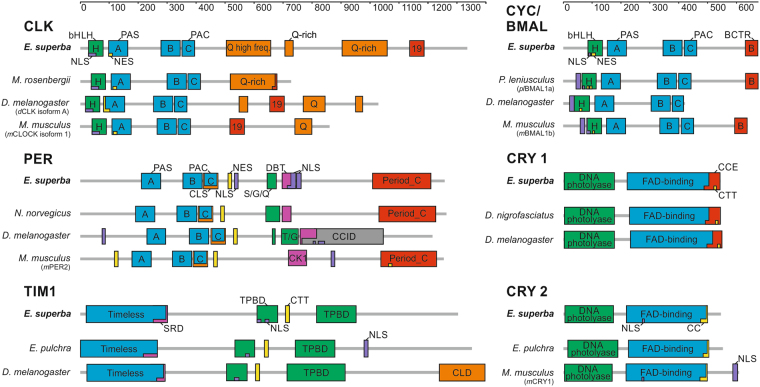
Figure 1
Figure 1
Schematic presentation of functional domains and motifs of the main krill circadian clock components (CLOCK, CYC/BMAL, PERIOD, TIMELESS 1; CRYPTOCRHOME 1, and CRYPTOCRHOME 2). Domains structure of E. superba proteins was compared to D. melanogaster, M. musculus, and the most similar orthologue from Crustacea. Grey bars indicate amino acidic length sequence. Specific domains were demarcated according to the SMART protein domain analysis. EsCLK’s exon 19 sequence corresponds to the entire exon 19 sequence of mCLOCK isoform 1. EsCYC/BMAL’s BCTR domain was defined as the final 39 amino acids of mBMAL1. EsPER’s Doubletime/Casein kinase 1 binding domain (DBT/CK1), EsTIM1’s serine-rich domain, and the TIM1/PER binding domains were defined via alignment to D. melanogaster orthologues. EsTIM1’s CLD corresponds to the sequence identified by deletion mutant mapping of dTIM. EsCRY1 C-terminal Extension (CCE) and EsCRY2 Coiled-coil domain (CC) were defined by alignment to the corresponding sequence of dCRY1 and mCRY1, respectively.
Figure 2
Figure 2
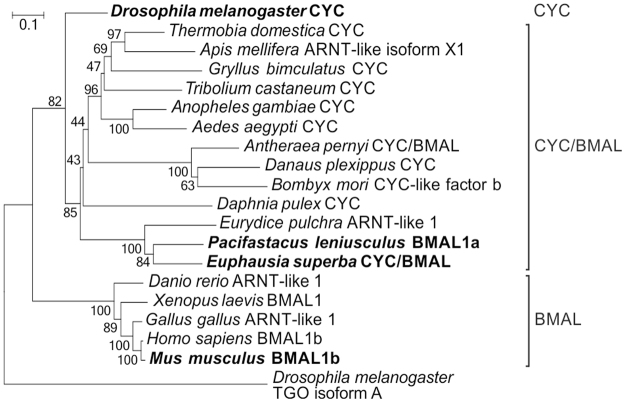
Phylogenetic relationships of the CYCLE/BMAL protein family. The D. melanogaster’s bHLH-PAS protein TANGO isoform A has been used as outgroup. Bootstrap confidence values based on 1,000 replicates are shown at nodes. Scale bar indicates amino acid substitutions per site. The most relevant orthologues are indicated in bold.
Figure 3
Figure 3
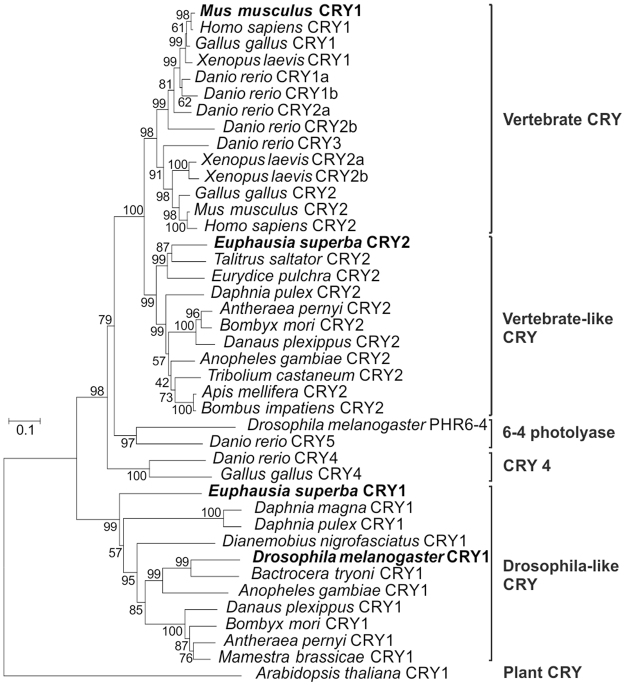
Phylogenetic relationships of CRYPTOCHROME protein family. The A. thaliana’s CRY has been used as outgroup. Bootstrap confidence values based on 1,000 replicates are shown at nodes. Scale bar indicates amino acid substitutions per site. The most relevant orthologues are indicated in bold.
Figure 4
Figure 4
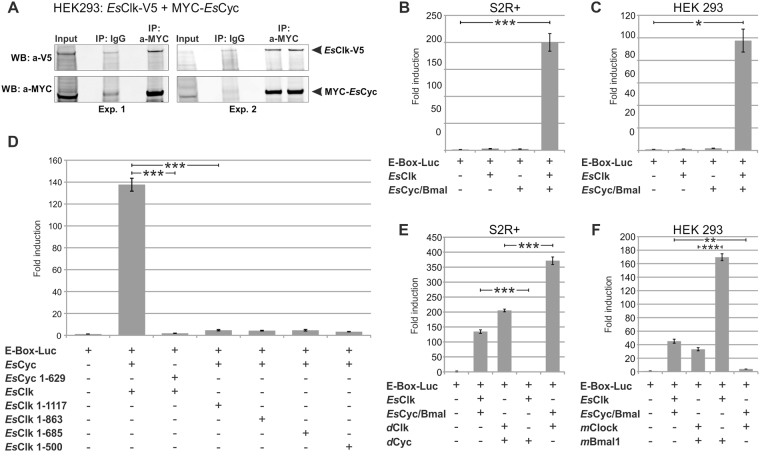
EsCLOCK and EsCYCLE/BMAL dimerize and activate transcription from the E-Box in vitro. (A) Co-immunoprecipitation of an epitope-tagged versions of EsCLK-V5 and MYC-EsCYC/BMAL co-expressed in HEK293 cells. Two experiments (Exp.) are reported showing that precipitates are enriched for EsClock-V5. Membranes were probed with anti-MYC antibody to visualize pulldown efficiencies. For presentation purposes western blot images have been cropped (full-length blots are presented in Supplementary Figure S8A-C). (B,C) EsCLK and EsCYC/BMAL luciferase assay. EsCLK and EsCYC/BMAL - only as a heterodimer - activate the transcription of an E-box luciferase reporter in S2R + and HEK 293 cells, respectively. Cells were transfected with indicated constructs. Negative control set as 1. Data are represented as mean ± SD (n = 3 independent transfections). (D) Identification of conserved domains responsible for the transactivation activity of the EsCLK:EsCYC/BMAL by luciferase assay and their selective deletion. Data are represented as mean ± SD (n = 3 independent transfections). See Supplementary Figure 7 for a schematic representation of the constructs generated. (E,F) Interactions between E. superba’s positive clock elements with those of D. melanogaster and M. musculus evaluated by luciferase assay in S2R + and HEK 293 cells, respectively. Negative control set as 1. Data are represented as mean ± SD (n = 3 independent transfections). Student’s t-test Bonferroni-corrected p-values for all the experimental comparisons discussed were presented in Supplementary Table 3. Statistical significance of the most relevant comparisons were shown as *p < 0.05, **p < 0.01, and ***p < 0.005.
Figure 5
Figure 5
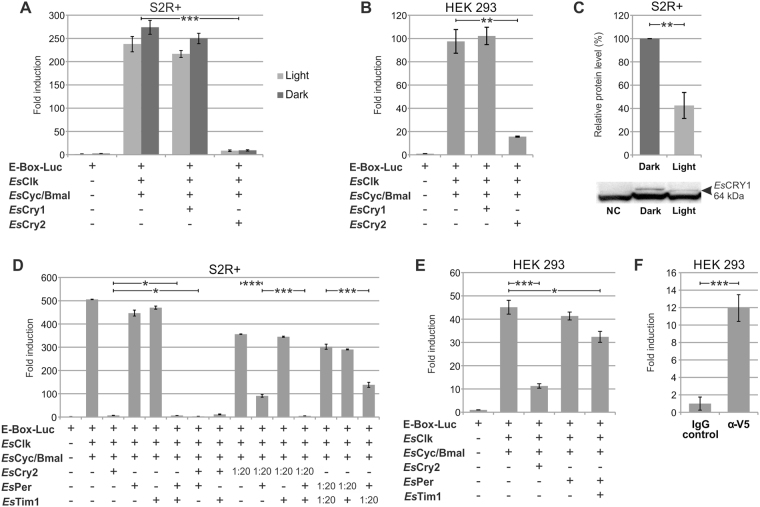
Functional characterization of the putative EsCLK:EsCYC/BMAL’s inhibitors. (A,B) EsCRY1 and EsCRY2 functional validation by luciferase assay in S2R + and HEK293 cells, respectively. Cells were transfected with indicated constructs. Negative control set as 1. Data are represented as mean ± SEM (n = 3 independent transfections). (C) Western blot and relative quantification of EsCRY1 protein in the dark and after a 8 hours light pulse in Drosophila cells. Data are represented as mean ± SD (n = 3 independent transfections). NC: negative control. (D,E) Comparison of the effectiveness of EsPER, EsTIM1, and EsCRY2 for inhibiting the transcription of the E-box/luciferase reporter mediated by the EsCLK:EsCYC/BMAL dimer in S2R + and HEK293 cells respectively. S2R + and HEK293 cells were transfected with the indicated constructs. Negative control set as 1. Data are represented as mean ± SD (n = 3 independent transfections). (F) Co-immonoprecipitation of EsCRY2 and EsCYC/BMAL quantified by luciferase assay. EsCyc/Bmal C-terminally fused to luciferase (EsCyc/Bmal-LUC) was co-immunoprecipitated with EsCry2-V5 and anti-V5 antidody in HEK293 cells. Data are presented as mean ± SD (n = 3 independent transfections). Student’s t-test Bonferroni-corrected p-values for all the experimental comparisons discussed were presented in Supplementary Table 3. Statistical significance of the most relevant comparisons were shown as *p < 0.05, **p < 0.01, and ***p < 0.005.
Figure 6
Figure 6
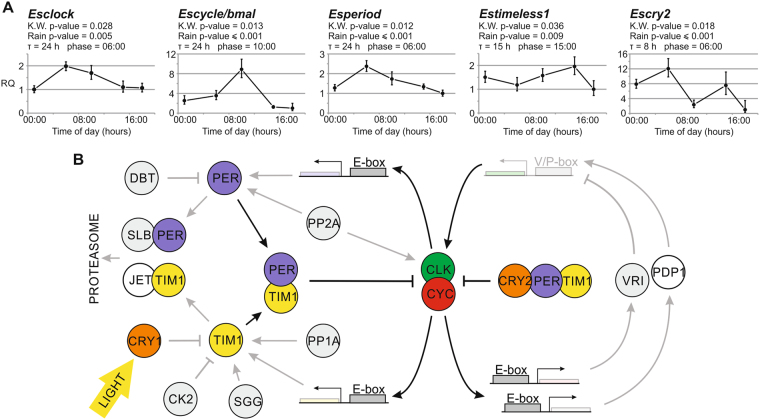
Putative functioning of the circadian clock machinery in E. superba. (A) Temporal patterns of expression of the five main circadian clock components (Esclock, Escycle/bmal, Esperiod, Estimeless1, and Escry2) in the eyestalks of krills sampled at 1:00, 6:00, 10:00, 15:00, and 18:00 during the Antarctic summer (almost 24 hours of light). Relative quantification (RQ) is represented as mean ± SD (n = 3 pools of 10 eyestalks each). Kruskal-Wallis p-value is reported, as well as adjusted p-value, period (τ) and phase of the oscillation estimated using RAIN algorithm. (B) A schematic model of the circadian clock in E. superba. The two main interlocked feedback loops are represented. The clock components identified in E. superba are colored; components sequenced but not functionally characterized are in grey (Supplementary Table 1); PDP1 and JET albeit only suggested by our data have been recently identified by Hunt et al..

References

    1. Marr, J. W. S. The natural history and geography of the Antarctic krill (Euphausia superba Dana). Discovery reports32 (1962).
    1. Croxall J, Reid K, Prince P. Diet, provisioning and productivity responses of marine predators to differences in availability of Antarctic krill. Mar. Ecol. Prog. Ser. 1999;177:115–131. doi: 10.3354/meps177115. - DOI
    1. Atkinson A, Siegel V, Pakhomov EA, Jessopp MJ, Loeb V. A re-appraisal of the total biomass and annual production of Antarctic krill. Deep Sea Res. Part I Oceanogr. Res. Pap. 2009;56:727–740. doi: 10.1016/j.dsr.2008.12.007. - DOI
    1. Nicol S, Foster J, Kawaguchi S. The fishery for Antarctic krill - recent developments. Fish Fish. 2012;13:30–40. doi: 10.1111/j.1467-2979.2011.00406.x. - DOI
    1. Ducklow H, et al. West Antarctic Peninsula: an ice-dependent coastal marine ecosystem in transition. Oceanography. 2013;26:190–203. doi: 10.5670/oceanog.2013.62. - DOI

LinkOut - more resources