


Accelerated hepatocellular carcinoma recurrence rate after postoperative direct-acting antivirals treatment - preliminary report
- PMID: 29255807
- PMCID: PMC5731431
- DOI: 10.5114/ceh.2017.71483
Accelerated hepatocellular carcinoma recurrence rate after postoperative direct-acting antivirals treatment - preliminary report
Abstract
Aim of the study: New interferon-free direct-acting antiviral (DAA) therapy has led to major progress in hepatitis C virus (HCV) treatment. Current outcomes are promising, especially in compensated cirrhosis. However, there are reports of accelerated hepatocellular carcinoma (HCC) recurrence after surgery in patients treated with DAAs. The influence of DAA therapy on the timing and frequency of recurrence after surgical treatment needs further observation.
Material and methods: Fifty-one HCV infected patients with advanced liver cirrhosis and history of surgical treatment for HCC in 2012-2016 were analyzed in a case-control study. Nineteen patients received DAA therapy (DAA group) after tumor remission achieved by surgery and 32 patients were not treated with DAA (NDAA group). Follow-up included multiphase computed tomography scan or magnetic resonance imaging of the liver and alpha-fetoprotein level in 3-6-month intervals.
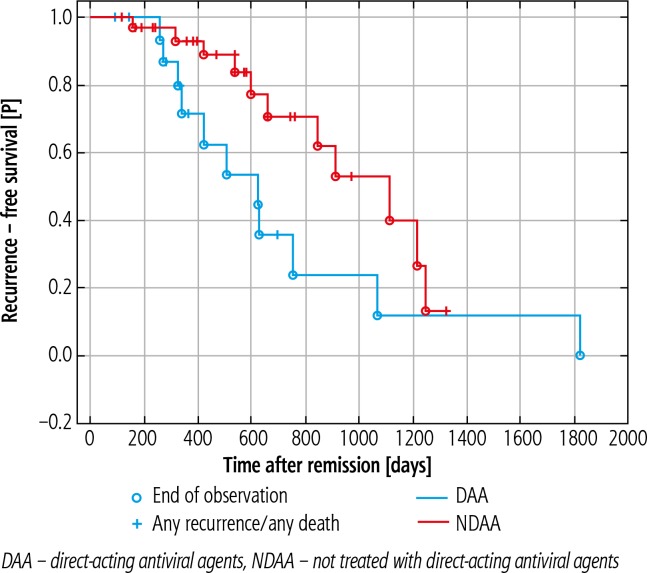
Results: An sustained virological response was achieved in 18 (95%) DAA treated patients. Hepatocellular carcinoma recurrence was observed in 8 (42.1%) patients from the DAA group and in 21 (65.6%) from the NDAA group (p = 0.058). Relapse occurred within 265 days after surgery in the DAA group vs. 532 days in the NDAA group (p = 0.033). The one-year recurrence-free survival (RFS) rate was 47.3% vs. 75% in the DAA and NDAA group respectively (p = 0.45).
Conclusions: Use of DAA therapy in patients with a history of HCC may result in significantly accelerated relapse of the disease. The number of analyzed patients in this study is too small to state unquestionable conclusions. Further observation with a longer follow-up and larger patient group is needed. The study confirms that contemporary HCV treatment is highly effective.
Keywords: direct acting antiviral drug; hepatitis C virus (HCV); hepatocellular carcinoma.
Figures
References
-
- Thein HH, Yi Q, Dore GJ, et al. Estimation of stage-specific fibrosis progression rates in chronic hepatitis C virus infection: a meta-analysis and meta-regression. Hepatology. 2008;48:418–431. - PubMed
-
- Seeff LB. Natural history of chronic hepatitis C. Hepatology. 2002;36(5 Suppl 1):S35–46. - PubMed
-
- Sangiovanni A, Del Ninno E, Fasani P, et al. Increased survival of cirrhotic patients with a hepatocellular carcinoma detected during surveillance. Gastroenterology. 2004;126:1005–1014. - PubMed
-
- Panasiuk A, Simon K, Krzmieniecki K, et al. Epidemiology of hepatocellular carcinoma in Poland (LIVER project) Clin Exp Hepatol. 2016;2:46.
LinkOut - more resources
Full Text Sources
Other Literature Sources
Research Materials
