


Recent Advances in Cancer Therapy Based on Dual Mode Gold Nanoparticles
- PMID: 29257070
- PMCID: PMC5742821
- DOI: 10.3390/cancers9120173
Recent Advances in Cancer Therapy Based on Dual Mode Gold Nanoparticles
Abstract
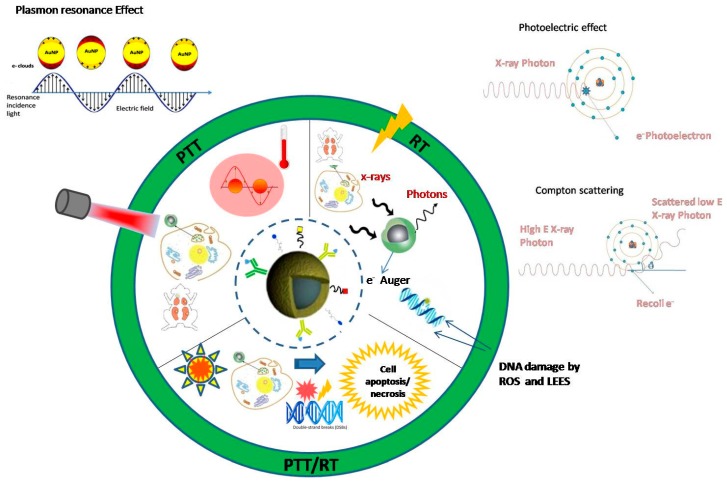
Many tumor-targeted strategies have been used worldwide to limit the side effects and improve the effectiveness of therapies, such as chemotherapy, radiotherapy (RT), etc. Biophotonic therapy modalities comprise very promising alternative techniques for cancer treatment with minimal invasiveness and side-effects. These modalities use light e.g., laser irradiation in an extracorporeal or intravenous mode to activate photosensitizer agents with selectivity in the target tissue. Photothermal therapy (PTT) is a minimally invasive technique for cancer treatment which uses laser-activated photoabsorbers to convert photon energy into heat sufficient to induce cells destruction via apoptosis, necroptosis and/or necrosis. During the last decade, PTT has attracted an increased interest since the therapy can be combined with customized functionalized nanoparticles (NPs). Recent advances in nanotechnology have given rise to generation of various types of NPs, like gold NPs (AuNPs), designed to act both as radiosensitizers and photothermal sensitizing agents due to their unique optical and electrical properties i.e., functioning in dual mode. Functionalized AuNPS can be employed in combination with non-ionizing and ionizing radiation to significantly improve the efficacy of cancer treatment while at the same time sparing normal tissues. Here, we first provide an overview of the use of NPs for cancer therapy. Then we review many recent advances on the use of gold NPs in PTT, RT and PTT/RT based on different types of AuNPs, irradiation conditions and protocols. We refer to the interaction mechanisms of AuNPs with cancer cells via the effects of non-ionizing and ionizing radiations and we provide recent existing experimental data as a baseline for the design of optimized protocols in PTT, RT and PTT/RT combined treatment.
Keywords: gold nanoparticles; ionizing radiation; photothermal therapy; radiosensitizing; radiotherapy.
Conflict of interest statement
The authors declare no conflict of interest.
Figures
References
-
- Huang X., El-Sayed M.A. Plasmonic photo-thermal therapy (PPTT) Alex. J. Med. 2011;47:1–9. doi: 10.1016/j.ajme.2011.01.001. - DOI
Publication types
LinkOut - more resources
Full Text Sources
Other Literature Sources
