


Comment
doi: 10.1016/j.cub.2017.10.055.
Meiosis: The Origins of Bias
Affiliations
- PMID: 29257963
- PMCID: PMC8191210
- DOI: 10.1016/j.cub.2017.10.055
Item in Clipboard
Comment
Meiosis: The Origins of Bias
Curr Biol.
.
Abstract
Biased, or non-Mendelian, segregation is frequently observed but not well understood. Two recent studies on a specific type of biased segregation in mammalian meiosis suggest that it arises from centromeric satellite expansion and asymmetric modification of microtubules in the oocyte spindle.
Copyright © 2017 Elsevier Ltd. All rights reserved.
Figures
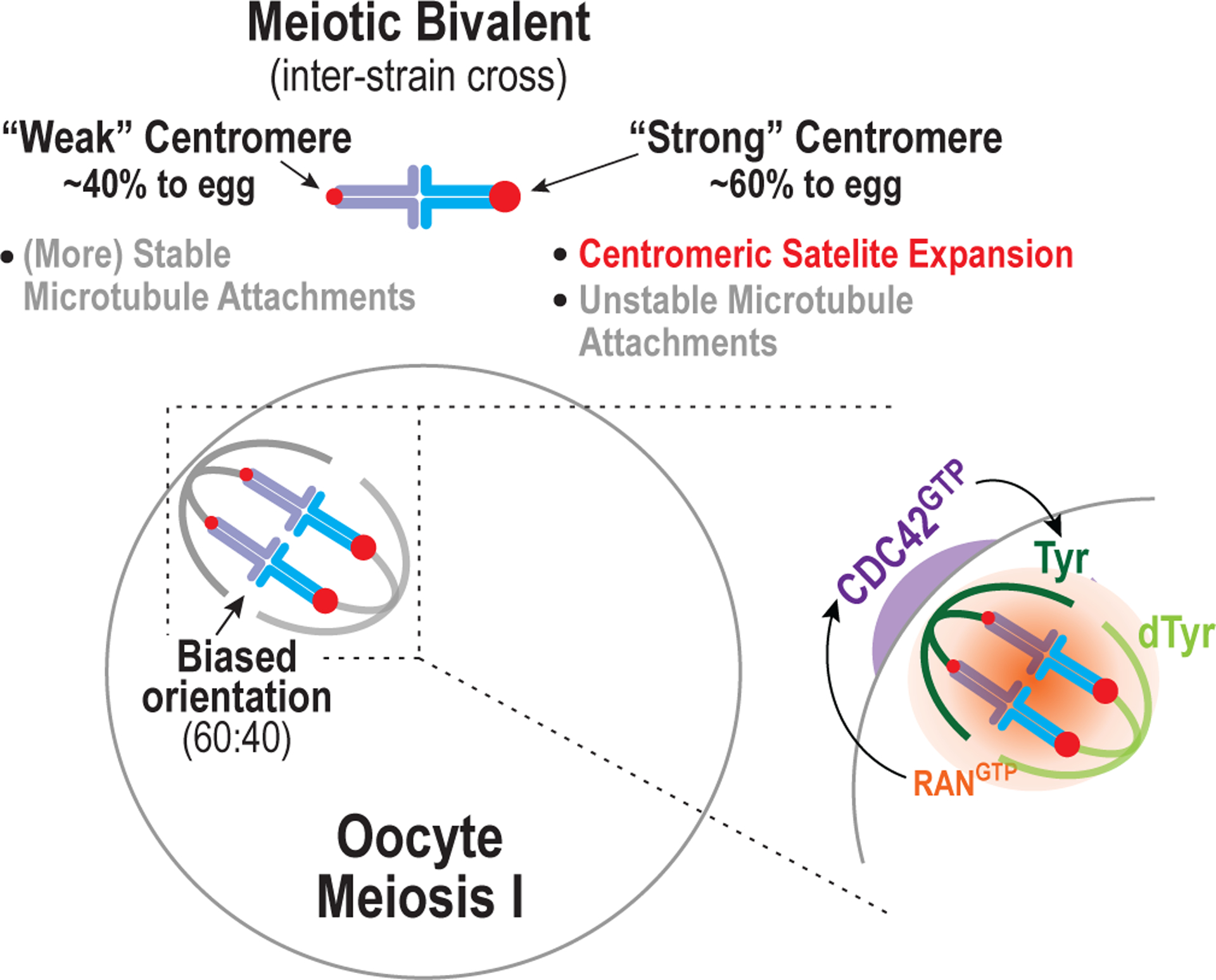
The figure depicts the biased orientation of bivalent chromosomes on the meiosis I spindle of oocytes after an inter-strain cross. One strain has ‘strong’ centromeres that have expanded centromeric minor satellite repeats and recruit more of a key microtubule attachment factor relative to the other strain with ‘weak’ centromeres. Surprisingly, strong centromeres make less stable microtubule attachments than weak centromeres. In oocytes of females derived from crossing the two strains, the chromosome with the strong centromere ends up in the egg more frequently than by chance (60% versus 50%). The spindle itself is asymmetric, in that its proximity to the cortex leads to elevated tyrosination of the microtubules of the half-spindle close to the cortex relative to the half-spindle facing the egg cytoplasm. The tyrosination asymmetry requires chromosome-derived Ran GTP that locally activates the Rho family GTPase Cdc42 on the oocyte cortex. The mechanism by which active Cdc42 promotes local tyrosination of microtubules is not yet known.
Comment on
-
Expanded Satellite Repeats Amplify a Discrete CENP-A Nucleosome Assembly Site on Chromosomes that Drive in Female Meiosis.Curr Biol. 2017 Aug 7;27(15):2365-2373.e8. doi: 10.1016/j.cub.2017.06.069. Epub 2017 Jul 27. Curr Biol. 2017. PMID: 28756949 Free PMC article.
References
-
- Sandler L, and Novitski E (1957). Meiotic drive as an evolutionary force. Am. Nat 91, 105–110.
-
- de Villena F, and Sapienza C (2001). Nonrandom segregation during meiosis: the unfairness of females. Mamm. Genome 12, 331–339. - PubMed
-
- Henikoff S, and Malik HS (2002). Centromeres: selfish drivers. Nature 417, 227. - PubMed
Publication types
MeSH terms
Substances
Grants and funding
LinkOut - more resources
Full Text Sources
Other Literature Sources
