


A selenium species in cerebrospinal fluid predicts conversion to Alzheimer's dementia in persons with mild cognitive impairment
- PMID: 29258624
- PMCID: PMC5735937
- DOI: 10.1186/s13195-017-0323-1
A selenium species in cerebrospinal fluid predicts conversion to Alzheimer's dementia in persons with mild cognitive impairment
Abstract
Background: Little is known about factors influencing progression from mild cognitive impairment to Alzheimer's dementia. A potential role of environmental chemicals and specifically of selenium, a trace element of nutritional and toxicological relevance, has been suggested. Epidemiologic studies of selenium are lacking, however, with the exception of a recent randomized trial based on an organic selenium form.
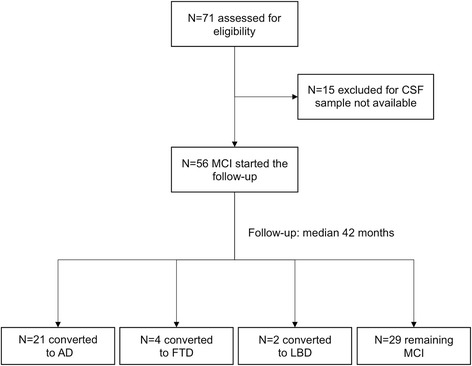
Methods: We determined concentrations of selenium species in cerebrospinal fluid sampled at diagnosis in 56 participants with mild cognitive impairment of nonvascular origin. We then investigated the relation of these concentrations to subsequent conversion from mild cognitive impairment to Alzheimer's dementia.
Results: Twenty-one out of the 56 subjects developed Alzheimer's dementia during a median follow-up of 42 months; four subjects developed frontotemporal dementia and two patients Lewy body dementia. In a Cox proportional hazards model adjusting for age, sex, duration of sample storage, and education, an inorganic selenium form, selenate, showed a strong association with Alzheimer's dementia risk, with an adjusted hazard ratio of 3.1 (95% confidence interval 1.0-9.5) in subjects having a cerebrospinal fluid content above the median level, compared with those with lower concentration. The hazard ratio of Alzheimer's dementia showed little departure from unity for all other inorganic and organic selenium species. These associations were similar in analyses that measured exposure on a continuous scale, and also after excluding individuals who converted to Alzheimer's dementia at the beginning of the follow-up.
Conclusions: These results indicate that higher amounts of a potentially toxic inorganic selenium form in cerebrospinal fluid may predict conversion from mild cognitive impairment to Alzheimer's dementia.
Keywords: Alzheimer’s disease; Cerebrospinal fluid; Dementia; Mild cognitive impairment; Selenium; Selenium species.
Conflict of interest statement
Ethics approval and consent to participate
The study protocol was approved by the Modena University Hospital Ethics Committee (approval number 84/2015), in accordance with the principles of the Declaration of Helsinki of the World Medical Association. Written consent to use CSF for scientific research purposes was obtained from all the patients involved in the study before sampling.
Consent for publication
Not applicable.
Competing interests
The authors declare that they have no competing interests.
Competing interests
The authors declare that they have no competing interests.
Publisher’s Note
Springer Nature remains neutral with regard to jurisdictional claims in published maps and institutional affiliations.
Figures
References
MeSH terms
Substances
Grants and funding
LinkOut - more resources
Full Text Sources
Other Literature Sources
Medical
