


Trunk flexor and extensor muscle performance in chronic stroke patients: a case-control study
- PMID: 29258736
- PMCID: PMC5993948
- DOI: 10.1016/j.bjpt.2017.12.002
Trunk flexor and extensor muscle performance in chronic stroke patients: a case-control study
Abstract
Background: Although chronic stroke patients commonly show impairment of trunk muscle performance, this disability has only been analyzed in terms of peak torque. Therefore, other measures are needed for a more adequate description.
Objective: This study aimed to compare concentric muscle performance of trunk flexor/extensor muscles between chronic stroke patients and matched-healthy subjects.
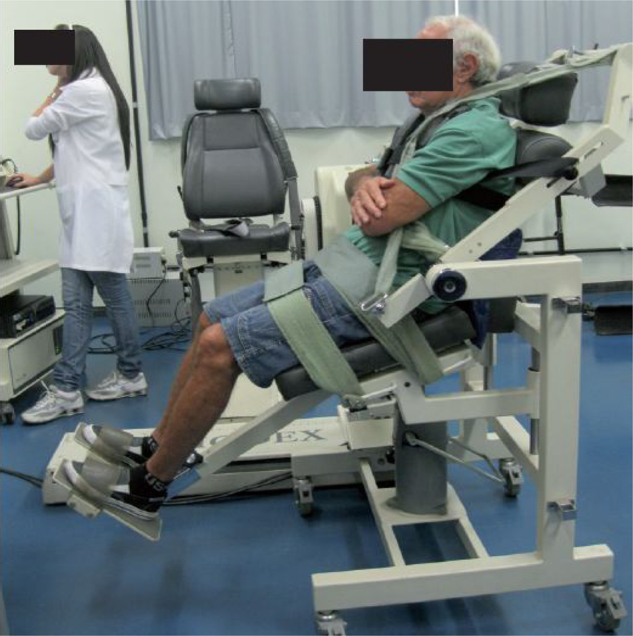
Methods: 18 chronic stroke patients and 18 healthy subjects were matched according to their age, sex, body mass index and level of physical activity. After familiarization, trunk flexor/extensor concentric muscle strength was measured using an isokinetic dynamometer (Biodex Medical Systems Inc, Shirley, NY, USA) with 3 repetitions at a velocity of 60°/s and 5 repetitions at a velocity of 120°/s. Trunk muscular performance was characterized by peak torque, torque at 90°, total work, and total work normalized by trunk mass. Student's t-test was used for independent samples (α=0.05) for group comparisons.
Results: All trunk muscle performance variables values investigated were significantly lower in chronic stroke patients when compared to matched-healthy subjects (p≤0.001). The obtained ratios of chronic stroke patients scores to that of the matched-healthy subjects at velocities of 60°/s and 120°/s were, respectively: flexor peak torque (60% & 53%)/extensor (54% & 53%); flexor torque at 90° (56.20% & 36.58%)/extensor (57.92% & 30.65%); flexor total muscular work (51.27% & 38.03%)/extensor (47.97% & 39.52%); and flexor total muscular work normalized by trunk mass (55.57% & 40%)/extensor (51.40% & 42%).
Conclusions: Chronic stroke patients showed decreased trunk muscle performance when compared to matched-healthy subjects in all variables investigated.
Keywords: Muscle strength; Physical Therapy; Rehabilitation; Stroke; Trunk.
Copyright © 2017 Associação Brasileira de Pesquisa e Pós-Graduação em Fisioterapia. Publicado por Elsevier Editora Ltda. All rights reserved.
Figures
References
-
- Lecours J., Nadeau S., Gravel D., Teixera-Salmela L. Interactions between foot placement, trunk frontal position, weight-bearing and knee moment asymmetry at seat-off during rising from a chair in healthy controls and persons with hemiparesis. J Rehabil Med. 2008;40(3):200–207. - PubMed
-
- Di Monaco M., Trucco M., Di Monaco R., Tappero R., Cavanna A. The relationship between initial trunk control or postural balance and inpatient rehabilitation outcome after stroke: a prospective comparative study. Clin Rehabil. 2010;24(6):543–554. - PubMed
-
- Taoka M., Toda T., Iwamura Y. Representation of the midline trunk, bilateral arms, and shoulders in the monkey postcentral somatosensory cortex. Exp Brain Res. 1998;123(3):315–322. - PubMed
MeSH terms
LinkOut - more resources
Full Text Sources
Other Literature Sources
Medical
