


A molecular algorithm to detect and differentiate human pathogens infecting Ixodes scapularis and Ixodes pacificus (Acari: Ixodidae)
- PMID: 29258802
- PMCID: PMC6452875
- DOI: 10.1016/j.ttbdis.2017.12.005
A molecular algorithm to detect and differentiate human pathogens infecting Ixodes scapularis and Ixodes pacificus (Acari: Ixodidae)
Abstract
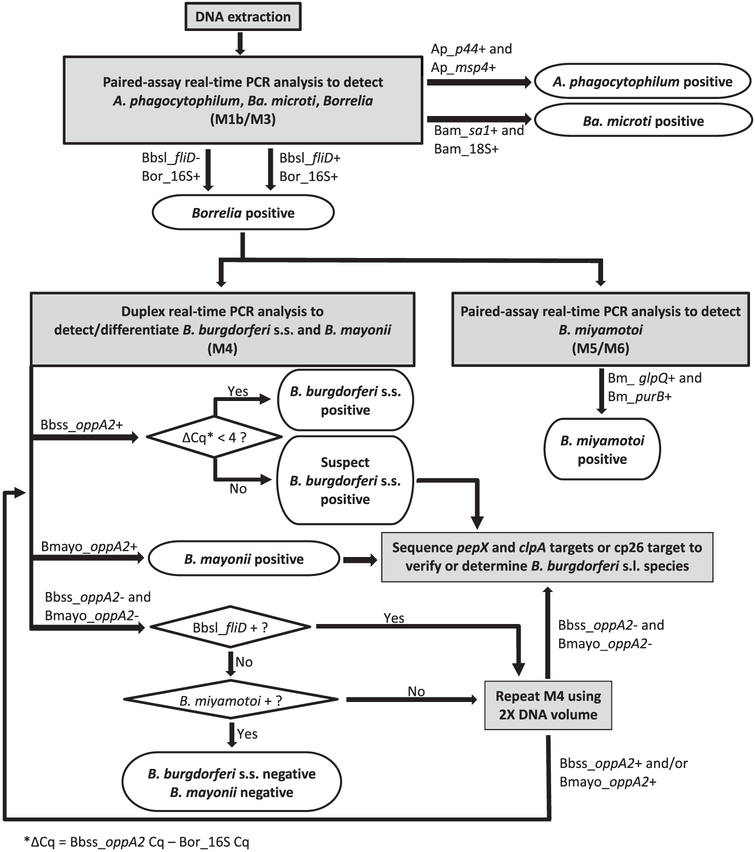
The incidence and geographic range of tick-borne illness associated with Ixodes scapularis and Ixodes pacificus have dramatically increased in recent decades. Anaplasmosis, babesiosis, and Borrelia spirochete infections, including Lyme borreliosis, account for tens of thousands of reported cases of tick-borne disease every year. Assays that reliably detect pathogens in ticks allow investigators and public health agencies to estimate the geographic distribution of human pathogens, assess geographic variation in their prevalence, and evaluate the effectiveness of prevention strategies. As investigators continue to describe new species within the Borrelia burgdorferi sensu lato complex and to recognize some Ixodes-borne Borrelia species as human pathogens, assays are needed to detect and differentiate these species. Here we describe an algorithm to detect and differentiate pathogens in unfed I. scapularis and I. pacificus nymphs including Anaplasma phagocytophilum, Babesia microti, Borrelia burgdorferi sensu stricto, Borrelia mayonii, and Borrelia miyamotoi. The algorithm comprises 5 TaqMan real-time polymerase chain reaction assays and 3 sequencing protocols. It employs multiple targets for each pathogen to optimize specificity, a gene target for I. scapularis and I. pacificus to verify tick-derived DNA quality, and a pan-Borrelia target to detect Borrelia species that may emerge as human disease agents in the future. We assess the algorithm's sensitivity, specificity, and performance on field-collected ticks.
Keywords: Anaplasma phagocytophilum; Babesia microti; Borrelia; Ixodes; Real-time PCR.
Published by Elsevier GmbH.
Figures
References
-
- Adams DA, Thomas KR, Jajosky RA, Foster L, Sharp P, Onweh DH, Schley AW, Anderson WJ, 2016. Summary of notifiable infectious diseases and conditions – United States, 2014. MMWR Morb. Mortal. Wkly. Rep 63, 1–152. - PubMed
-
- Bacon RM, Pilgard MA, Johnson BJ, Piesman J, Biggerstaff BJ, Quintana M, 2005. Rapid detection methods and prevalence estimation for Borrelia lonestari glpQ in Amblyomma americanum (Acari: Ixodidae) pools of unequal size. Vector-Borne Zoon. Dis 5, 146–156. - PubMed
-
- Bakken JS, Dumler S, 2008. Human granulocytic anaplasmosis. Inf. Dis. Clin. N. Am 22, 433–448. - PubMed
-
- Belongia EA, Reed KD, Mitchell PD, Chyou PH, Mueller-Rizner N, Finkel MF, Schriefer ME, 1999. Clinical and epidemiological features of early Lyme disease and human granulocytic ehrlichiosis in Wisconsin. Clin. Infect. Dis 29, 1472–1477. - PubMed
MeSH terms
Grants and funding
LinkOut - more resources
Full Text Sources
Other Literature Sources
Research Materials
