


doi: 10.1021/acsmedchemlett.7b00386.
eCollection 2017 Dec 14.
Design and Synthesis of Piperazine Sulfonamide Cores Leading to Highly Potent HIV-1 Protease Inhibitors
Affiliations
- PMID: 29259750
- PMCID: PMC5733263
- DOI: 10.1021/acsmedchemlett.7b00386
Item in Clipboard
Design and Synthesis of Piperazine Sulfonamide Cores Leading to Highly Potent HIV-1 Protease Inhibitors
ACS Med Chem Lett.
.
Abstract
Using the HIV-1 protease binding mode of MK-8718 and PL-100 as inspiration, a novel aspartate binding bicyclic piperazine sulfonamide core was designed and synthesized. The resulting HIV-1 protease inhibitor containing this core showed an 60-fold increase in enzyme binding affinity and a 10-fold increase in antiviral activity relative to MK-8718.
Conflict of interest statement
The authors declare no competing financial interest.
Figures
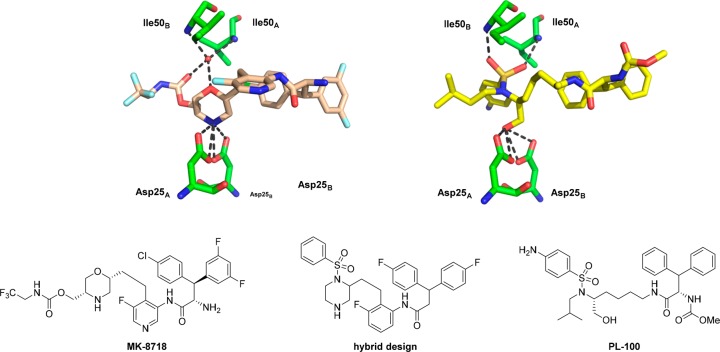
Hybrid design concept based on the binding modes of MK-8718
and PL-100 (PDB codes 5IVT and 2QMP).
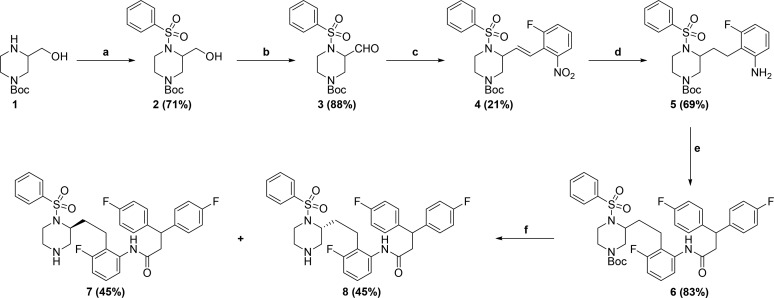
Reagents and conditions:
(a) PhSO2Cl, Hunig’s base, CH2Cl2, −78 °C to RT; (b) Dess–Martin periodinane,
CH2Cl2, 0 °C; (c) K2CO3, 18-crown-6, (2-nitrobenzyl)triphenylphosphonium bromide, DME, RT; (d) Pearlman’s catalyst, H2 balloon,
CF3CH2OH, RT; (e) 3,3-Bis(4-fluorophenyl)propanoic
acid, T3P, Hunig’s base, EtOAc, RT; (f) TFA, CH2Cl2, RT, then Chiralpak AD.
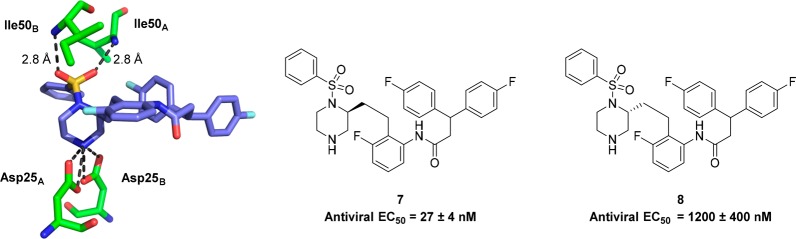
X-ray crystal
structure of 7 bound to HIV-1 protease showing hydrogen
bonding to Ile50A and Ile50B residues.
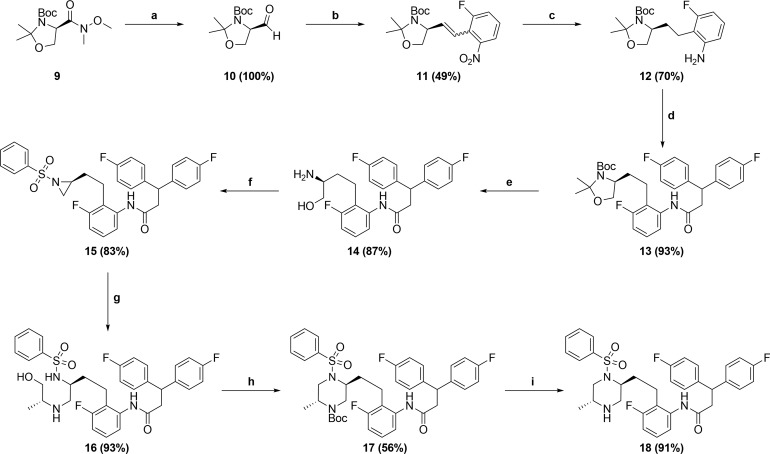
Reagents and conditions:
(a) LiAlH4, 2-Me-THF, 0 °C; (b) K2CO3, 18-crown-6, (2-nitrobenzyl)triphenylphosphonium bromide, DME, RT; (c) Pearlman’s catalyst, 50 psi H2, EtOAc/MeOH, RT; (d) 3,3-Bis(4-fluorophenyl)propanoic acid, T3P,
Hunig’s base, EtOAc, RT; (e) TFA, H2O, CH2Cl2; RT; (f) (i) PhSO2Cl, NEt3,
DMF, 0 °C; (ii) diazene-1,2-diylbismorpholinomethanone, PBu3, THF, RT; (g) (R)-2-aminopropan-1-ol, 1,2-DCE,
40 °C; (h) (i) Boc2O, NEt3, CH2Cl2, RT; (ii) diazene-1,2-diylbismorpholinomethanone,
PBu3, THF, RT; (i) TFA, CH2Cl2, RT.
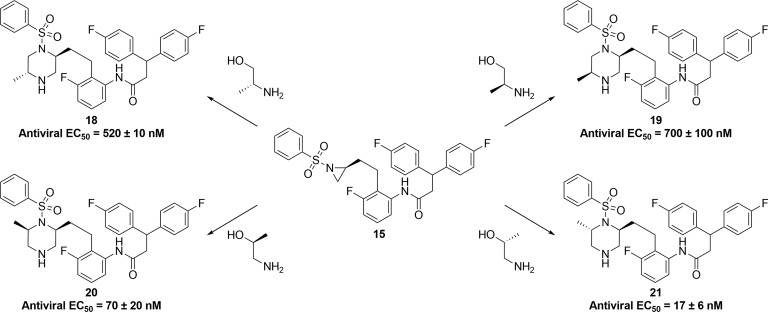
Antiviral activity (EC50) of analogues 18–21 formed
via amino alcohol opening of aziridine 15.
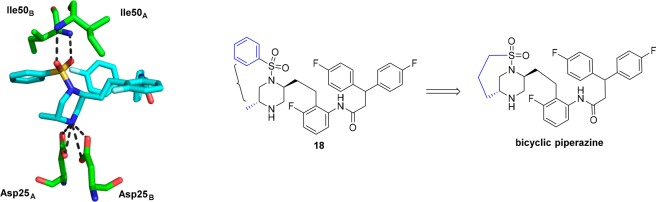
X-ray crystal structure of 18 bound to HIV-1 protease,
showing steric clash and leading to design of a bicyclic piperazine.
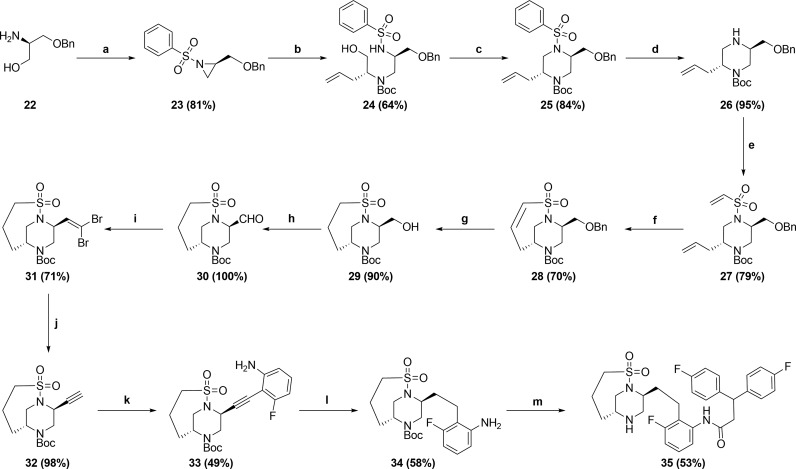
(a) (i) PhSO2Cl, NEt3, DMF, 0 °C; (ii) DIAD, PBu3,
THF, 0 °C; (b) (i) (R)-2-aminopent-4-en-1-ol,
THF, 45 °C; (ii) Boc2O, NEt3, CH3CN, 45 °C; (c) DIAD, PBu3, THF, RT; (d) Mg, MeOH,
sonication, RT; (e) 2-chloroethanesulfonyl chloride, NEt3, CH2Cl2, RT; (f) Zhan Catalyst-1B, 1,2-DCE,
50 °C; (g) Pearlman’s catalyst, H2 balloon,
EtOAc, RT; (h) Dess–Martin periodinane, CH2Cl2, RT; (i) PPh3, CBr4, CH2Cl2, RT; (j) EtMgBr, THF, 0 °C; (k) 3-fluoro-2-iodoaniline,
(PPh3)2PdCl2, CuI, NEt3, CH3CN, 70 °C; (l) Pearlman’s catalyst, H2 balloon, EtOH, RT; (m) (i) 3,3-Bis(4-fluorophenyl)propanoic
acid, T3P, Hunig’s base, EtOAc, RT; (ii) HCl, dioxane, RT.
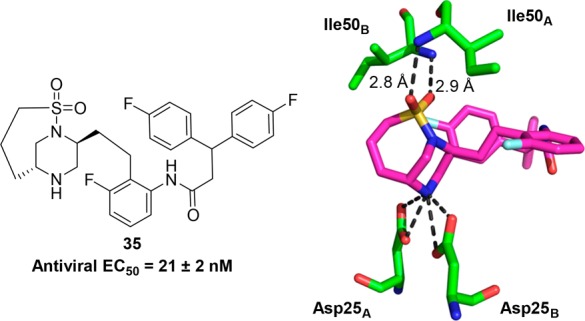
Antiviral activity (EC50) and X-ray crystal structure of 35 bound to
HIV-1 protease.
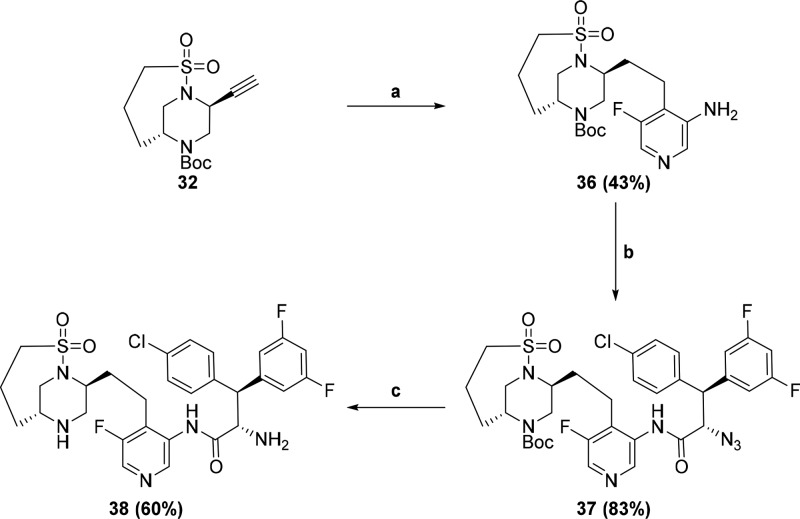
Reagents
and conditions: (a) (i) 5-fluoro-4-iodopyridin-3-amine, (PPh3)2PdCl2, CuI, NEt3, CH3CN, 70 °C; (ii) Pearlman’s catalyst, H2 balloon,
EtOH, RT; (b) (2S,3S)-2-azido-3-(4-chlorophenyl)-3-(3,5-difluorophenyl)propanoic
acid, POCl3, pyridine, 0 °C; (c) (i) PMe3, THF/H2O, 0 °C; (ii) HCl, dioxane/CH2Cl2, RT.
References
-
- Erickson-Viitanen S.; Manfredi J.; Viitanen P.; Tribe D. E.; Tritch R.; Hutchison C. A. 3rd; Loeb D. D.; Swanstrom R. Cleavage of HIV-1 gag polyprotein synthesized in vitro: sequential cleavage by the viral protease. AIDS Res. Hum. Retroviruses 1989, 5 (6), 577–91. 10.1089/aid.1989.5.577. - DOI - PubMed
-
- Bungard C. J.; Williams P. D.; Ballard J. E.; Bennett D. J.; Beaulieu C.; Bahnck-Teets C.; Carroll S. S.; Chang R. K.; Dubost D. C.; Fay J. F.; Diamond T. L.; Greshock T. J.; Hao L.; Holloway K. M.; Felock P. J.; Gesell J. J.; Su H.; Manikowski J. J.; McKay D. J.; Miller M.; Min X.; Molinaro C.; Moradei O. M.; Nantermet P. J.; Nadeau C.; Sanchez R. I.; Satyanarayana T.; Shipe W. D.; Sanjay S. K.; Truong V. L.; Vijayasaradhi S.; Wiscount C. M.; Vacca J. P.; Crane S. N.; McCauley J. A. Discovery of MK-8718, an HIV-1 protease inhibitor containing a novel morpholine aspartate binding group. ACS Med. Chem. Lett. 2016, 7 (7), 702–707. 10.1021/acsmedchemlett.6b00135. - DOI - PMC - PubMed
LinkOut - more resources
Full Text Sources
Other Literature Sources
Chemical Information
