Review
. 2017:2017:7082696.
doi: 10.1155/2017/7082696. Epub 2017 Nov 13.

mTOR-Dependent Cell Proliferation in the Brain

Affiliations
Review

mTOR-Dependent Cell Proliferation in the Brain

Larisa Ryskalin et al. Biomed Res Int. 2017.

Abstract

The mammalian Target of Rapamycin (mTOR) is a molecular complex equipped with kinase activity which controls cell viability being key in the PI3K/PTEN/Akt pathway. mTOR acts by integrating a number of environmental stimuli to regulate cell growth, proliferation, autophagy, and protein synthesis. These effects are based on the modulation of different metabolic pathways. Upregulation of mTOR associates with various pathological conditions, such as obesity, neurodegeneration, and brain tumors. This is the case of high-grade gliomas with a high propensity to proliferation and tissue invasion. Glioblastoma Multiforme (GBM) is a WHO grade IV malignant, aggressive, and lethal glioma. To date, a few treatments are available although the outcome of GBM patients remains poor. Experimental and pathological findings suggest that mTOR upregulation plays a major role in determining an aggressive phenotype, thus determining relapse and chemoresistance. Among several activities, mTOR-induced autophagy suppression is key in GBM malignancy. In this article, we discuss recent evidence about mTOR signaling and its role in normal brain development and pathological conditions, with a special emphasis on its role in GBM.


Figures
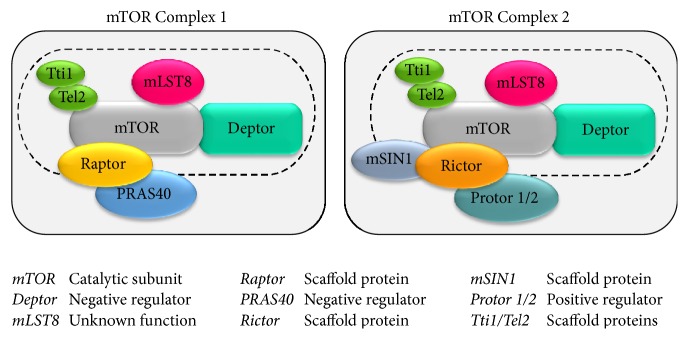
Figure 1
Figure 1
mTOR structure and components. In mammals, the mTOR kinase interacts with several proteins to form two functionally distinct multiprotein complexes, namely, mTOR Complex 1 (mTORC1) and mTOR Complex 2 (mTORC2). The dashed line indicates the components shared between mTORC1 and mTORC1.
Figure 2
Figure 2
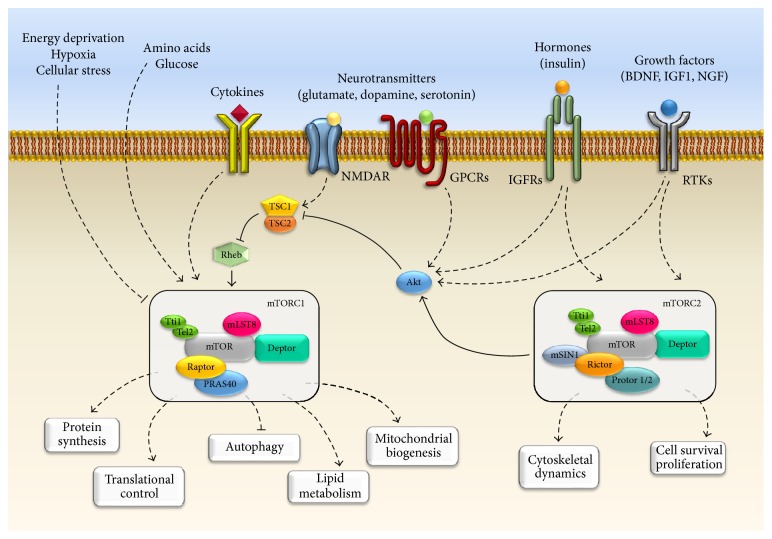
mTOR signaling in neurons. The cartoon summarizes the main pathways placed both upstream and downstream to mTOR. The activation of mTORC1 is elicited by a variety of upstream signaling molecules such as growth factors (e.g., BDNF, NGF, and IGF1), hormones (e.g., insulin), and amino acids and neurotransmitters (e.g., glutamate) via the stimulation of various receptors. These include RTKs (Receptor tyrosine kinases), GPCRs (G-protein coupled receptors), channel receptors, and cytokines receptors. Conversely, stimulation of NMDA receptor decreases mTOR activity. Even hypoxia and energy defect enhance TSC complex activity, which in turn leads to mTOR inhibition. The main downstream effects of mTORC1 are reported. Classically mTORC1 activates protein synthesis, translation, lipid biogenesis, and mitochondrial biogenesis, while autophagy is under the negative control of mTORC1. In contrast, mTORC2 is not sensitive to nutrients and it is mostly activated by growth factors and hormones to control cell survival and cytoskeletal organization.
Figure 3
Figure 3
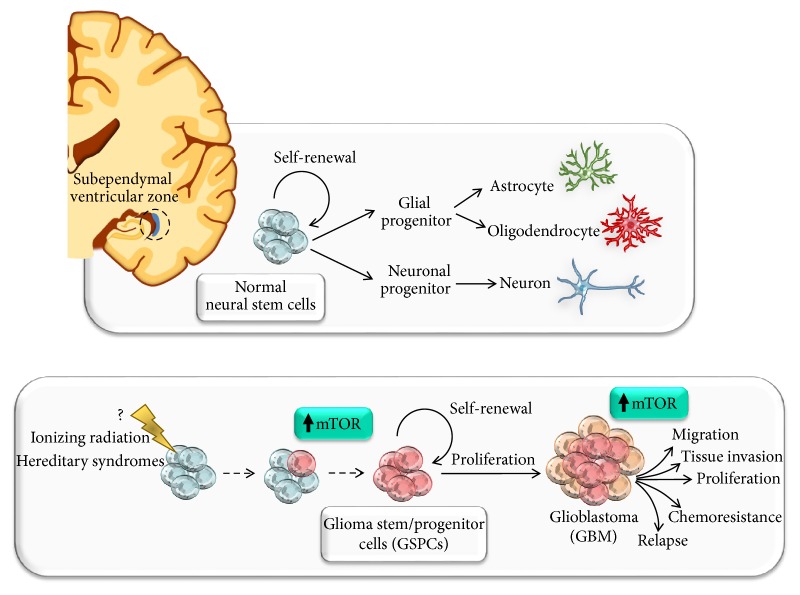
The role of mTOR signaling in Glioma Stem/Progenitor Cells (GSPCs). mTOR is involved in neural stem cells (NSCs) proliferation, migration, differentiation, axonal and dendritic development, synaptic plasticity, learning, and memory storage. Aberrant mTOR signaling alters neural development and produces brain malformations in a wide spectrum of neurological disorders including neurodegeneration and brain tumors. In fact, mTOR governs the proliferation and maintenance of NSCs within normal CNS. These stem cell niches are placed within the subependymal ventricular zone of cornu temporalis nearby the cornu ammonis and dentatus gyrus of hippocampus. Several reports demonstrate that a fine spatiotemporal tuning of mTOR expression in the forebrain is essential for normal brain physiology and development. Thus, enhanced activation of mTOR may lead to brain malformation and neurodevelopmental disorders. In GBM, Glioma Stem/Progenitor Cells (GSPCs), which represent the amplification of normal stem cell niches, have been reported to support microvascular proliferation and to promote infiltration into the surrounding tissues. Moreover, these cells are key for GBM progression, radio- and chemoresistance and recurrence. Among several pathways which have been implicated in the maintenance and viability of GSPCs population, the marked upregulation of mTOR is key in fostering cancer stem cells self-renewal and malignant phenotype.

References

    1. Laplante M., Sabatini D. M. MTOR signaling in growth control and disease. Cell. 2012;149(2):274–293. doi: 10.1016/j.cell.2012.03.017. - DOI - PMC - PubMed
    1. Vézina C., Kudelski A., Sehgal S. N. Rapamycin (AY 22,989), a new antifungal antibiotic. I. Taxonomy of the producing streptomycete and isolation of the active principle. The Journal of Antibiotics. 1975;28(10):721–726. doi: 10.7164/antibiotics.28.721. - DOI - PubMed
    1. Sehgal S. N. Sirolimus: its discovery, biological properties, and mechanism of action. Transplantation Proceedings. 2003;35(3):7S–14S. doi: 10.1016/S0041-1345(03)00211-2. - DOI - PubMed
    1. Brown E. J., Albers M. W., Ichikawa K., Keith C. T., Lane W. S., Schreiber S. L. A mammalian protein targeted by G1-arresting rapamycin-receptor complex. Nature. 1994;369(6483):756–758. doi: 10.1038/369756a0. - DOI - PubMed
    1. Liu B., Cheng Y., Liu Q., Bao J., Yang J. Autophagic pathways as new targets for cancer drug development. Acta Pharmacologica Sinica. 2010;31(9):1154–1164. doi: 10.1038/aps.2010.118. - DOI - PMC - PubMed

MeSH terms