Review
. 2017 Dec 20;18(12):2774.
doi: 10.3390/ijms18122774.

Molecular Determinants of Malignant Brain Cancers: From Intracellular Alterations to Invasion Mediated by Extracellular Vesicles

Affiliations
Review

Molecular Determinants of Malignant Brain Cancers: From Intracellular Alterations to Invasion Mediated by Extracellular Vesicles

Gabriella Schiera et al. Int J Mol Sci. .

Abstract

Malignant glioma cells invade the surrounding brain parenchyma, by migrating along the blood vessels, thus promoting cancer growth. The biological bases of these activities are grounded in profound alterations of the metabolism and the structural organization of the cells, which consequently acquire the ability to modify the surrounding microenvironment, by altering the extracellular matrix and affecting the properties of the other cells present in the brain, such as normal glial-, endothelial- and immune-cells. Most of the effects on the surrounding environment are probably exerted through the release of a variety of extracellular vesicles (EVs), which contain many different classes of molecules, from genetic material to defined species of lipids and enzymes. EV-associated molecules can be either released into the extracellular matrix (ECM) and/or transferred to neighboring cells: as a consequence, both deep modifications of the recipient cell phenotype and digestion of ECM components are obtained, thus causing cancer propagation, as well as a general brain dysfunction. In this review, we first analyze the main intracellular and extracellular transformations required for glioma cell invasion into the brain parenchyma; then we discuss how these events may be attributed, at least in part, to EVs that, like the pawns of a dramatic chess game with cancer, open the way to the tumor cells themselves.

Keywords: ECM; brain cancer invasion; extracellular RNAs; extracellular vesicles (EVs); glioma cells.


Conflict of interest statement

The authors declare no conflict of interest.

Figures
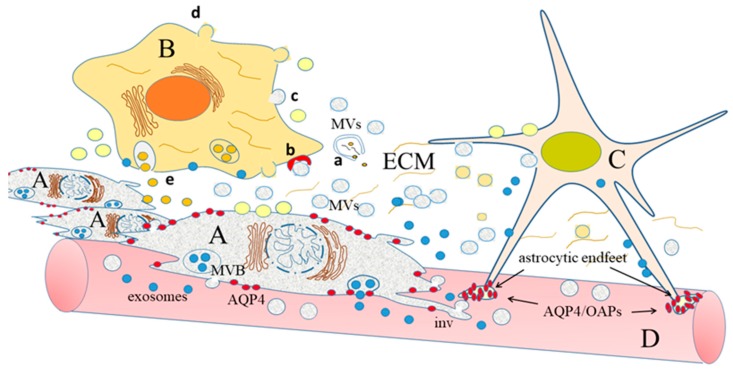
Figure 1
Figure 1
Cross-talk between glioma cells (A) and other cells (B,C), embedded in the extracellular matrix (ECM). The glioma cells have acquired the ability to move through the brain parenchyma, along the blood vessels (D), in small groups (guerrilla war) [23]; their invasiveness is mostly due to the extension of invadopodia (inv) and to the release of different kinds of extracellular vesicles: (i) membrane vesicles (MVs), light grey, which originate by directly budding from the plasma membrane and (ii) exosomes, blue, which are released after fusion with the plasma membrane of multivesicular bodies (MVB), components of the endosomal compartment. Both kinds of vesicles are equipped with different molecules (lipids, proteins and RNAs od different classes), which can be directly released into ECM if the vesicles break outside the cells (a). Alternatively, EVs can be bound by receptors present on the recipient cells (b), or fuse with the plasma membrane of these cells (c). Cells that receive information from glioma cells can, in turn, produce MVs, light yellow (d) and exosomes, dark yellow (e), which contain factors able to further stimulate glioma cell proliferation and invasion. In a normal astrocyte (C) AQP4 forms orthogonal arrays of particles (OAPs), localized in the cell endfeet (groups of small ovals drawn in red). In the glioma cell, AQP4 (red circles) is neither included in OAPs, nor localized; in addition, AQP4 levels are upregulated.

References

    1. Jovčevska I., Kočevar N., Komel R. Glioma and glioblastoma-how much do we (not) know? Mol. Clin. Oncol. 2013;1:935–941. doi: 10.3892/mco.2013.172. - DOI - PMC - PubMed
    1. Sampetrean O., Saya H. Modeling phenotypes of malignant gliomas. Cancer Sci. 2017 doi: 10.1111/cas.13351. - DOI - PMC - PubMed
    1. Chen R., Pan Y., Gutmann D.H. The power of the few. Genes Dev. 2017;31:1177–1179. doi: 10.1101/gad.303453.117. - DOI - PMC - PubMed
    1. Fuller G.N., Scheithauer B.W. The 2007 revised World Health Organization (WHO) classification of tumors of the central nervous system: Newly codified entities. Brain Pathol. 2007;17:304–307. doi: 10.1111/j.1750-3639.2007.00084.x. - DOI - PMC - PubMed
    1. Louis D.N., Ohgaki H., Wiestler O.D., Cavenee W.K., Burger P.C., Jouvet A., Scheithauer B.W., Kleihues P. The 2007 WHO classification of tumors of the central nervous system. Acta Neuropathol. 2007;114:97–109. doi: 10.1007/s00401-007-0243-4. - DOI - PMC - PubMed

LinkOut - more resources
