


Oxygen Exposure Resulting in Arterial Oxygen Tensions Above the Protocol Goal Was Associated With Worse Clinical Outcomes in Acute Respiratory Distress Syndrome
- PMID: 29261565
- PMCID: PMC5851805
- DOI: 10.1097/CCM.0000000000002886
Oxygen Exposure Resulting in Arterial Oxygen Tensions Above the Protocol Goal Was Associated With Worse Clinical Outcomes in Acute Respiratory Distress Syndrome
Abstract
Objectives: High fractions of inspired oxygen may augment lung damage to exacerbate lung injury in patients with acute respiratory distress syndrome. Participants enrolled in Acute Respiratory Distress Syndrome Network trials had a goal partial pressure of oxygen in arterial blood range of 55-80 mm Hg, yet the effect of oxygen exposure above this arterial oxygen tension range on clinical outcomes is unknown. We sought to determine if oxygen exposure that resulted in a partial pressure of oxygen in arterial blood above goal (> 80 mm Hg) was associated with worse outcomes in patients with acute respiratory distress syndrome.
Design: Longitudinal analysis of data collected in these trials.
Setting: Ten clinical trials conducted at Acute Respiratory Distress Syndrome Network hospitals between 1996 and 2013.
Subjects: Critically ill patients with acute respiratory distress syndrome.
Interventions: None.
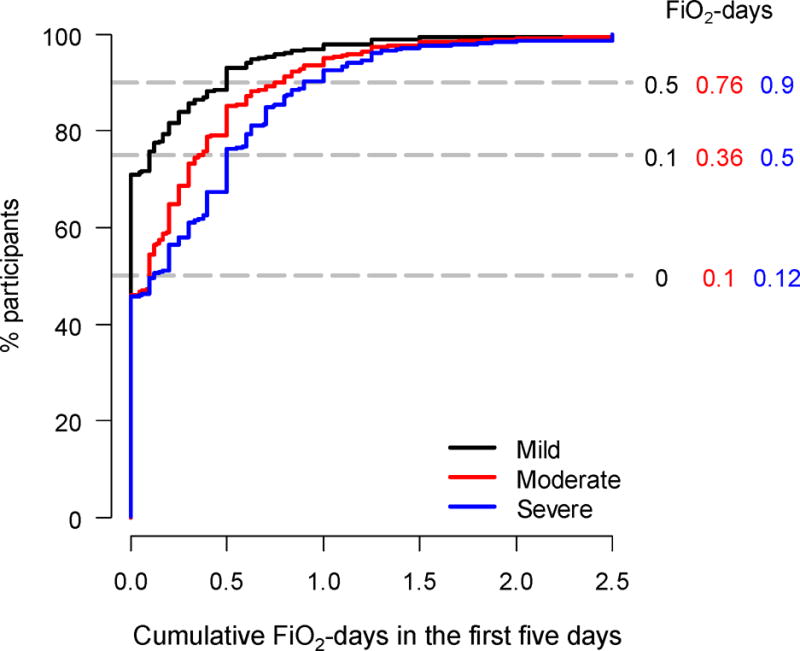
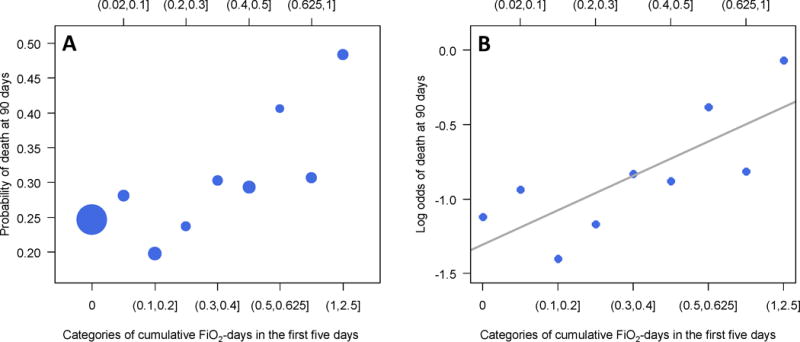
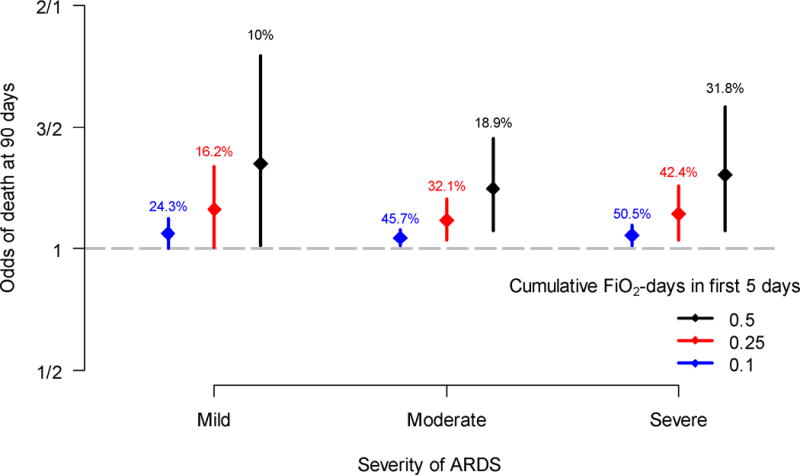
Measurements and main results: We defined above goal oxygen exposure as the difference between the fraction of inspired oxygen and 0.5 whenever the fraction of inspired oxygen was above 0.5 and when the partial pressure of oxygen in arterial blood was above 80 mm Hg. We then summed above goal oxygen exposures in the first five days to calculate a cumulative above goal oxygen exposure. We determined the effect of a cumulative 5-day above goal oxygen exposure on mortality prior to discharge home at 90 days. Among 2,994 participants (mean age, 51.3 yr; 54% male) with a study-entry partial pressure of oxygen in arterial blood/fraction of inspired oxygen that met acute respiratory distress syndrome criteria, average cumulative above goal oxygen exposure was 0.24 fraction of inspired oxygen-days (interquartile range, 0-0.38). Participants with above goal oxygen exposure were more likely to die (adjusted interquartile range odds ratio, 1.20; 95% CI, 1.11-1.31) and have lower ventilator-free days (adjusted interquartile range mean difference of -0.83; 95% CI, -1.18 to -0.48) and lower hospital-free days (adjusted interquartile range mean difference of -1.38; 95% CI, -2.09 to -0.68). We observed a dose-response relationship between the cumulative above goal oxygen exposure and worsened clinical outcomes for participants with mild, moderate, or severe acute respiratory distress syndrome, suggesting that the observed relationship is not primarily influenced by severity of illness.
Conclusions: Oxygen exposure resulting in arterial oxygen tensions above the protocol goal occurred frequently and was associated with worse clinical outcomes at all levels of acute respiratory distress syndrome severity.
Conflict of interest statement
The remaining authors have disclosed that they do not have any potential conflicts of interest.
Figures
Comment in
-
A Fine Balance for Oxygen in Acute Respiratory Distress Syndrome.Crit Care Med. 2018 Apr;46(4):646-647. doi: 10.1097/CCM.0000000000002910. Crit Care Med. 2018. PMID: 29538116 No abstract available.
-
Between hypoxia or hyperoxia: not perfect but more physiologic.J Thorac Dis. 2018 Jun;10(Suppl 17):S2052-S2054. doi: 10.21037/jtd.2018.05.129. J Thorac Dis. 2018. PMID: 30023116 Free PMC article. No abstract available.
-
Change is in the air: dying to breathe oxygen in acute respiratory distress syndrome?J Thorac Dis. 2018 Jul;10(Suppl 18):S2133-S2137. doi: 10.21037/jtd.2018.06.73. J Thorac Dis. 2018. PMID: 30123542 Free PMC article. No abstract available.
-
Supplemental oxygen or something else?J Thorac Dis. 2018 Sep;10(Suppl 26):S3211-S3214. doi: 10.21037/jtd.2018.08.06. J Thorac Dis. 2018. PMID: 30370115 Free PMC article. No abstract available.
References
-
- Force ADT. Ranieri VM, Rubenfeld GD, et al. Acute respiratory distress syndrome: the Berlin Definition. Jama. 2012;307(23):2526–2533. - PubMed
-
- Rubenfeld GD, Caldwell E, Peabody E, et al. Incidence and outcomes of acute lung injury. The New England journal of medicine. 2005;353(16):1685–1693. - PubMed
-
- Brun-Buisson C, Minelli C, Bertolini G, et al. Epidemiology and outcome of acute lung injury in European intensive care units. Results from the ALIVE study Intensive Care Med. 2004;30(1):51–61. - PubMed
-
- Estenssoro E, Dubin A, Laffaire E, et al. Incidence, clinical course, and outcome in 217 patients with acute respiratory distress syndrome. Crit Care Med. 2002;30(11):2450–2456. - PubMed
-
- Hudson LD, Milberg JA, Anardi D, et al. Clinical risks for development of the acute respiratory distress syndrome. Am J Respir Crit Care Med. 1995;151(2 Pt 1):293–301. - PubMed
Publication types
MeSH terms
Substances
Grants and funding
LinkOut - more resources
Full Text Sources
Other Literature Sources
Medical
Miscellaneous
