. 2017 Oct 12;8(61):102769-102782.
doi: 10.18632/oncotarget.21800. eCollection 2017 Nov 28.

PHIP - a novel candidate breast cancer susceptibility locus on 6q14.1

Xiang Jiao  1 Christos Aravidis  1   2 Rajeshwari Marikkannu  1 Johanna Rantala  1 Simone Picelli  1 Tatjana Adamovic  1 Tao Liu  1 Paula Maguire  1 Barbara Kremeyer  1 Liping Luo  1 Susanna von Holst  1 Vinaykumar Kontham  1 Jessada Thutkawkorapin  1 Sara Margolin  3 Quan Du  1 Johanna Lundin  1 Kyriaki Michailidou  4   5 Manjeet K Bolla  4 Qin Wang  4 Joe Dennis  4 Michael Lush  4 Christine B Ambrosone  6 Irene L Andrulis  7   8 Hoda Anton-Culver  9 Natalia N Antonenkova  10 Volker Arndt  11 Matthias W Beckmann  12 Carl Blomqvist  13 William Blot  14   15 Bram Boeckx  16   17 Stig E Bojesen  18   19   20 Bernardo Bonanni  21 Judith S Brand  22 Hiltrud Brauch  23   24   25 Hermann Brenner  11   25   26 Annegien Broeks  27 Thomas Brüning  28 Barbara Burwinkel  29   30 Qiuyin Cai  14 Jenny Chang-Claude  31   32 NBCS CollaboratorsFergus J Couch  33 Angela Cox  34 Simon S Cross  35 Sandra L Deming-Halverson  14 Peter Devilee  36   37 Isabel Dos-Santos-Silva  38 Thilo Dörk  39 Mikael Eriksson  22 Peter A Fasching  12   40 Jonine Figueroa  41   42 Dieter Flesch-Janys  43   44 Henrik Flyger  45 Marike Gabrielson  22 Montserrat García-Closas  42 Graham G Giles  46   47 Anna González-Neira  48 Pascal Guénel  49 Qi Guo  50 Melanie Gündert  29   30 Christopher A Haiman  51 Emily Hallberg  52 Ute Hamann  53 Patricia Harrington  54 Maartje J Hooning  55 John L Hopper  47 Guanmengqian Huang  53 Anna Jakubowska  56 Michael E Jones  57 Michael J Kerin  58 Veli-Matti Kosma  59   60   61 Vessela N Kristensen  62   63   64 Diether Lambrechts  16   17 Loic Le Marchand  65 Jan Lubinski  56 Arto Mannermaa  59   60   61 John W M Martens  55 Alfons Meindl  66 Roger L Milne  46   47 Anna Marie Mulligan  67   68 Susan L Neuhausen  69 Heli Nevanlinna  70 Julian Peto  38 Katri Pylkäs  71   72 Paolo Radice  73 Valerie Rhenius  54 Elinor J Sawyer  74 Marjanka K Schmidt  27   75 Rita K Schmutzler  76   77   78 Caroline Seynaeve  55 Mitul Shah  54 Jacques Simard  79 Melissa C Southey  80 Anthony J Swerdlow  57   81 Thérèse Truong  49 Camilla Wendt  3 Robert Winqvist  71   72 Wei Zheng  14 kConFab/AOCS InvestigatorsJavier Benitez  48   82 Alison M Dunning  54 Paul D P Pharoah  4   54 Douglas F Easton  4   54 Kamila Czene  22 Per Hall  22 Annika Lindblom  1
Affiliations

PHIP - a novel candidate breast cancer susceptibility locus on 6q14.1

Xiang Jiao et al. Oncotarget. .

Abstract

Most non-BRCA1/2 breast cancer families have no identified genetic cause. We used linkage and haplotype analyses in familial and sporadic breast cancer cases to identify a susceptibility locus on chromosome 6q. Two independent genome-wide linkage analysis studies suggested a 3 Mb locus on chromosome 6q and two unrelated Swedish families with a LOD >2 together seemed to share a haplotype in 6q14.1. We hypothesized that this region harbored a rare high-risk founder allele contributing to breast cancer in these two families. Sequencing of DNA and RNA from the two families did not detect any pathogenic mutations. Finally, 29 SNPs in the region were analyzed in 44,214 cases and 43,532 controls from BCAC, and the original haplotypes in the two families were suggested as low-risk alleles for European and Swedish women specifically. There was also some support for one additional independent moderate-risk allele in Swedish familial samples. The results were consistent with our previous findings in familial breast cancer and supported a breast cancer susceptibility locus at 6q14.1 around the PHIP gene.

Keywords: familial breast cancer; linkage analysis; risk haplotype; sequencing.


Conflict of interest statement

CONFLICTS OF INTEREST The authors declare that they have no competing interests.

Figures
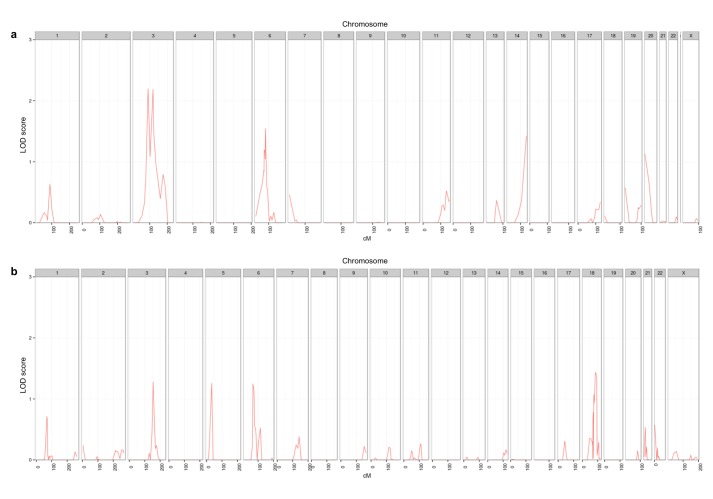
Figure 1
Figure 1. Linkage analysis revealed genomic regions with HLOD score above one in: a) families with moderate risk of breast cancer and b) High risk breast cancer families with other types of cancer
Figure 2
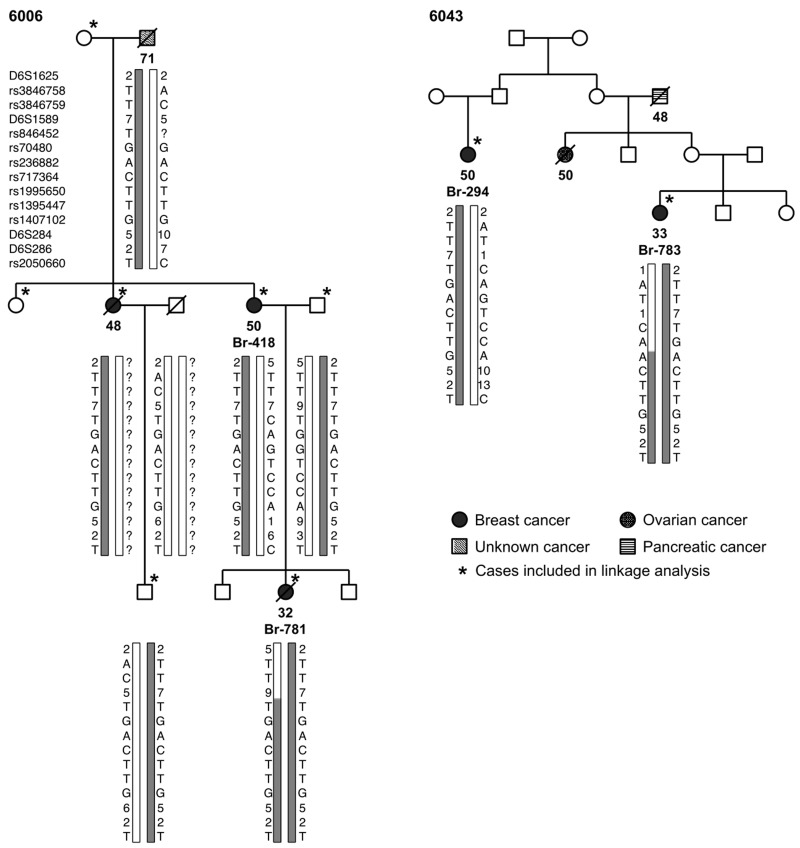
Figure 2. Pedigrees of the families 6006 and 6043 showing the haplotypes of selected family members (the families’ risk haplotype is indicated in grey shade)

References

    1. Lichtenstein P, Holm NV, Verkasalo PK, Iliadou A, Kaprio J, Koskenvuo M, Pukkala E, Skytthe A, Hemminki K. Environmental and heritable factors in the causation of cancer—analyses of cohorts of twins from Sweden, Denmark, and Finland. N Engl J Med. 2000;343:78–85. doi: 10.1056/NEJM200007133430201. - DOI - PubMed
    1. Nathanson KL, Wooster R, Weber BL. Breast cancer genetics: what we know and what we need. Nat Med. 2001;7:552–6. doi: 10.1038/87876. - DOI - PubMed
    1. Stratton MR, Rahman N. The emerging landscape of breast cancer susceptibility. Nat Genet. 2008;40:17–22. doi: 10.1038/ng.2007.53. - DOI - PubMed
    1. Lalloo F, Evans DG. Familial breast cancer. Clin Genet. 2012;82:105–14. doi: 10.1111/j.1399-0004.2012.01859.x. - DOI - PubMed
    1. Hall JM, Lee MK, Newman B, Morrow JE, Anderson LA, Huey B, King MC. Linkage of early-onset familial breast cancer to chromosome 17q21. Science. 1990;250:1684–9. - PubMed