Predictors of overall survival in metastatic castration-resistant prostate cancer patients receiving [177Lu]Lu-PSMA-617 radioligand therapy
- PMID: 29262549
- PMCID: PMC5732715
- DOI: 10.18632/oncotarget.21600
Predictors of overall survival in metastatic castration-resistant prostate cancer patients receiving [177Lu]Lu-PSMA-617 radioligand therapy
Abstract
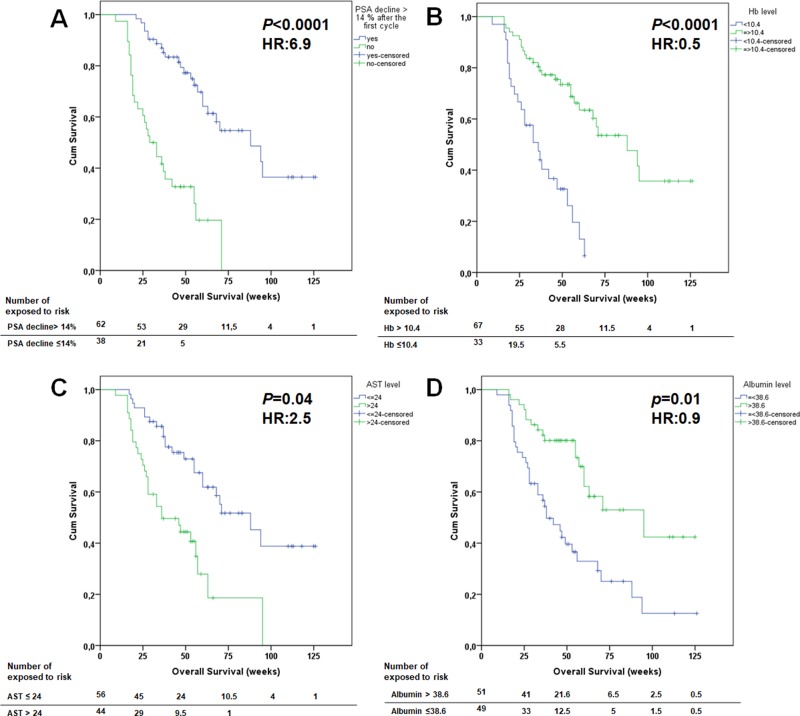
Prostate-specific membrane antigen (PSMA) is a promising target for the diagnosis of and therapy for metastatic castration-resistant prostate cancer (mCRPC). The aim of this study was to measure overall-survival (OS) in mCRPC patients who received either abiraterone or enzalutamide prior to PSMA therapy. The second aim of this study was to analyse the predictors of OS according to different pre-therapeutic parameters and also the responses to the first cycle of radioligand therapy (RLT) base on PSA level. Patients with mCRPC and a history of therapy with either abiraterone or enzalutamide or both, were included in this study. Different laboratory tests and pre-therapeutic parameters have been included into the analysis. One-hundred patients received a total of 347 cycles of Lu-PSMA (median: three cycles). 69 patients showed a decline in PSA two months after the first cycle, and 38 of those patients showed a PSA decline of = > 50%. The median OS was 60 weeks. In the multivariate analysis, the level of albumin, AST and haemoglobin, existence of liver metastases and a decline of > 14% in PSA level had a significant impact on overall-survival. The median OS is significantly longer in patients without hepatic involvement, with high levels of albumin and Hb and low levels of AST. A decline in PSA levels of more than 14% was the most important response parameter with regard to overall survival.
Keywords: 177Lu; PSMA; overall survival; prostate cancer; radioligand therapy.
Conflict of interest statement
CONFLICTS OF INTEREST The authors declare that they have no financial or nonfinancial competing interests.
Figures

References
-
- Afshar-Oromieh A, Hetzheim H, Kratochwil C, Benesova M, Eder M, Neels OC, Eisenhut M, Kubler W, Holland-Letz T, Giesel FL, Mier W, Kopka K, Haberkorn U. The Theranostic PSMA Ligand PSMA-617 in the Diagnosis of Prostate Cancer by PET/CT: Biodistribution in Humans, Radiation Dosimetry, and First Evaluation of Tumor Lesions. J Nucl Med. 2015;56:1697–1705. - PubMed
-
- Afshar-Oromieh A, Malcher A, Eder M, Eisenhut M, Linhart HG, Hadaschik BA, Holland-Letz T, Giesel FL, Kratochwil C, Haufe S, Haberkorn U, Zechmann CM. PET imaging with a [68Ga] gallium-labelled PSMA ligand for the diagnosis of prostate cancer: biodistribution in humans and first evaluation of tumour lesions. Eur J Nucl Med Mol Imaging. 2013;40:486–495. - PubMed
-
- Rai BP, Baum RP, Patel A, Hughes R, Alonzi R, Lane T, Adshead J, Vasdev N. The Role of Positron Emission Tomography With (68) Gallium (Ga)-Labeled Prostate-specific Membrane Antigen (PSMA) in the Management of Patients With Organ-confined and Locally Advanced Prostate Cancer Prior to Radical Treatment and After Radical Prostatectomy. Urology. 2016;95:11–15. - PubMed
-
- Ahmadzadehfar H, Azgomi K, Hauser S, Wei X, Yordanova A, Gaertner FC, Kurpig S, Strunk H, Essler M. 68Ga-PSMA-11 PET as a Gatekeeper for the Treatment of Metastatic Prostate Cancer with 223Ra: Proof of Concept. J Nucl Med. 2017;58:438–444. - PubMed
-
- Braat A, Ahmadzadehfar H. Lutetium-177 labelled PSMA ligands for the treatment of metastatic castrate-resistant prostate cancer. Tijdschr Nucl Geneesk. 2016;38:1627–1634.
LinkOut - more resources
Full Text Sources
Other Literature Sources
Research Materials
Miscellaneous