


GEJ cancers: gastric or esophageal tumors? searching for the answer according to molecular identity
- PMID: 29262640
- PMCID: PMC5732806
- DOI: 10.18632/oncotarget.22216
GEJ cancers: gastric or esophageal tumors? searching for the answer according to molecular identity
Abstract
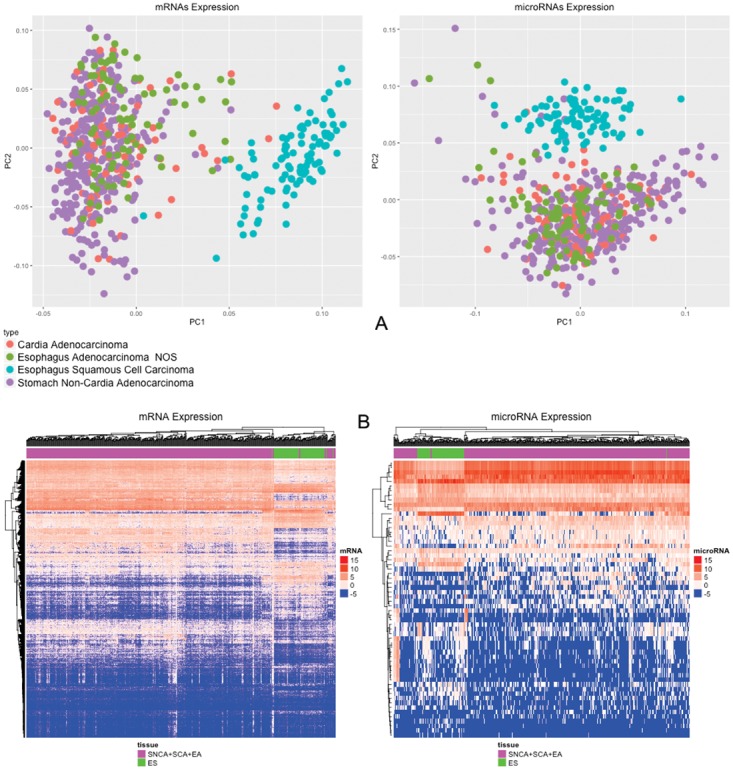
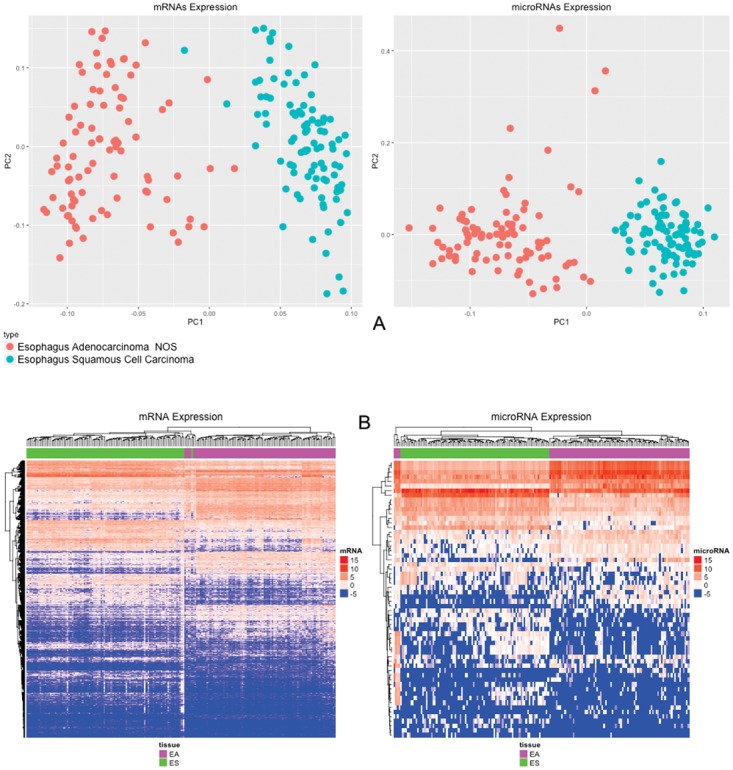
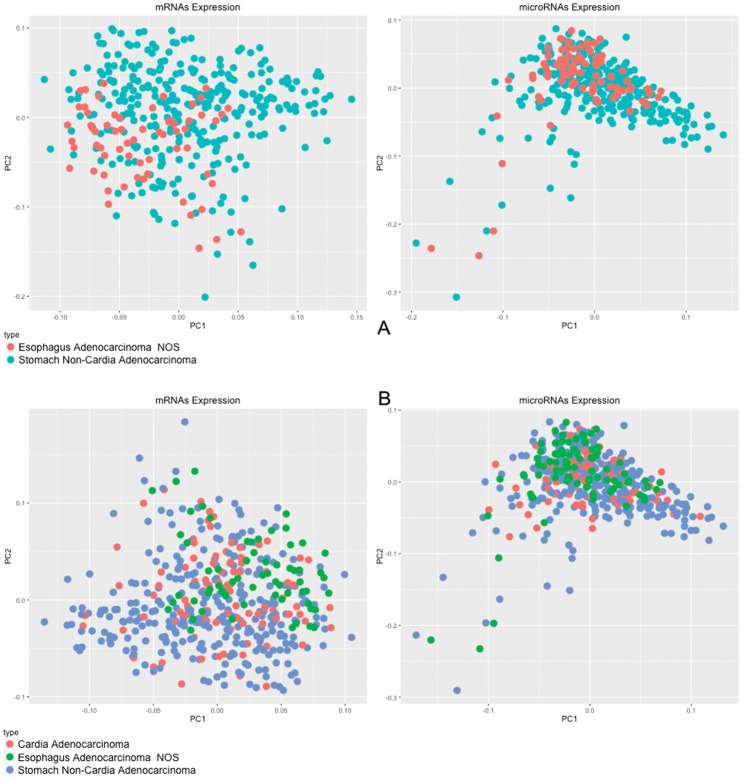
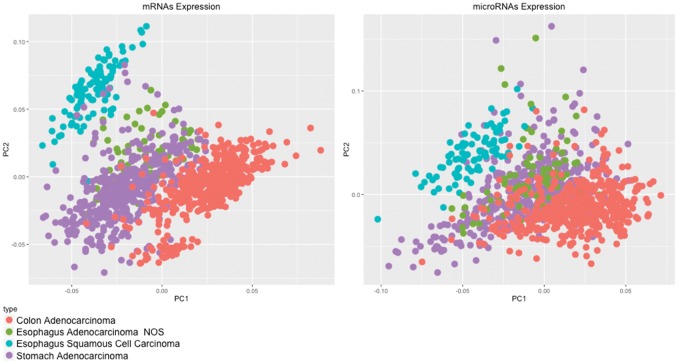
The 7th edition of Union for International Cancer Control (UICC) staging system moved gastroesophageal junction (GEJ) cancers from gastric to esophageal group. Since clinical management is strongly influenced by this staging system, we looked at molecular fingerprints of GEJ tumors and compared to gastric and esophageal profiles. We aimed at elucidating whether GEJ cancers cluster with gastric or esophageal groups according to mRNA and microRNA expression pattern, since this might represent tumor identity. The clinical and expression data were downloaded from The Cancer Genome Atlas (TCGA) with 395 stomach, 184 esophagus and 521 colon samples for mRNA analyses and 392 stomach, 175 esophagus and 459 colon samples for microRNA comparisons. Both Principal Component Analysis (PCA) and Heat Map plots were performed in R platform, using Log2 transformation of RPKM normalized data. Differential Expression Analysis was also performed in R, using RAW data and the DESeq2 package. The mRNAs and microRNAs were tagged as differentially expressed if they met the following criteria: i) FDR adjusted p-value < 0.05; and ii) |Log2 (fold-change)| > 2. Esophagus squamous cell carcinoma (ESCC) clustered apart of the others tumors, while adenocarcinomas (AC) clustered all together according to both mRNAs and microRNAs expression patterns. The HMs of the differentially expressed mRNAs and microRNAs also demonstrated that ESCC belongs to a different group, while AC molecular signature of esophagus looks like AC of the cardia and non cardia regions. Even distal gastric cancers are quite similar to AC of the lower esophagus, demonstrating that esophagus AC relies much closer to gastric cancers than to esophagus cancers. By using robust molecular fingerprints, it was strongly demonstrated that GEJ tumors looks more like gastric cancers than esophageal cancers, despite of tumor heterogeneity.
Keywords: 7th UICC; TCGA; expression pattern; gastroesophageal junction; molecular fingerprints.
Conflict of interest statement
CONFLICTS OF INTEREST The authors declare that they have no conflicts of interest.
Figures
References
-
- Sobin LH, Compton CC. TNM seventh edition: what’s new, what's changed. Cancer. 2010;116:5336–9. https://doi.org/10.1002/cncr.25537. - DOI - PubMed
-
- Rice TW, Rusch VW, Apperson-Hansen C, Allen MS, Chen LQ, Hunter JG, Kesler KA, Law S, Lerut TE, Reed CE, Salo JA, Scott WJ, Swisher SG, et al. Worldwide esophageal cancer collaboration. Dis Esophagus. 2009;22:1–8. https://doi.org/10.1111/j.1442-2050.2008.00901.x. - DOI - PubMed
-
- Talsma K, van Hagen P, Grotenhuis BA, Steyerberg EW, Tilanus HW, van Lanschot JJ, Wijnhoven BP. Comparison of the 6th and 7th editions of the UICC-AJCC TNM classification for esophageal cancer. Ann Surg Oncol. 2012;19:2142–8. https://doi.org/10.1245/s10434-012-2218-5. - DOI - PMC - PubMed
-
- Lü F, Xue Q, Shao K, Mao YS, Gao SG, Mu JW, Tan FW, Cheng GY, He J. Preliminary experience of clinical applications of the 7th UICC-AJCC TNM staging system of esophageal carcinoma. Zhonghua Zhong Liu Za Zhi. 2012;34:461–4. https://doi.org/10.3760/cma.j.issn.0253-3766.2012.06.013. - DOI - PubMed
-
- Suh YS, Han DS, Kong SH, Lee HJ, Kim YT, Kim WH, Lee KU, Yang HK. Should adenocarcinoma of the esophagogastric junction be classified as esophageal cancer? A comparative analysis according to the seventh AJCC TNM classification. Ann Surg. 2012;255:908–15. https://doi.org/10.1097/SLA.0b013e31824beb95. - DOI - PubMed
LinkOut - more resources
Full Text Sources
Other Literature Sources
Molecular Biology Databases
Miscellaneous
