


Antimicrobial Activity of Dalbavancin against Staphylococcus aureus with Decreased Susceptibility to Glycopeptides, Daptomycin, and/or Linezolid from U.S. Medical Centers
- PMID: 29263077
- PMCID: PMC5826162
- DOI: 10.1128/AAC.02397-17
Antimicrobial Activity of Dalbavancin against Staphylococcus aureus with Decreased Susceptibility to Glycopeptides, Daptomycin, and/or Linezolid from U.S. Medical Centers
Abstract
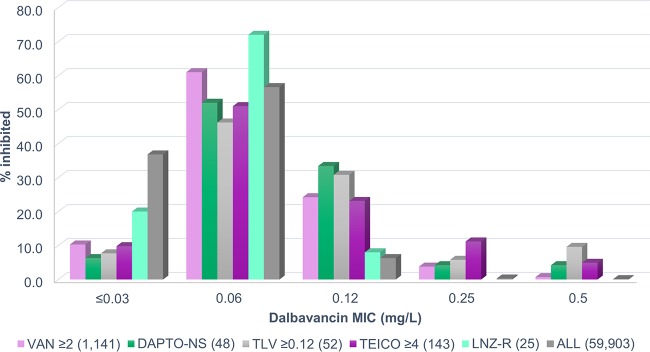
Dalbavancin activity was assessed against a large collection of Staphylococcus aureus isolates (n = 59,903), including isolates with decreased susceptibility to vancomycin (MIC, ≥2 mg/liter; n = 1,141), daptomycin (MIC, ≥2 mg/liter; n = 48), telavancin (MIC, ≥0.12 mg/liter; n = 52), teicoplanin (MIC, ≥4 mg/liter; n = 143), and/or linezolid (MIC, ≥8 mg/liter; n = 25). Dalbavancin displayed susceptibility rates ranging from 90.4% (isolates with telavancin MIC ≥0.12 mg/liter) to 100.0% (linezolid-resistant isolates) and lower MIC values than the comparators against these resistant subsets.
Keywords: glycopeptides; lipoglycopeptides; vancomycin-intermediate S. aureus.
Copyright © 2018 American Society for Microbiology.
Figures
References
-
- Bal AM, David MZ, Garau J, Gottlieb T, Mazzei T, Scaglione F, Tattevin P, Gould IM. 2017. Future trends in the treatment of methicillin-resistant Staphylococcus aureus (MRSA) infection: an in-depth review of newer antibiotics active against an enduring pathogen. J Glob Antimicrob Resist 10:295–303. doi: 10.1016/j.jgar.2017.05.019. - DOI - PubMed
-
- Weiner LM, Webb AK, Limbago B, Dudeck MA, Patel J, Kallen AJ, Edwards JR, Sievert DM. 2016. Antimicrobial-resistant pathogens associated with healthcare-associated infections: summary of data reported to the National Healthcare Safety Network at the Centers for Disease Control and Prevention, 2011–2014. Infect Control Hosp Epidemiol 37:1288–1301. doi: 10.1017/ice.2016.174. - DOI - PMC - PubMed
-
- Sader HS, Mendes RE, Streit JM, Flamm RK. 2017. Antimicrobial susceptibility trends among Staphylococcus aureus from U.S. hospitals: results from 7 years of the ceftaroline (AWARE) surveillance program, 2010 to 2016. Antimicrob Agents Chemother 61:e01043. doi: 10.1128/AAC.01043-17. - DOI - PMC - PubMed
Publication types
MeSH terms
Substances
LinkOut - more resources
Full Text Sources
Other Literature Sources
Medical
