. 2017 Oct 16:2:28.
doi: 10.1038/s41541-017-0029-1. eCollection 2017.

Protective efficacy of a novel simian adenovirus vaccine against lethal MERS-CoV challenge in a transgenic human DPP4 mouse model

Affiliations

Protective efficacy of a novel simian adenovirus vaccine against lethal MERS-CoV challenge in a transgenic human DPP4 mouse model

Vincent J Munster et al. NPJ Vaccines. .

Abstract

Middle East respiratory syndrome coronavirus (MERS-CoV) is a novel zoonotic virus that causes severe respiratory disease in humans with a case fatality rate close to 40%, but for which no vaccines are available. Here, we evaluated the utility of ChAdOx1, a promising replication-deficient simian adenovirus vaccine vector platform with an established safety profile in humans and dromedary camels, for MERS-CoV vaccine development. Using a transgenic lethal BALB/c MERS-CoV mouse model we showed that single dose intranasal or intramuscular immunisation with ChAdOx1 MERS, encoding full-length MERS-CoV Spike glycoprotein, is highly immunogenic and confers protection against lethal viral challenge. Immunogenicity and efficacy were comparable between immunisation routes. Together these data provide support for further evaluation of ChAdOx1 MERS vaccine in humans and dromedary camels, the animal reservoir of infection.


Conflict of interest statement

S.C.G. is a co-founder of, consultant to and shareholder in Vaccitech plc, which is developing a vectored MERS vaccine. Remaining authors declares that they have no competing financial interests.

Figures
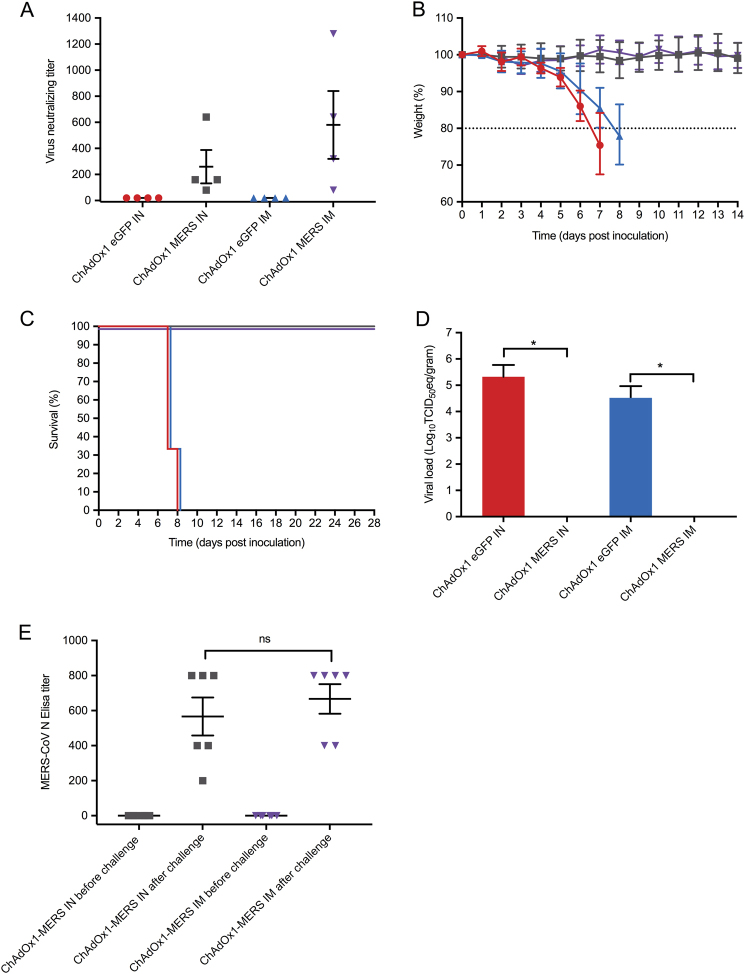
Fig. 1
Fig. 1
Protective Efficacy of ChAdOx1 MERS vaccine. Groups of 10 mice were vaccinated with 108 Infectious Units (IU) ChAdOx1 eGFP or ChAdOx1 MERS via the intranasal or intramuscular route, blood samples were collected before vaccination, and before challenge at 28 days post vaccination. hDPP4 mice were challenged intranasally with 104 TCID50 MERS-CoV (strain HCoV-EMC2012), four animals of each group were euthanized at 3 days post inoculation for serological, virological and histopathological analyses. All analyses were performed in duplicate. a Neutralising antibody titre of hDPP4 mouse serum samples against MERS-CoV strain HCoV-EMC/2012 after vaccination (n = 4 per group). b Weight loss after intranasal challenge with 104 TCID50 MERS-CoV, (n = 6 per group). c Survival curves of the vaccinated groups (n = 6 per group). d Mean ± SD of MERS-CoV viral loads in the lower respiratory tract of vaccinated hDPP4 mice at 3 dpi (n =  4 per group). e Nucleocapsid ELISA responses (n =  6 per group). All experimental procedures were performed as previously described. Red = ChAdOx1 eGFP intranasally vaccinated animals; Grey = ChAdOx1 MERS intranasally vaccinated animals; Blue = ChAdOx1 eGFP intramuscularly vaccinated animals; Purple = ChAdOx1 MERS intramuscularly vaccinated animals
Fig. 2
Fig. 2
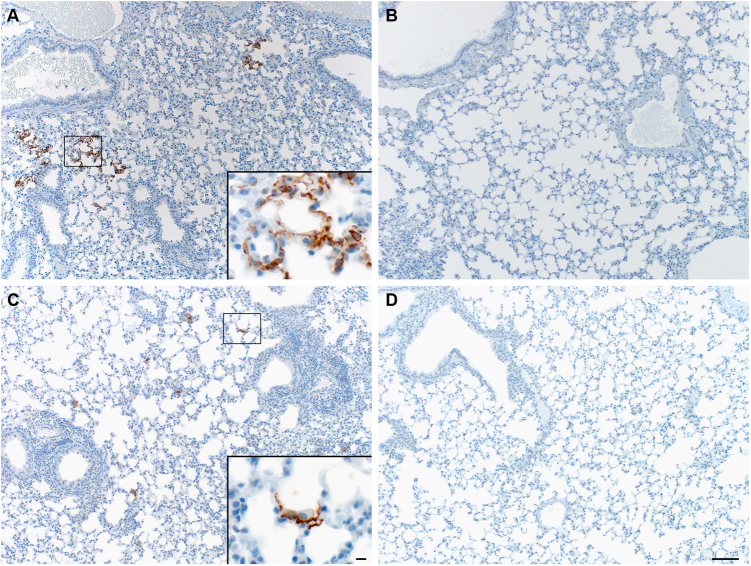
Immunohistochemistry staining for MERS-CoV antigen in the lower respiratory tract of vaccinated hDPP4 mice. hDPP4 mouse tissues were evaluated for pathology and the presence of viral antigen as described previously. Briefly, tissues were fixed in 10% neutral-buffered formalin for 7 days and paraffin-embedded. Tissue sections were stained with hematoxylin and eosin (H&E). An in-house produced rabbit polyclonal antiserum against HCoV-EMC/2012 (1:1000) was used as a primary antibody for the detection of viral antigen. Grading of histopathology and immunohistochemistry was done blinded by a board-certified veterinary pathologist. Lung tissues are shown at 100 and 1000× (insert) magnification. ChAdOx1 eGFP intranasally (a) and intramuscularly (c) vaccinated animals show multifocal scattered positivity in the lungs. The inserts display MERS-CoV antigen within the Type I and II pneumocytes. ChAdOx1 MERS intranasally (b) and intramuscularly (d) vaccinated animals showed no MERS-CoV antigen positivity

References

    1. Arabi YM, et al. Middle East respiratory syndrome. N. Engl. J. Med. 2017;376:584–594. doi: 10.1056/NEJMsr1408795. - DOI - PMC - PubMed
    1. Oboho IK, et al. 2014 MERS-CoV outbreak in Jeddah--a link to health care facilities. N. Engl. J. Med. 2015;372:846–854. doi: 10.1056/NEJMoa1408636. - DOI - PMC - PubMed
    1. Reusken CB, et al. Geographic distribution of MERS coronavirus among dromedary camels, Africa. Emerg. Infect. Dis. 2014;20:1370–1374. doi: 10.3201/eid2008.140590. - DOI - PMC - PubMed
    1. Modjarrad K, et al. A roadmap for MERS-CoV research and product development: report from a World Health Organization consultation. Nat. Med. 2016;22:701–705. doi: 10.1038/nm.4131. - DOI - PMC - PubMed
    1. Ewer KJ, et al. Viral vectors as vaccine platforms: from immunogenicity to impact. Curr. Opin. Immunol. 2016;41:47–54. doi: 10.1016/j.coi.2016.05.014. - DOI - PubMed