


Arthroscopic repair for subacromial incarceration of a torn rotator cuff
- PMID: 29264246
- PMCID: PMC5730653
- DOI: 10.1016/j.asmart.2015.04.001
Arthroscopic repair for subacromial incarceration of a torn rotator cuff
Abstract
Background/objective: Rotator cuff tears are common shoulder injuries. Various forms of rotator cuff tears are observed by arthroscopy. Inverted flap tears of the rotator cuff, however, also occur. The aim of the present study was to determine the preoperative characteristics of inverted torn cuffs and clinical outcomes after arthroscopic repair.
Methods: Seventeen patients (10 men, 7 women; mean age, 65.8 years; age range, 41-80 years) who underwent arthroscopic rotator cuff repair for an inverted flap tear participated in the study. The mean follow-up period was 31.8 months (range, 24-61 months). The preoperative history, radiographs, magnetic resonance images, tear pattern of the rotator cuff, preoperative and postoperative University of California Los Angeles (UCLA) rating scale, and postoperative repair integrity were assessed.
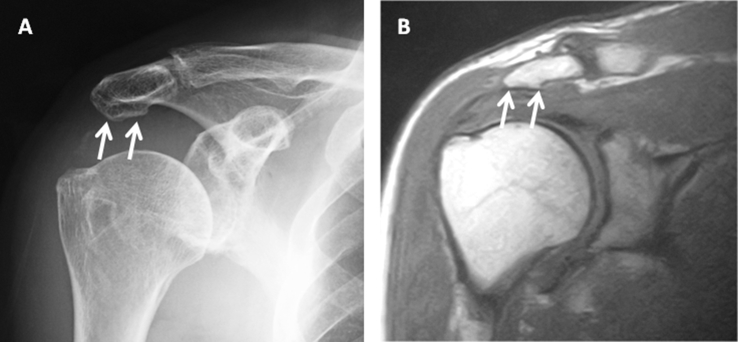
Results: Only two patients had acute episodes of aggravated shoulder pain. In radiographs, the anteroposterior view revealed a heel-type acromion in 8/17 (47.1%) patients with an inverted flap tear compared with 27/345 (7.8%) patients with ordinary retracted tears (p < 0.001). The supraspinatus tendon was incarcerated in all cases. The UCLA score increased from 11.9 ± 2.7 points to 32.5 ± 2.1 points postoperatively (p = 0.002). Postoperative magnetic resonance images at 12 months after surgery showed good repair integrity in all cases.
Conclusion: Arthroscopic reduction and repair are applicable for inverted flap tears of the rotator cuff. The findings of the present study indicated that patients with a heel-type acromion in the anteroposterior view of radiographs are at greater risk for inverted flap tears of the rotator cuff.
Keywords: arthroscopy; inverted flap tear; rotator cuff tear; subacromial incarceration.
Figures
References
-
- Gartsman G.M., Khan M., Hammerman S.M. Arthroscopic repair of full-thickness tears of rotator cuff. J Bone Joint Surg. 1998;80-A:832–840. - PubMed
-
- Tauro J.C. Arthroscopic rotator cuff repair: analysis of technique and results at 2- and 3- year follow-up. Arthroscopy. 1998;14:45–51. - PubMed
-
- Sugaya H., Maeda K., Matsuki K., Moriishi J. Functional and structural outcome after arthroscopic full-thickness rotator cuff repair: single-row versus dual-row fixation. Arthroscopy. 2005;21:1307–1316. - PubMed
-
- Frank J.B., ElAttrache N.S., Dines J.S., Blackburn A., Crues J., Tibone J.E. Repair site integrity after arthroscopic transosseous-equivalent suture-bridge rotator cuff repair. Am J Sports Med. 2008;36:1496–1503. - PubMed
-
- Dodson C.C., Bedi S., Sahai A., Potter H.G., Cordasco F.A. Complete rotator cuff tendon avulsion and glenohumeral joint incarceration in a young patient: a case report. J Shoulder Elbow Surg. 2010;19:e9–12. - PubMed
LinkOut - more resources
Full Text Sources
Other Literature Sources
