


Acupressure bands do not improve chemotherapy-induced nausea control in pediatric patients receiving highly emetogenic chemotherapy: A single-blinded, randomized controlled trial
- PMID: 29266260
- PMCID: PMC5839969
- DOI: 10.1002/cncr.31198
Acupressure bands do not improve chemotherapy-induced nausea control in pediatric patients receiving highly emetogenic chemotherapy: A single-blinded, randomized controlled trial
Abstract
Background: Chemotherapy-induced nausea and vomiting remain common, distressing side effects of chemotherapy. It has been reported that acupressure prevents chemotherapy-induced nausea in adults, but it has not been well studied in children.
Methods: In this multicenter, prospective, randomized, single-blind, sham-controlled trial, the authors compared acute-phase nausea severity in patients ages 4 to 18 years who were receiving highly emetic chemotherapy using standard antiemetic agents combined with acupressure wrist bands, the most common type of acupressure, versus sham bands. Patients wore acupressure or sham bands continuously on each day of chemotherapy and for up to 7 days afterward. Chemotherapy-induced nausea severity in the delayed phase and chemotherapy-induced vomiting control in the acute and delayed phases also were compared.
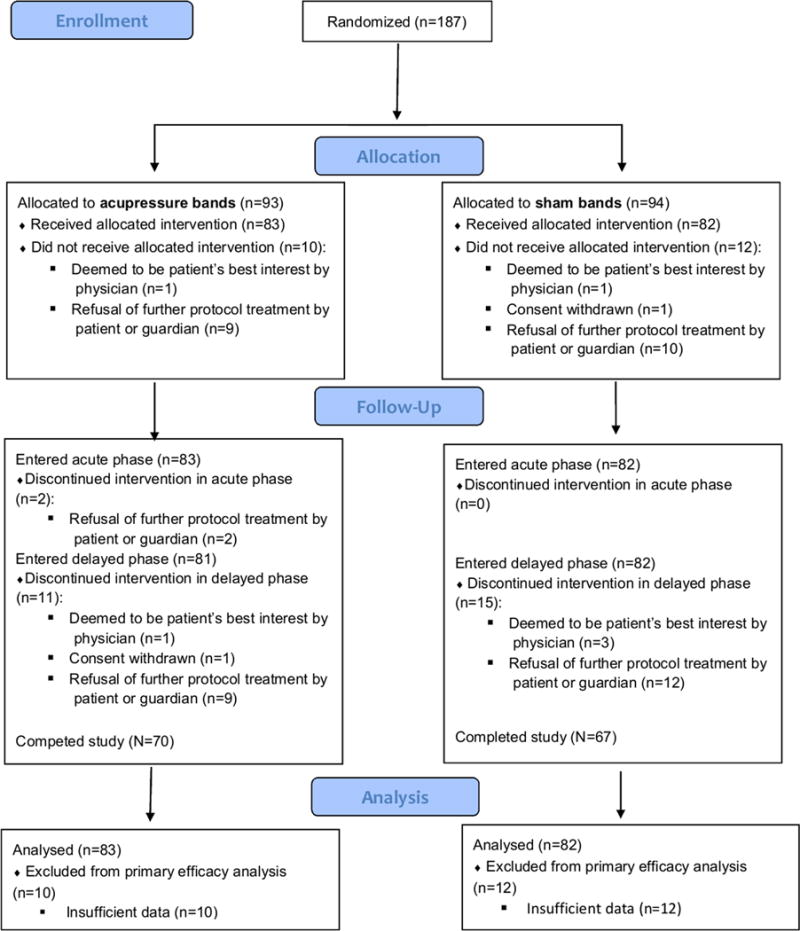
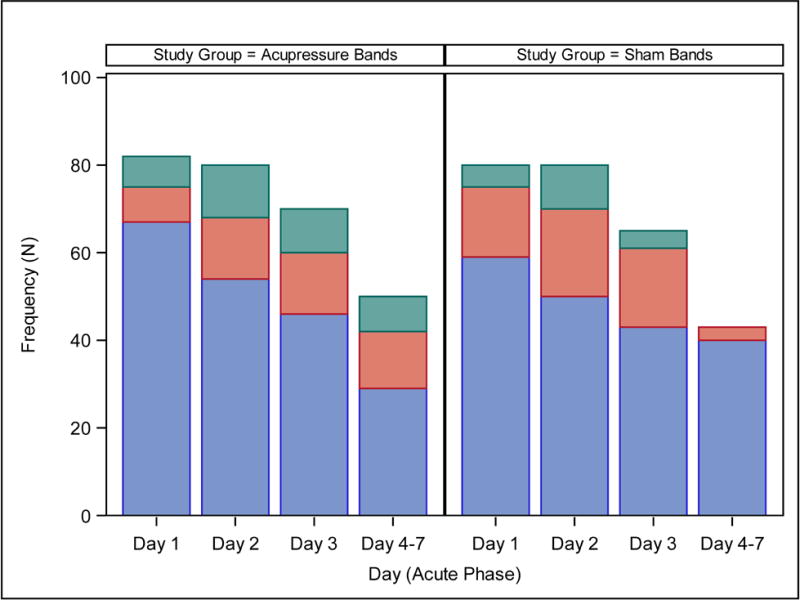
Results: Of the 187 patients randomized, 165 contributed nausea severity assessments during the acute phase. Acupressure bands did not reduce the severity of chemotherapy-induced nausea in the acute phase (odds ratio [OR], 1.33; 95% confidence limits, 0.89-2.00, in which an OR <1.00 favored acupressure) or in the delayed phase (OR, 1.23; 95% CL, 0.75-2.01). Furthermore, acupressure bands did not improve daily vomiting control during the acute phase (OR, 1.57; 95% CL, 0.95-2.59) or the delayed phase (OR, 0.84; 95% CL, 0.45-1.58). No serious adverse events were reported.
Conclusions: Acupressure bands were safe but did not improve chemotherapy-induced nausea or vomiting in pediatric patients who were receiving highly emetic chemotherapy. Cancer 2018;124:1188-96. © 2017 American Cancer Society.
Keywords: acupressure; chemotherapy; nausea; pediatrics; supportive care; vomiting.
© 2017 American Cancer Society.
Conflict of interest statement
Figures
References
-
- Sommariva S, Pongiglione B, Tarricone R. Impact of chemotherapy-induced nausea and vomiting on health-related quality of life and resource utilization: A systematic review. Critical Reviews in Oncology/Hematology. 2016;99:13–36. - PubMed
-
- Dupuis LL, Taddio A, Kerr EN, Kelly A, MacKeigan L. Development and validation of a pediatric nausea assessment tool (PeNAT) for use by children receiving antineoplastic agents. Pharmacotherapy. 2006;26:1221–1231. - PubMed
-
- Flank J, Sparavalo J, Vol H, et al. The burden of chemotherapy-induced nausea and vomiting in children receiving hematopoietic stem cell transplantation conditioning: a prospective study. Bone Marrow Transplantation. 2017;52(9):1294–1299. - PubMed
-
- Vol H, Flank J, Lavoratore S, et al. Poor chemotherapy-induced nausea and vomiting control in children receiving intermediate or high-dose methotrexate. Support Care Cancer. 2016;24(3):1365–1371. - PubMed
-
- Bishop F, Prescott P, Chan Y, Saville J, von Elm E, Lewith G. Prevalence of complementary medicine use in pediatric cancer: a systematic review. Pediatrics. 2010;125(4):768–776. - PubMed
Publication types
MeSH terms
Substances
Grants and funding
LinkOut - more resources
Full Text Sources
Other Literature Sources
Medical
