. 2018 Feb;30(6):10.1002/adma.201704367.
doi: 10.1002/adma.201704367. Epub 2017 Dec 21.

Activatable Hybrid Nanotheranostics for Tetramodal Imaging and Synergistic Photothermal/Photodynamic Therapy

Affiliations

Activatable Hybrid Nanotheranostics for Tetramodal Imaging and Synergistic Photothermal/Photodynamic Therapy

Shreya Goel et al. Adv Mater. 2018 Feb.

Abstract

A multifunctional core-satellite nanoconstruct is designed by assembling copper sulfide (CuS) nanoparticles on the surface of [89 Zr]-labeled hollow mesoporous silica nanoshells filled with porphyrin molecules, for effective cancer imaging and therapy. The hybrid nanotheranostic demonstrates three significant features: (1) simple and robust construction from biocompatible building blocks, demonstrating prolonged blood retention, enhanced tumor accumulation, and minimal long-term systemic toxicity, (2) rationally selected functional moieties that interact together to enable simultaneous tetramodal (positron emission tomography/fluorescence/Cerenkov luminescence/Cerenkov radiation energy transfer) imaging for rapid and accurate delineation of tumors and multimodal image-guided therapy in vivo, and (3) synergistic interaction between CuS-mediated photothermal therapy and porphyrin-mediated photodynamic therapy which results in complete tumor elimination within a day of treatment with no visible recurrence or side effects. Overall, this proof-of-concept study illustrates an efficient, generalized approach to design high-performance core-satellite nanohybrids that can be easily tailored to combine a wide variety of imaging and therapeutic modalities for improved and personalized cancer theranostics in the future.

Keywords: cancer theranostics; core-satellite nanoparticles; multimodal imaging; synergistic therapy.


Figures

Figure 1
Figure 1. Characterization of CSNCs
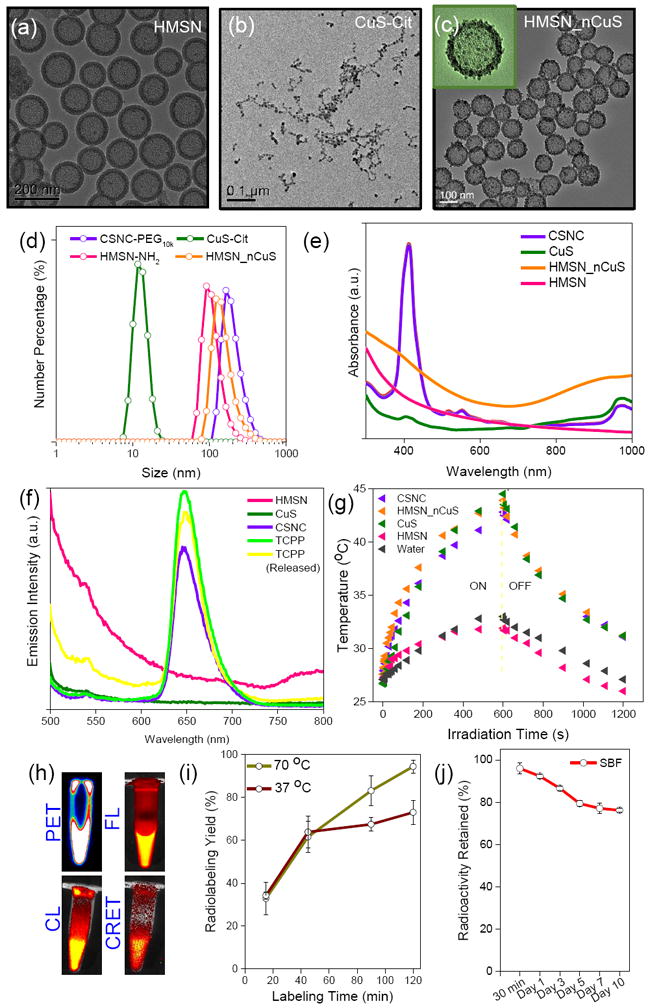
(a-c) Transmission electron microscopy images of (a) HMSN, (b) CuS-Cit, and (c) HMSN_nCuS at different magnifications. (d) Hydrodynamic diameters measured via dynamic light scattering (DLS), and (e) UV-Vis-NIR spectra, of individual components and self-assembled CSNCs. (f) Emission spectra of different nanoparticle solutions and TCPP, based on fluorescence of TCPP (Ex: 420 nm). Encapsulation of TCPP into CSNC results in slight reduction in fluorescence (violet curve) possibly due to self-quenching. The fluorescence is rapidly regained upon release of TCPP from the nanoconstructs (yellow curve). (g) Time-dependent photothermal profiles of different nanoparticle solutions. (h) Representative PET, FL, CL and CRET images of radiolabeled CSNCs. (i) Time-dependent chelator-free labeling of PET 89Zr onto CSNCs at 37 and 70 °C after 50 mM EDTA challenge, and (j) radiostability of [89Zr]CSNCs prepared at 70 °C in simulated body fluid over a period of 10 days.
Figure 2
Figure 2. In vivo multimodal imaging with [89Zr]CSNC-PEG10k
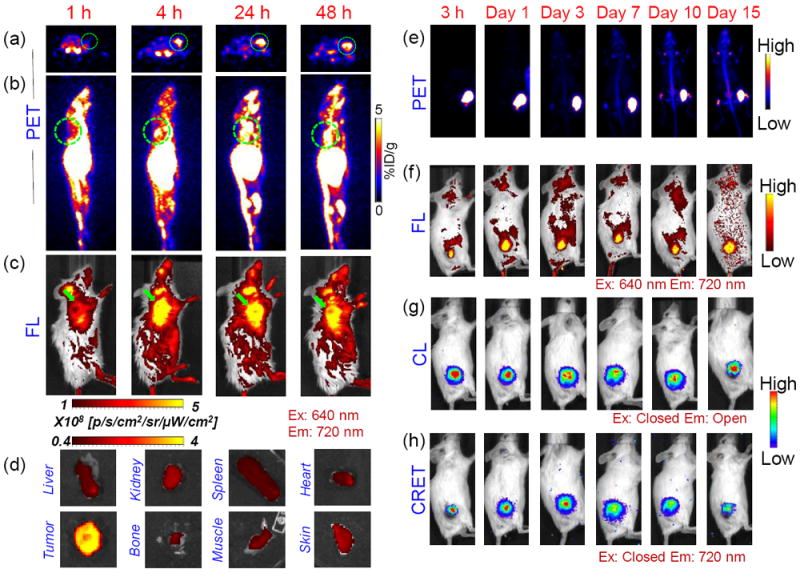
Representative serial (a) axial PET slices, (b) sagittal maximum intensity projections (MIP) and (c) FL images overlaid with digital photographs depicting EPR-mediated uptake of intravenously injected [89Zr]CSNC-PEG10k (~7.4 MBq; 2.5 mg kg-1 dose of TCPP) in 4T1 tumors (indicated by green circles and arrowheads) at 1, 4, 24 and 48 h p.i. (d) Ex vivo FL imaging of explanted tumor and major organs at 48 h p.i. (Ex: 640 nm, Em: 720 nm). (e) PET MIP images and optical (FL, CL and CRET) images of 4T1 tumor-bearing mice acquired at different time-points post-intratumor injection of [89Zr]CSNC-PEG10k (~1.8 MBq; 0.7 mg kg-1 dose of TCPP). (n=3)
Figure 3
Figure 3. CSNC-mediated synergistic photothermal/photodynamic therapy in vivo
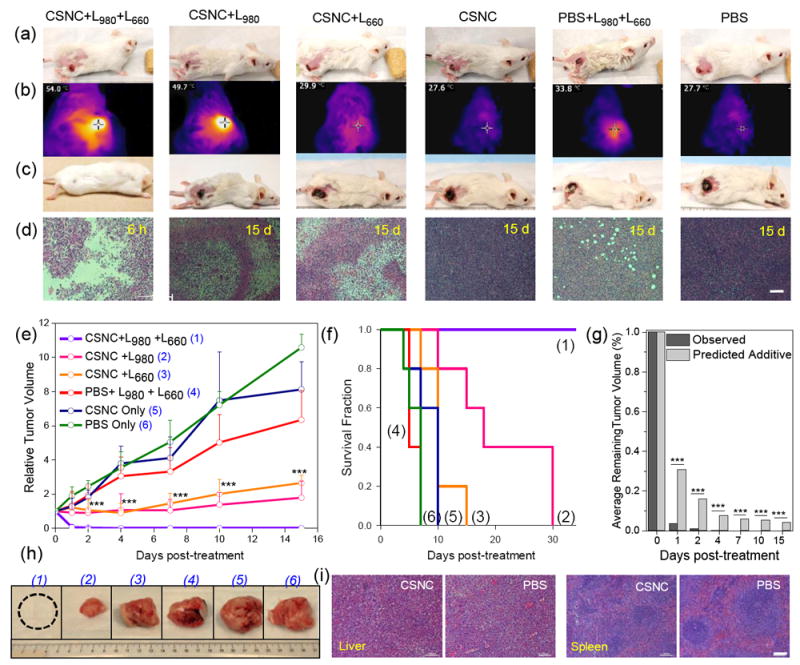
(a,c) Digital photographs of 4T1 tumor-bearing mice before and 15 days after different treatments. (b) IR thermal images depicting increase in temperature after irradiation with 980 nm laser. (d) H&E stained tumor sections collected 6 h or 15 days post-treatment. Scale bar: 100 μm. (e) Time-dependent tumor growth curves and (f) survival curves of mice after various treatments. (n = 5). (g) Synergistic behavior of CSNC-mediated PTT/PDT therapy indicated by a statistically significant difference between tumor volumes after dual-laser treatment and that predicted by a purely additive theoretical model. (h) Digital photographs of tumors explanted from different treatment groups 1-6, after 15 days. All experimental conditions were kept constant: CSNC dose: 30 mg kg-1, 980 nm laser (4 W cm-2) irradiated for 10 min followed by irradiation with 660 nm laser (50 mWcm-2) for 20 min. Statistical analysis was performed using two sample t test (** P < 0.01, **** P < 0.001). (i) H&E stained slices of liver and spleen tissues explanted after 60 days from mice injected intravenously with therapeutic dose of CSNC-PEG10k or PBS. Scale bar: 100 μm. Data presented as mean ± SD.
Figure 4
Figure 4. Long term toxicity assessment in vivo
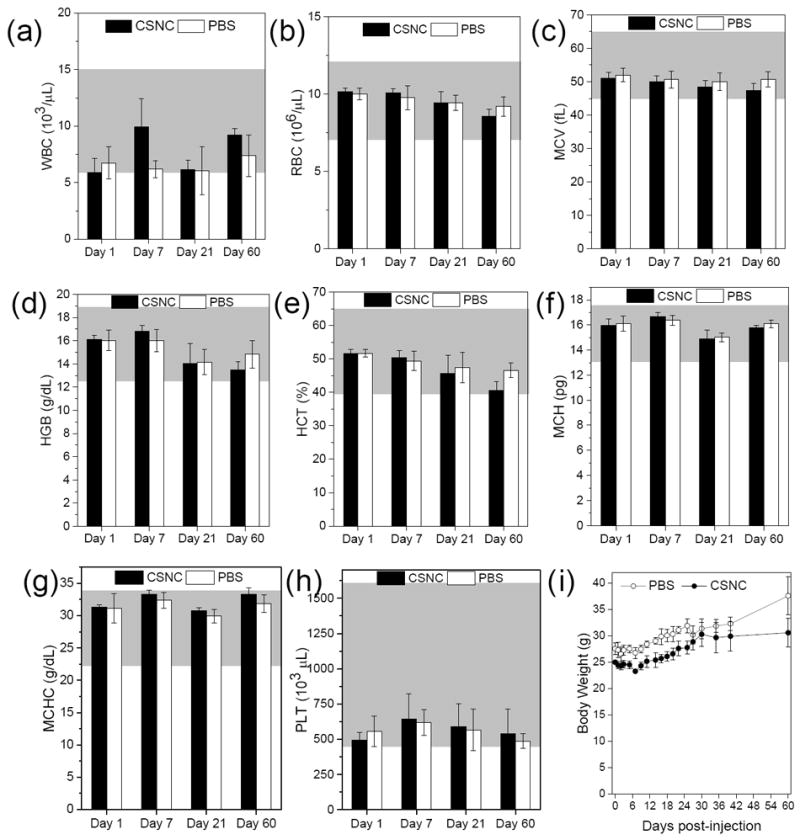
Complete hematology data (a) white blood cell, (b) red blood cell, (c) mean corpuscular volume, (d) hemoglobin, (e) hematocrit, (f) mean corpuscular hemoglobin, (g) mean corpuscular hemoglobin concentration, and (h) platelet, collected at day 1, 7, 21 and 60 from female ICR CD-1 mice injected with therapeutic dose of CSNC (30 mg kg-1) or PBS (n = 3). Grey regions represent normal range of the hematology parameters in female ICR mice. (i) Body weight measurements over a period of 60 days. Data is presented as mean ± SD.
Scheme 1
Scheme 1
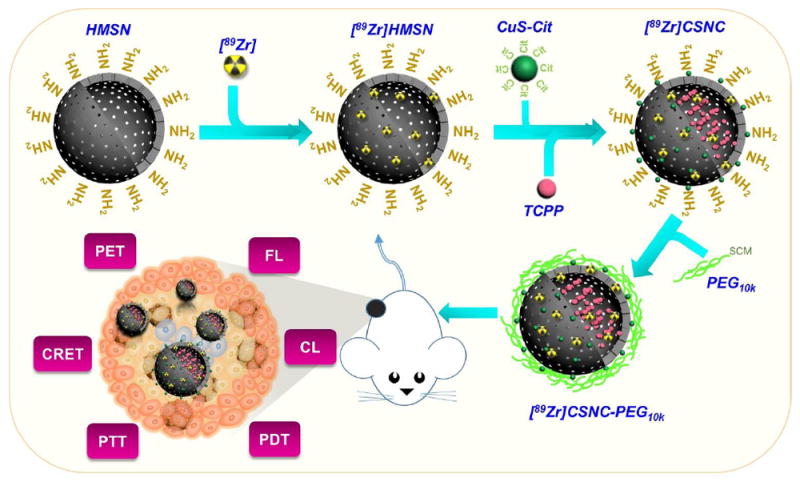
Schematic illustration for the self-assembly of radiolabeled core-satellite nanoconstructs (CSNC) for simultaneous positron emission tomography (PET), fluorescence (FL), Cerenkov luminescence (CL) and Cerenkov resonance energy transfer(CRET) imaging and synergistic photothermal (PTT) and photodynamic therapy (PDT) in breast tumor-bearing mice. CSNCs are prepared by electrostatic interaction-driven self-assembly of [89Zr]-labeled hollow mesoporous silica nanoparticles (HMSN) and citrate-capped CuS nanosatellites, followed by encapsulation of TCPP porphyrin. Branched-PEG is grafted to impart greater colloidal stability and biocompatibility.

References

    1. He C, Lu J, Lin W. J Control Release. 2015;219:224. - PMC - PubMed
    1. Zhang Z, Wang J, Chen C. Adv Mater. 2013;25:3869. - PubMed
    1. Gao S, Zheng M, Ren X, Tang Y, Liang X. Oncotarget. 2016;7:57367. - PMC - PubMed
    1. Abbas M, Zou Q, Li S, Yan X. Adv Mater. 2017;29:6. - PubMed
    2. Zou Q, Abbas M, Zhao L, Li S, Shen G, Yan X. J Am Chem Soc. 2017;139:1921. - PubMed
    1. Goel S, England CG, Chen F, Cai W. Adv Drug Deliv Rev. 2016;9:30233. - PMC - PubMed

LinkOut - more resources