


Prevalence and Disparities in Tobacco Product Use Among American Indians/Alaska Natives - United States, 2010-2015
- PMID: 29267265
- PMCID: PMC5751578
- DOI: 10.15585/mmwr.mm6650a2
Prevalence and Disparities in Tobacco Product Use Among American Indians/Alaska Natives - United States, 2010-2015
Abstract
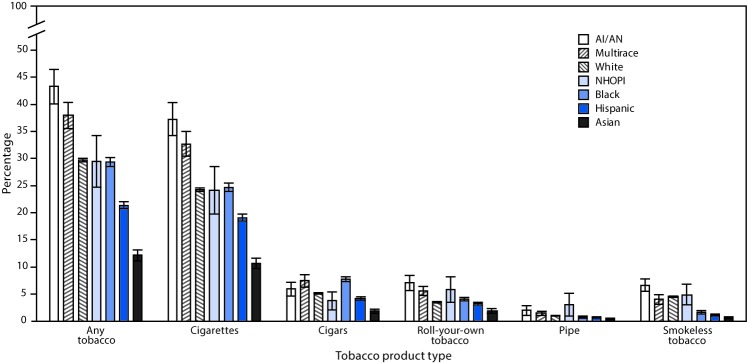
An overarching goal of Healthy People 2020 is to achieve health equity, eliminate disparities, and improve health among all groups.* Although significant progress has been made in reducing overall commercial tobacco product use,† disparities persist, with American Indians or Alaska Natives (AI/ANs) having one of the highest prevalences of cigarette smoking among all racial/ethnic groups (1,2). Variations in cigarette smoking among AI/ANs have been documented by sex and geographic location (3), but not by other sociodemographic characteristics. Furthermore, few data exist on use of tobacco products other than cigarettes among AI/ANs (4). CDC analyzed self-reported current (past 30-day) use of five tobacco product types among AI/AN adults from the 2010-2015 National Survey on Drug Use and Health (NSDUH); results were compared with six other racial/ethnic groups (Hispanic; non-Hispanic white [white]; non-Hispanic black [black]; non-Hispanic Native Hawaiian or other Pacific Islander [NHOPI]; non-Hispanic Asian [Asian]; and non-Hispanic multirace [multirace]). Prevalence of current tobacco product use was significantly higher among AI/ANs than among non-AI/ANs combined for any tobacco product, cigarettes, roll-your-own tobacco, pipes, and smokeless tobacco. Among AI/ANs, prevalence of current use of any tobacco product was higher among males, persons aged 18-25 years, those with less than a high school diploma, those with annual family income <$20,000, those who lived below the federal poverty level, and those who were never married. Addressing the social determinants of health and providing evidence-based, population-level, and culturally appropriate tobacco control interventions could help reduce tobacco product use and eliminate disparities in tobacco product use among AI/ANs (1).
Conflict of interest statement
Figures
References
-
- US Department of Health and Human Services. The health consequences of smoking—50 years of progress: a report of the Surgeon General, 2014. Atlanta, GA: US Department of Health and Human Services, CDC; 2014. https://www.surgeongeneral.gov/library/reports/50-years-of-progress/inde...
-
- Substance Abuse and Mental Health Services Administration. Population data. National Survey on Drug Use and Health. Rockville, MD: US Department of Health and Human Services, Substance Abuse and Mental Health Services Administration; 2017.. https://www.samhsa.gov/data/population-data-nsduh
-
- 5. Garrett BE, Dube SR, Trosclair A, Caraballo RS, Pechacek TF. Cigarette smoking—United States, 1965–2008. MMWR Suppl 2011;60:109–13. - PubMed
MeSH terms
LinkOut - more resources
Full Text Sources
Other Literature Sources
Medical
Miscellaneous
