


The Efficacy of Platelet-Rich Plasma on Tendon and Ligament Healing: A Systematic Review and Meta-analysis With Bias Assessment
- PMID: 29268037
- PMCID: PMC6339617
- DOI: 10.1177/0363546517743746
The Efficacy of Platelet-Rich Plasma on Tendon and Ligament Healing: A Systematic Review and Meta-analysis With Bias Assessment
Abstract
Background: There has been a surge in high-level studies investigating platelet-rich plasma (PRP) for tendon and ligament injuries. A number of meta-analyses have been published, but few studies have focused exclusively on tendon and ligament injuries.
Purpose: To perform a meta-analysis assessing the ability of PRP to reduce pain in patients with tendon and ligament injuries.
Study design: Systematic review and meta-analysis.
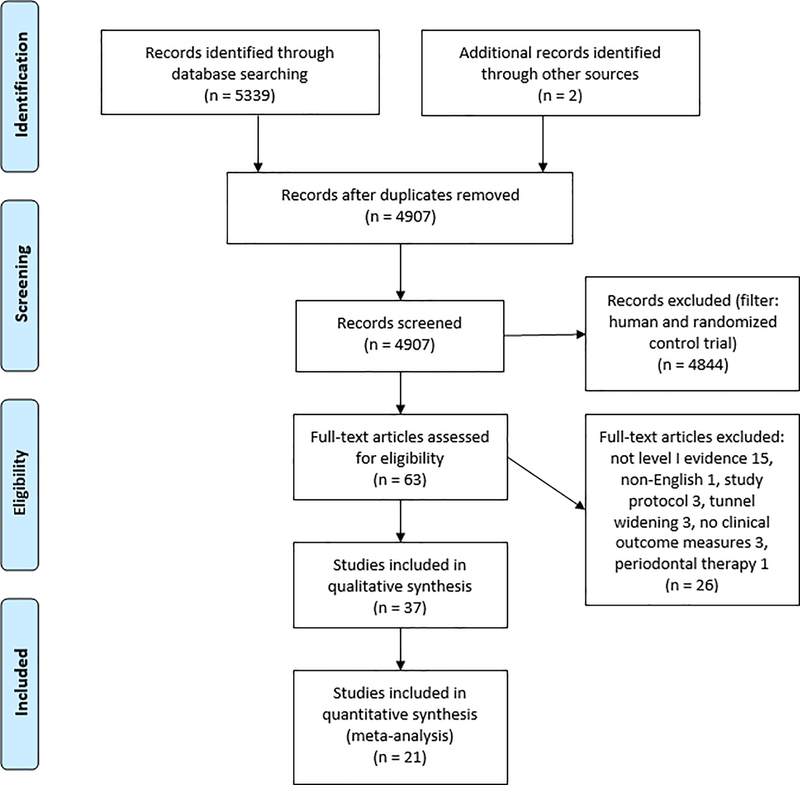
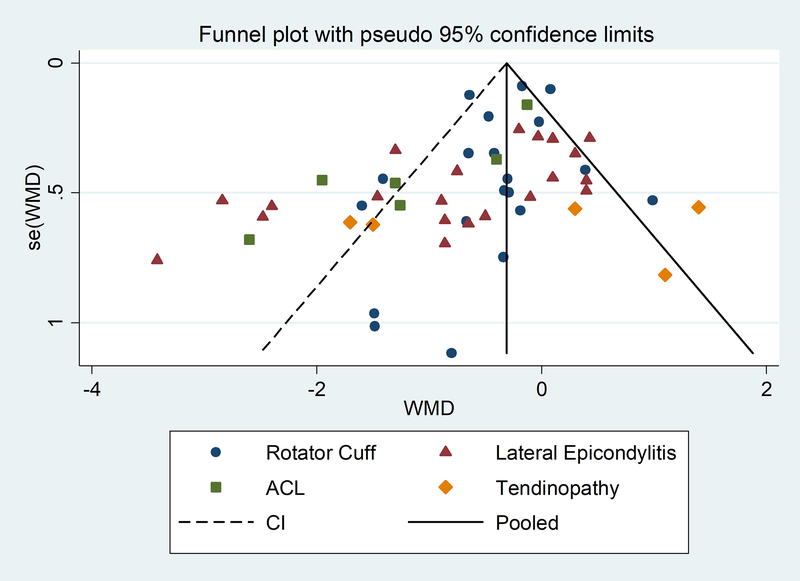
Methods: This study followed the PRISMA (Preferred Reporting Items for Systematic Reviews and Meta-Analyses) guidelines. A comprehensive search of the literature was carried out in April 2017 using electronic databases PubMed, MEDLINE, and the Cochrane Library. Only level 1 studies were included. Platelet and leukocyte count, injection volume, kit used, participant age/sex, comparator, and activating agent used were recorded. The short-term and long-term efficacy of PRP was assessed using the visual analog scale (VAS) to measure pain intensity. Injury subgroups (rotator cuff, tendinopathy, anterior cruciate ligament, and lateral epicondylitis) were evaluated. Funnel plots and the Egger test were used to screen for publication bias, and sensitivity analysis was performed to evaluate the effect of potential outliers by removing studies one at a time.
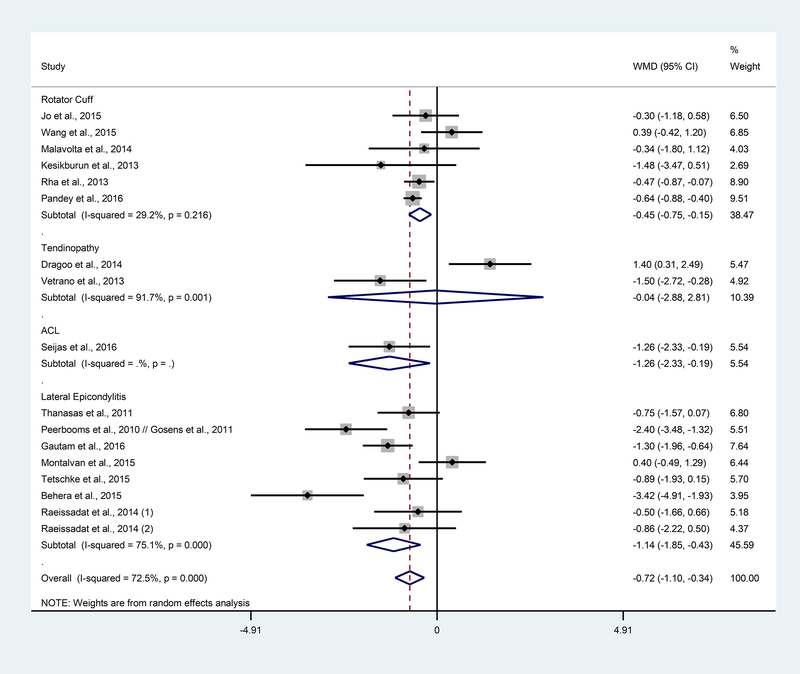
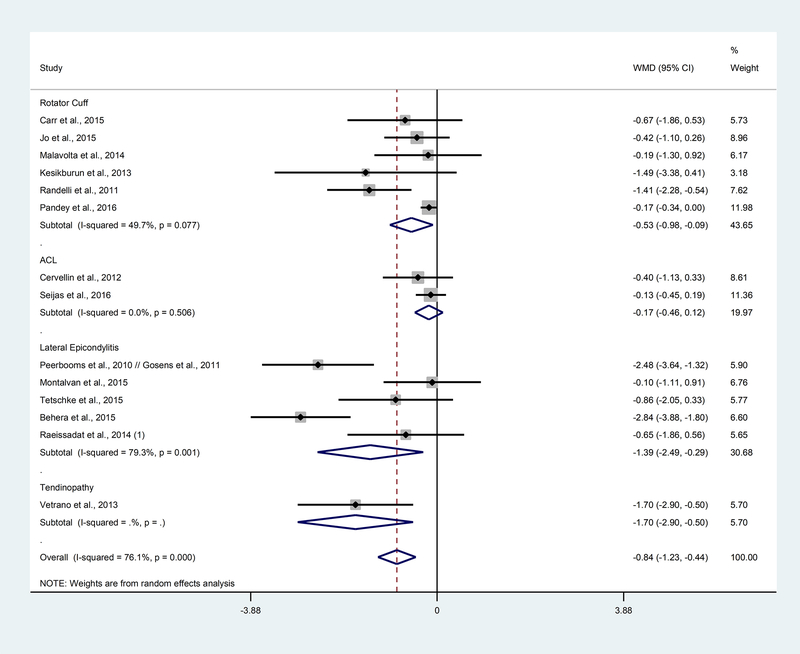
Results: Thirty-seven articles were included in this review, 21 (1031 participants) of which could be included in the quantitative analysis. The majority of studies published investigated rotator cuff injuries (38.1%) or lateral epicondylitis (38.1%). Seventeen studies (844 participants) reported short-term VAS data, and 14 studies (771 participants) reported long-term VAS data. Overall, long-term follow-up results showed significantly less pain in the PRP group compared with the control group (weighted mean difference [WMD], -0.84; 95% CI, -1.23 to -0.44; P < .01). Patients treated with PRP for rotator cuff injuries (WMD, -0.53; 95% CI, -0.98 to -0.09; P = .02) and lateral epicondylitis (WMD, -1.39; 95% CI, -2.49 to -0.29; P = .01) reported significantly less pain in the long term. Substantial heterogeneity was reported at baseline ( I2 = 72.0%; P < .01), short-term follow-up ( I2 = 72.5%; P < .01), long-term follow-up ( I2 = 76.1%; P < .01), and overall ( I2 = 75.8%; P < .01). The funnel plot appeared to be asymmetric, with some missingness at the lower right portion of the plot suggesting possible publication bias.
Conclusion: This review shows that PRP may reduce pain associated with lateral epicondylitis and rotator cuff injuries.
Keywords: Achilles tendinopathy; PRP; anterior cruciate ligament; biologics; injection therapy; lateral epicondylitis; meta-analysis; patellar tendon; platelet-rich plasma; rotator cuff; systematic review; tendinopathy.
Figures
References
-
- Arirachakaran A, Sukthuayat A, Sisayanarane T, Laoratanavoraphong S, Kanchanatawan W, Kongtharvonskul J. Platelet-rich plasma versus autologous blood versus steroid injection in lateral epicondylitis: systematic review and network meta-analysis. J Orthop Traumatol. 2016;17(2):101–112. doi: 10.1007/s10195-015-0376-5. - DOI - PMC - PubMed
Publication types
MeSH terms
Grants and funding
LinkOut - more resources
Full Text Sources
Other Literature Sources
Medical
Research Materials
Miscellaneous
