Review
. 2017 Nov;9(11):4599-4606.
doi: 10.21037/jtd.2017.10.79.

Clinical consensus of emergency airway management

Affiliations
Review

Clinical consensus of emergency airway management

Feng Sun et al. J Thorac Dis. 2017 Nov.

Abstract

Airway management is a common and key method to maintain and improve external respiration function of patients. Emergency physicians need a more appropriate guide to airway management. We concisely concluded current circumstances of Chinese emergency airway management. Then, we raised four principles: (I) priority to ventilation and oxygenation; (II) evaluation before intubation; (III) higher level of preparation (de-escalation); (IV) simplest (and least potentially harmful) form of intubation. We raised "CHANNEL" flow to direct initial emergency airway management and an algorithm was showed for emergency physicians understanding key points of airway management and further making medical decision. Finally, we introduced pharmacology of airway management.

Keywords: Emergency medicine; airway management; intubation; tracheostomy.


Conflict of interest statement

Conflicts of Interest: The authors have no conflicts of interest to declare.

Figures
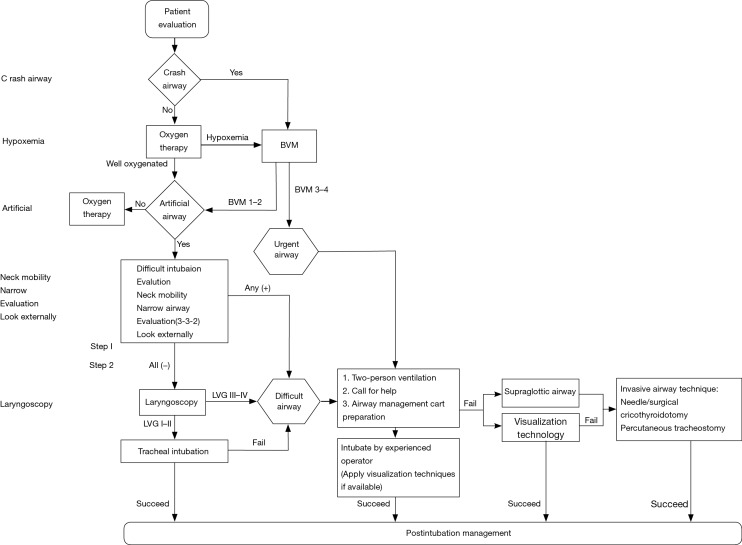
Figure 1
Figure 1
Clinical decision-making algorithm for emergency airway management. BVM, bag-valve-mask; LVG, laryngoscopy view grading.
Figure 2
Figure 2
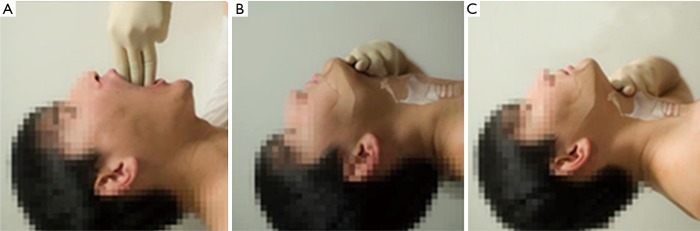
The 3-3-2 Rule. (A) More than 3 fingers between the open incisors, indicating patient’s mouth opens adequately to permit the laryngoscope to reach the airway; (B) more than 3 fingers along from mentum to hyoid bone, which indicates enough space for intubation; (C) more than 2 fingers from the laryngeal prominence to hyoid bone, less than 2 fingers indicate high position of pharynx in the neck and likely difficult exposure with direct laryngoscope.
Figure 3
Figure 3
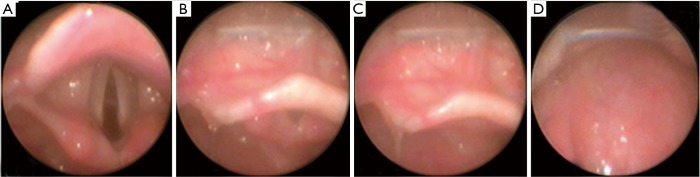
Laryngoscopy view grading system. (A) Visualization of the entire laryngeal aperture (Grade I); (B) visualization of only the posterior commissure of the laryngeal aperture (Grade II); (C) visualization of only the epiglottis (Grade III); (D) visualization of only the soft palate (Grade IV).

References

    1. Yu BW, Wu XM, Zuo MZ, et al. Difficult Airway Management Guidelines. J Clini Anesth 2013;29:93-8.
    1. Langeron O, Masso E, Huraux C, et al. Prediction of difficult mask ventilation. Anesthesiology 2000;92:1229-36. 10.1097/00000542-200005000-00009 - DOI - PubMed
    1. Han R, Tremper KK, Kheterpal S, et al. Grading scale for mask ventilation. Anesthesiology 2004;101:267. 10.1097/00000542-200407000-00059 - DOI - PubMed
    1. Sellick BA. Cricoid pressure to control regurgitation of stomach contents during induction of anaesthesia. Lancet 1961;2:404-6. 10.1016/S0140-6736(61)92485-0 - DOI - PubMed
    1. Vanner RG, Pryle BJ. Regurgitation and oesophageal rupture with cricoid pressure: a cadaver study. Anaesthesia 1992;47:732-5. 10.1111/j.1365-2044.1992.tb03248.x - DOI - PubMed

LinkOut - more resources