. 2018 Feb 14;84(5):e02526-17.
doi: 10.1128/AEM.02526-17. Print 2018 Mar 1.

An Attenuated Salmonella enterica Serovar Typhimurium Strain and Galacto-Oligosaccharides Accelerate Clearance of Salmonella Infections in Poultry through Modifications to the Gut Microbiome

Affiliations

An Attenuated Salmonella enterica Serovar Typhimurium Strain and Galacto-Oligosaccharides Accelerate Clearance of Salmonella Infections in Poultry through Modifications to the Gut Microbiome

M Andrea Azcarate-Peril et al. Appl Environ Microbiol. .

Abstract

Salmonella is estimated to cause one million foodborne illnesses in the United States every year. Salmonella-contaminated poultry products are one of the major sources of salmonellosis. Given the critical role of the gut microbiota in Salmonella transmission, a manipulation of the chicken intestinal microenvironment could prevent animal colonization by the pathogen. In Salmonella, the global regulator gene fnr (fumarate nitrate reduction) regulates anaerobic metabolism and is essential for adapting to the gut environment. This study tested the hypothesis that an attenuated Fnr mutant of Salmonella enterica serovar Typhimurium (attST) or prebiotic galacto-oligosaccharides (GOS) could improve resistance to wild-type Salmonella via modifications to the structure of the chicken gut microbiome. Intestinal samples from a total of 273 animals were collected weekly for 9 weeks to evaluate the impact of attST or prebiotic supplementation on microbial species of the cecum, duodenum, jejunum, and ileum. We next analyzed changes to the gut microbiome induced by challenging the animals with a wild-type Salmonella serovar 4,[5],12:r:- (Nalr) strain and determined the clearance rate of the virulent strain in the treated and control groups. Both GOS and the attenuated Salmonella strain modified the gut microbiome but elicited alterations of different taxonomic groups. The attST produced significant increases of Alistipes and undefined Lactobacillus, while GOS increased Christensenellaceae and Lactobacillus reuteri The microbiome structural changes induced by both treatments resulted in a faster clearance after a Salmonella challenge.IMPORTANCE With an average annual incidence of 13.1 cases/100,000 individuals, salmonellosis has been deemed a nationally notifiable condition in the United States by the Centers for Disease Control and Prevention (CDC). Earlier studies demonstrated that Salmonella is transmitted by a subset of animals (supershedders). The supershedder phenotype can be induced by antibiotics, ascertaining an essential role for the gut microbiota in Salmonella transmission. Consequently, modulation of the gut microbiota and modification of the intestinal microenvironment could assist in preventing animal colonization by the pathogen. Our study demonstrated that a manipulation of the chicken gut microbiota by the administration of an attenuated Salmonella strain or prebiotic galacto-oligosaccharides (GOS) can promote resistance to Salmonella colonization via increases of beneficial microorganisms that translate into a less hospitable gut microenvironment.

Keywords: Salmonella; Salmonella enterica serovar Typhimurium attenuated strain; chicken gut microbiome; galacto-oligosaccharides; gut microbiome modulation; prebiotics.


Figures

FIG 1
FIG 1
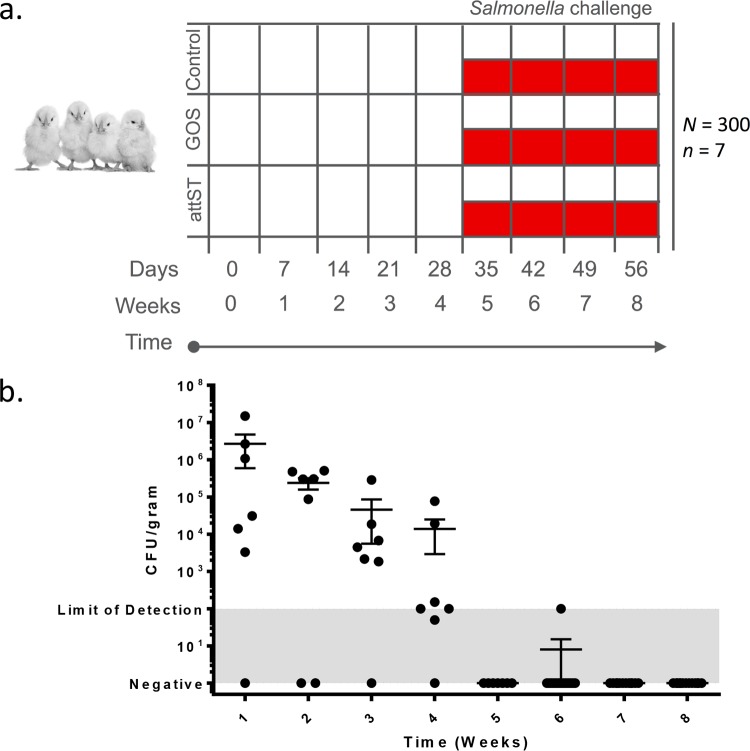
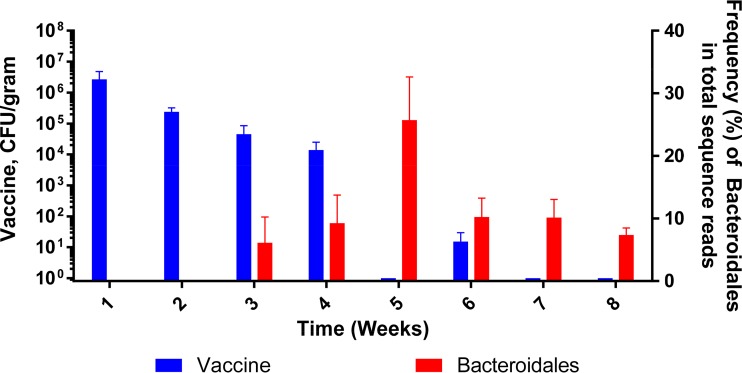
(a) Experimental design. A total of 273 1-day-old chicks were assigned to the following groups: control, prebiotics (galacto-oligosaccharides [GOS]), and attST. A total of 7 animals were sampled at 0, 7, 14, 21, and 28 days. After sampling on day 28, half of the remaining birds in each treatment group were challenged with the virulent Salmonella strain. There are 3 groups from 0 to 28 days (i.e., control, GOS, and attST) and 6 groups after challenging with the virulent Salmonella (i.e., control challenged, GOS challenged, and attST challenged). After the challenge, birds were sampled weekly (n = 7 birds) for up to 8 weeks (56 days). (b) Kinetics of clearance of the attST strain in the ceca of chickens in the treated group. Determination of the number of CFU was done by culturing.
FIG 2
FIG 2
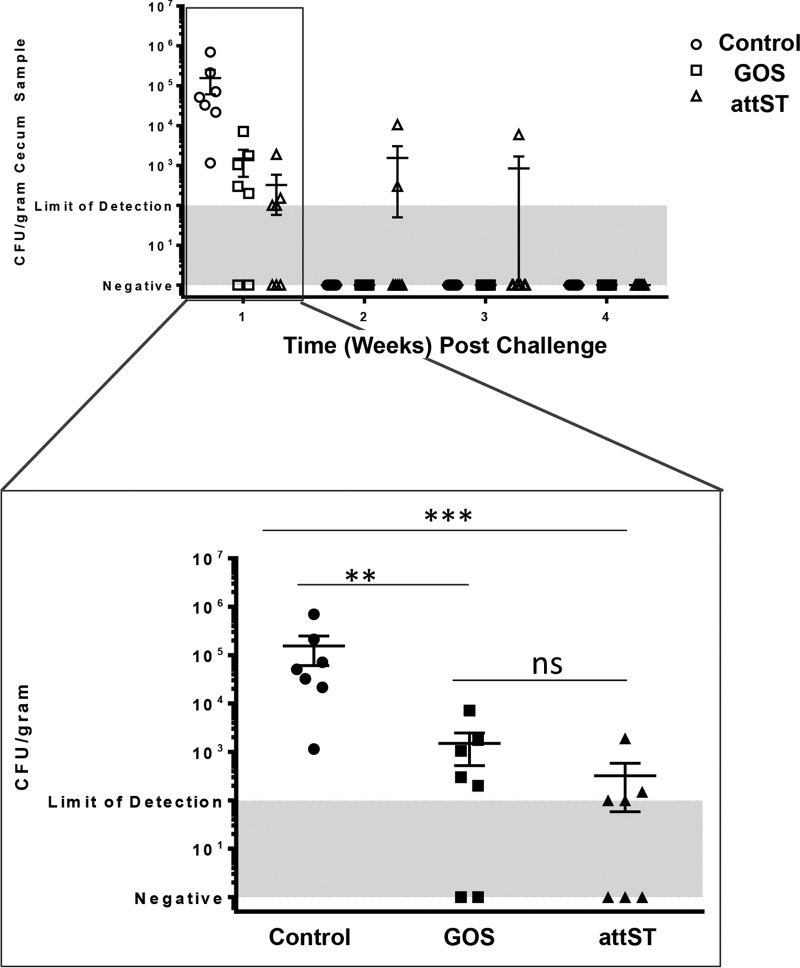
Clearance of the challenge Salmonella strain from the ceca of control, GOS-treated, and attST-treated animals during the 4-week period postchallenge. **, P < 0.01; ***, P < 0.001; ns, nonsignificant (P > 0.05).
FIG 3
FIG 3
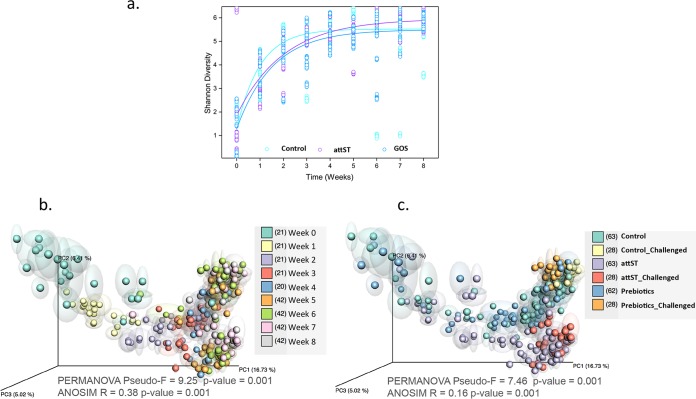
(a) Shannon diversity index of samples by time (weeks) and treatment, including all time points. (b and c) Unweighted UniFrac principal-coordinate analysis (PCoA) plot of chicken cecal samples colored by time (b) and treatment (c). PERMANOVA and ANOSIM statistics for each category are indicated. The numbers between brackets in the legends indicate the numbers of samples included in the analyses.
FIG 4
FIG 4
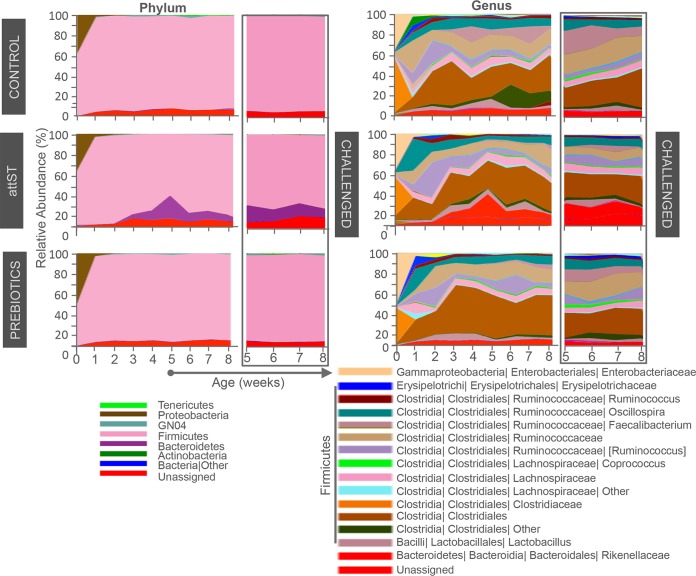
Relative abundance of phyla and genera over time in nonchallenged and challenged groups. For clarity, only taxa represented at >1% were included in the legends.
FIG 5
FIG 5
Detection of the order Bacteroidales in the ceca of attST-treated birds in relation to the clearing of the attenuated strain.
FIG 6
FIG 6
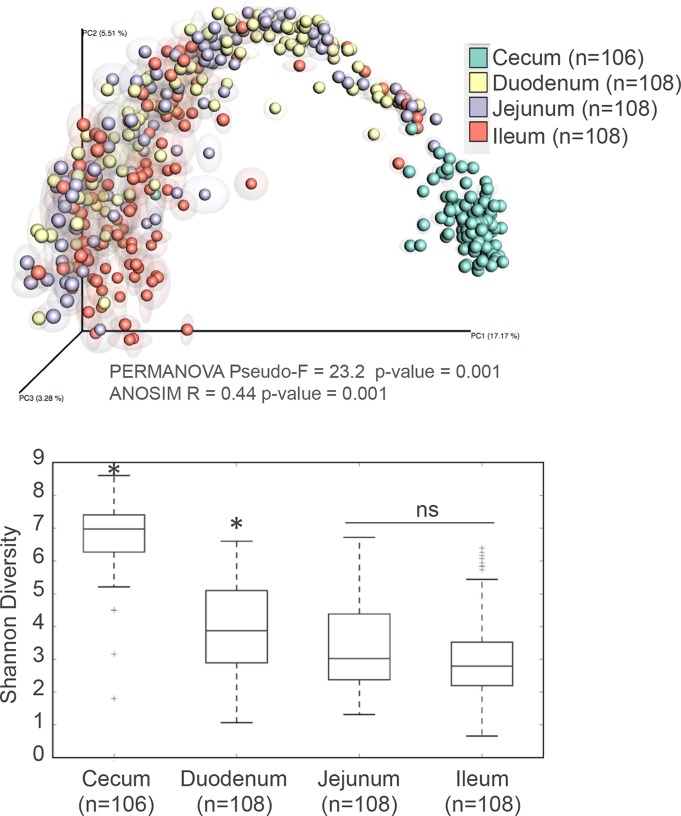
Effect of intestinal location on composition and diversity of the microbiome. (Top) PCoA analysis of samples with repeated resampling according to location. Only time points from week 5 and later (i.e., weeks 5 to 8) were included in this analysis. PERMANOVA and ANOSIM statistics are indicated in the figure. (Bottom) Shannon diversity indices of samples by location starting at week 5.
FIG 7
FIG 7
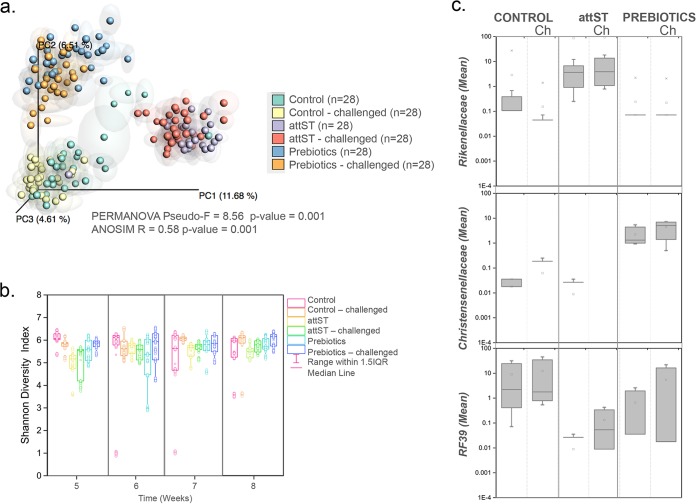
Effect of treatment on composition and diversity of the cecum microbiome. (Top left) PCoA analysis of samples with repeated resampling, colored according to treatment. Only time points from week 5 and later were included in this analysis. PERMANOVA and ANOSIM statistics are indicated in the figure. (Bottom left) Shannon diversity indices of samples by treatment starting at week 5. (Right) Highly discriminant bacterial taxa determined by random forest analysis differentially represented in the different treatments (Kruskal-Wallis test, Bonferroni's correction, P < 0.05).

References

    1. Basler C, Nguyen TA, Anderson TC, Hancock T, Behravesh CB. 2016. Outbreaks of human Salmonella infections associated with live poultry, United States, 1990–2014. Emerg Infect Dis 22:1705–1711. doi: 10.3201/eid2210.150765. - DOI - PMC - PubMed
    1. Chen Y, Glass K, Liu B, Hope K, Kirk M. 2016. Salmonella infection in middle-aged and older adults: incidence and risk factors from the 45 and up study. Foodborne Pathog Dis 13:689–694. doi: 10.1089/fpd.2016.2170. - DOI - PubMed
    1. Gieraltowski L, Higa J, Peralta V, Green A, Schwensohn C, Rosen H, Libby T, Kissler B, Marsden-Haug N, Booth H, Kimura A, Grass J, Bicknese A, Tolar B, Defibaugh-Chavez S, Williams I, Wise M, Salmonella Heidelberg Investigation Team. 2016. National outbreak of multidrug resistant Salmonella Heidelberg infections linked to a single poultry company. PLoS One 11:e0162369. doi: 10.1371/journal.pone.0162369. - DOI - PMC - PubMed
    1. Foley SL, Lynne AM. 2008. Food animal-associated Salmonella challenges: pathogenicity and antimicrobial resistance. J Anim Sci 86:E173–E187. doi: 10.2527/jas.2007-0447. - DOI - PubMed
    1. Foley SL, Lynne AM, Nayak R. 2008. Salmonella challenges: prevalence in swine and poultry and potential pathogenicity of such isolates. J Anim Sci 86:E149–E162. doi: 10.2527/jas.2007-0464. - DOI - PubMed

Publication types

MeSH terms

LinkOut - more resources