Review
. 2018 Mar;176(3):1894-1918.
doi: 10.1104/pp.17.01677. Epub 2017 Dec 21.

Plant Lipid Droplets and Their Associated Proteins: Potential for Rapid Advances

Affiliations
Review

Plant Lipid Droplets and Their Associated Proteins: Potential for Rapid Advances

Anthony H C Huang. Plant Physiol. 2018 Mar.

Abstract

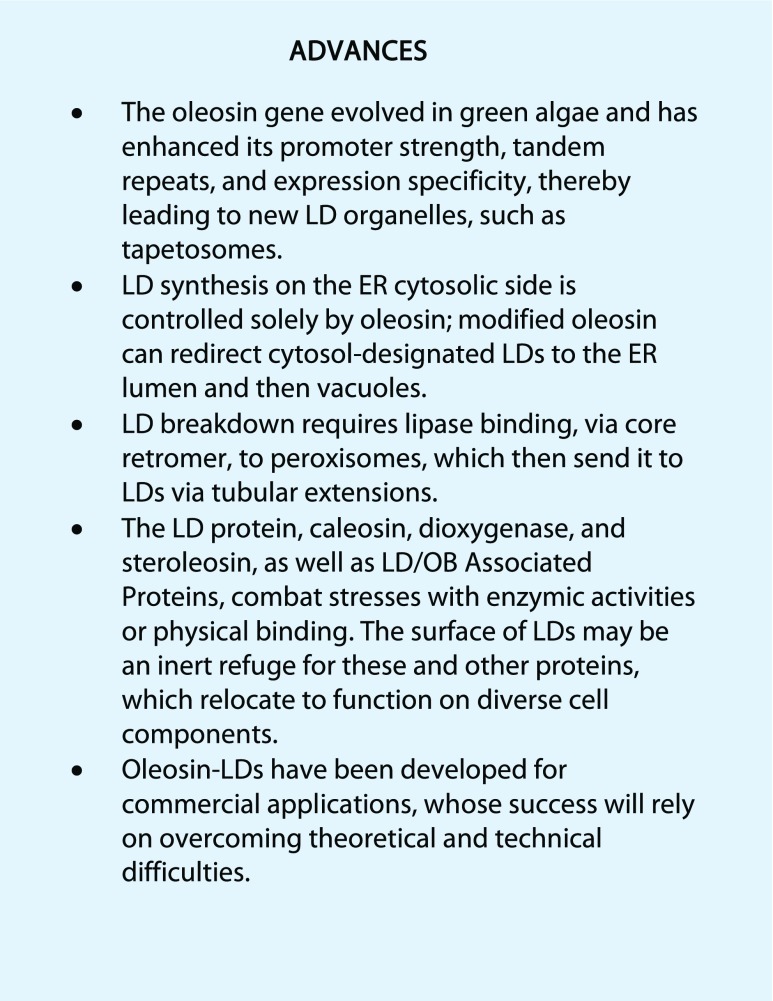
Cytoplasmic lipid droplets (LDs) of neutral lipids (triacylglycerols [TAGs], sterylesters, etc.) are reserves of high-energy metabolites and other constituents for future needs. They are present in diverse cells of eukaryotes and prokaryotes. An LD has a core of neutral lipids enclosed with a monolayer of phospholipids and proteins, which play structural and/or metabolic roles. During the past 3 decades, studies of LDs in diverse organisms have blossomed after they were found to be involved in prevalent human diseases and industrial uses. LDs in plant seeds were studied before those in mammals and microbes, and the latter studies have since moved forward. Plant LDs carry a hallmark protein called oleosin, which has a long hydrophobic hairpin penetrating the TAG core and stabilizing the LD. The oleosin gene first appeared in green algae and has evolved in enhancing promoter strength, tandem repeats, and/or expression specificity, leading to the appearance of new LD organelles, such as tapetosomes in Brassicaceae. The synthesis of LDs occurs with TAG-synthesizing enzymes on the endoplasmic reticulum (ER), and nascent TAGs are sequestered in the acyl moiety region between the bilayers of phospholipids, which results in ER-LD swelling. Oleosin is synthesized on the cytosol side of the ER and extracts the LD from the ER-LD to cytosol. This extraction of LD to the cytosol is controlled solely by the innate properties of oleosin, and modified oleosin can redirect the LD to the ER lumen and then vacuoles. The breakdown of LDs requires lipase associating with core retromer and binding to peroxisomes, which then send the enzyme to LDs via tubular extensions. Two groups of LD-associated proteins, caleosin/dioxygenase/steroleosin and LD/oil body-associated proteins, participate in cellular stress defenses via enzymic activities and binding, respectively. The surface of LDs in all plant cells may be an inert refuge for these and other proteins, which exert functions on diverse cell components. Oleosin-LDs have been explored for commercial applications; successes in their uses will rely on overcoming conceptual and technical difficulties.


Figures

Figure 1.
Figure 1.
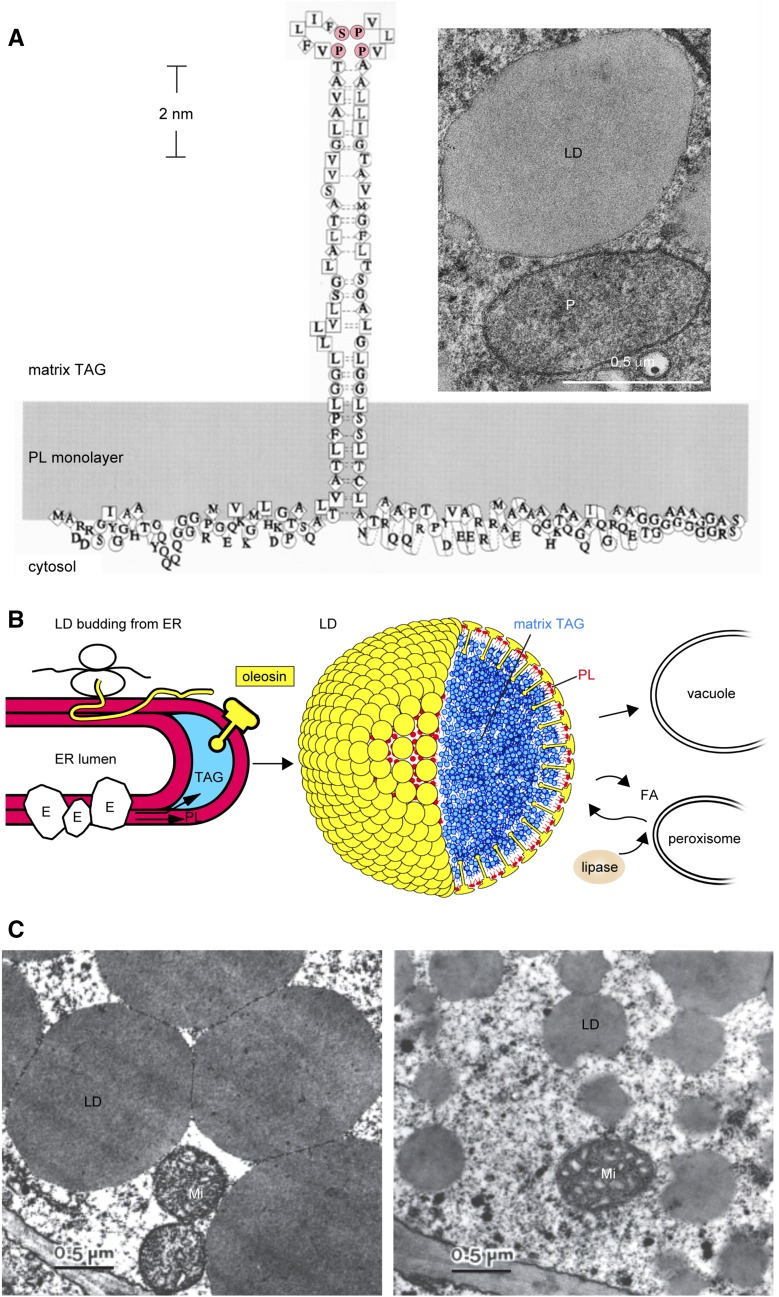
Seed LDs and oleosin. A, Model of an oleosin molecule on the surface of an LD (Tzen and Huang, 1992). The shaded area represents a monolayer of PLs with the head groups facing the cytosol. Symbols of amino acids and their hydropathy indices are as follows: square for very hydrophobic (4.5–3.8), diamond for hydrophobic (2.8–1.8), circle for amphipathic (−0.4 to −1.6), and no enclosure for hydrophilic (−3.2 to −4.5) residues. The N-terminal segment is shown without any well-defined structure. The central hydrophobic segment is depicted as a hairpin with a Pro knot at the loop (P and S in pink); its secondary structure is unknown. The C-terminal segment is an amphipathic α-helical structure interacting with the PL surface and a variable-length nonconserved peptide at the terminus. The monolayer of PL enclosing an LD is revealed in the inset electron micrograph of a shoot apex cell of a 1-d-old maize seedling (courtesy of Richard Trelease). LD, peroxisome (P), and plastid (at the top right corner; not labeled) are enclosed with one, two, and four electron-dense lines, representing one (one half-unit membrane), two (one unit membrane), and four (double membrane) PL layers, respectively. B, Model of LD synthesis during seed maturation and degradation during seed germination. Oleosin is shaped like a mushroom, which includes the mushroom head (N- and C-terminal amphipathic segments) and a stalk (the central hydrophobic hairpin; courtesy of Ariel Kuan [Tzen and Huang, 1992]). Left, Budding LD on rough ER during seed maturation. The overall structure includes the ER lumen, two PL layers (red), sequestered TAGs (blue), a ribosome with an mRNA synthesizing an oleosin polypeptide (thin yellow ribbon, of unknown configuration), and ER enzymes (irregular spheres [E]) for the synthesis of TAGs and PLs. All constituents are not drawn to scale. Middle, LD model, with oleosin (yellow) and PLs (red) enclosing the matrix TAGs (blue). All three types of molecules are drawn approximately to scale, but the diameter of the LD has been reduced 24 times to reveal clearly the surface structure. Right, LD degradation during germination. Lipase associated with core retromer binds to peroxisome, which transfers the lipase to LD for lipolysis; the enzymic product fatty acid (FA) is transferred to peroxisome for gluconeogenesis. A TAG-depleted ghost may join with the vacuole membrane. Alternatively, the whole LD is engulfed by a vacuole. All constituents are not drawn to scale. C, Electron micrographs of LDs in embryos of two maize lines with diverse TAG-oleosin ratios. LDs in Illinois High Oil line (with a high ratio of TAGs to oleosin) are larger and spherical. LDs in Illinois Low Oil line (with one-seventh the TAG-oleosin ratio) are smaller and have an irregularly contoured surface. Double-membraned mitochondria (Mi) are present. LDs isolated from the two lines are stable without coalescence or aggregation and maintain their respective sizes and shapes (Ting et al., 1996).
Figure 2.
Figure 2.
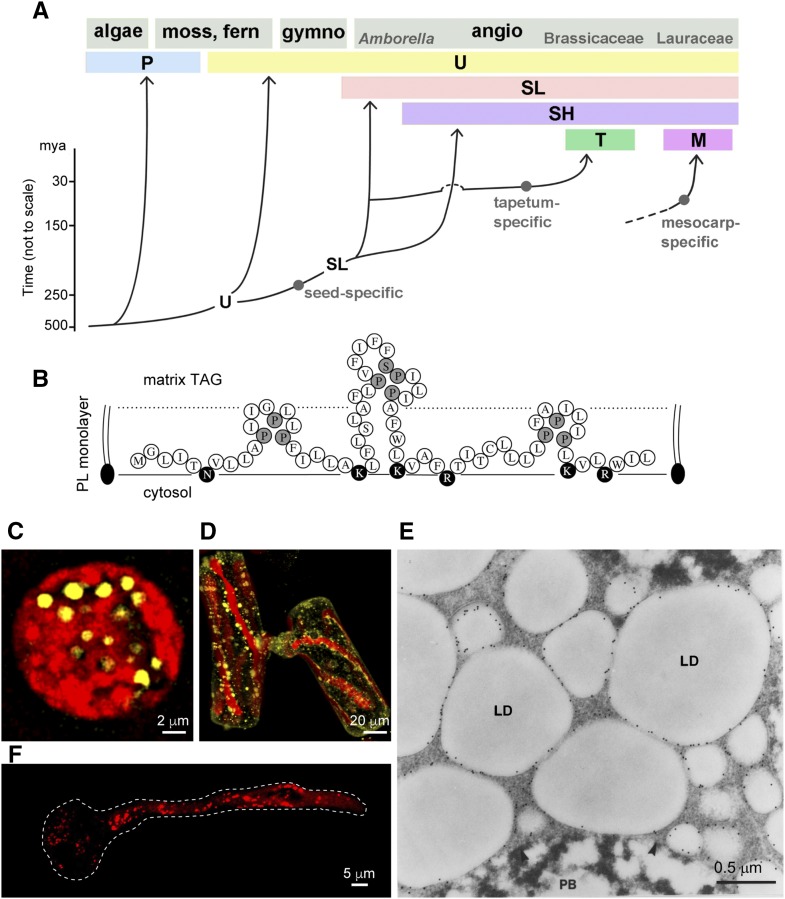
Evolution of the six oleosin lineages and LDs housing some of these oleosins. A, Cartoon of the evolution of six oleosin lineages: P (primitive), U (universal), SL (seed low molecular weight), SH (seed high molecular weight), T (tapetum in Brassicaceae), and M (mesocarp in Lauraceae). The origin of M oleosin is unknown and is shown with a broken line. (Modified from Huang and Huang [2015].) B, Predicted polypeptide organization of an oleosin-like protein on the surface of an LD in the primitive green algae C. reinhardtii and V. carteri. The polypeptide has one hydrophobic hairpin with a loop identical to that of oleosin and two adjacent hairpins with less similar loops. Pivotal Pro and Ser residues are shaded, and hydrophilic residues are darkened. All three hairpins are shorter than the oleosin hairpin (for comparison, see Fig. 1A). The cytosol, the surface PL monolayer, and the matrix TAGs are labeled. This oleosin-like protein could be the precursor of oleosin or a remnant of degenerating oleosin (Huang et al., 2013b). C and D, P oleosin-containing LDs in C. reinhardtii zygote and conjugating S. grevilleana cells viewed by CLSM. The cells were stained for LDs with BODIPY (shown in yellow) in the presence of chloroplasts (autofluorescence [in red]; Huang et al., 2013b). E, SL and SH oleosin-containing LDs in maize embryo of seed (after 12 h of soaking) subjected to immunogold labeling with antibodies against the maize oleosin, viewed by electron microscopy. LD and protein body (PB) are visible (Fernandez et al., 1988). F, U oleosin-containing LDs in Arabidopsis pollen after germination. The pollen grain produces a tube that carries the two sperm nuclei to the ovary. LDs travel to the tube tip via streaming cytoskeleton. LDs were stained with Nile Red (shown in red). The boundary of the pollen grain and tube is shown with a dotted white line. (Courtesy of Ming-Der Huang.)
Figure 3.
Figure 3.
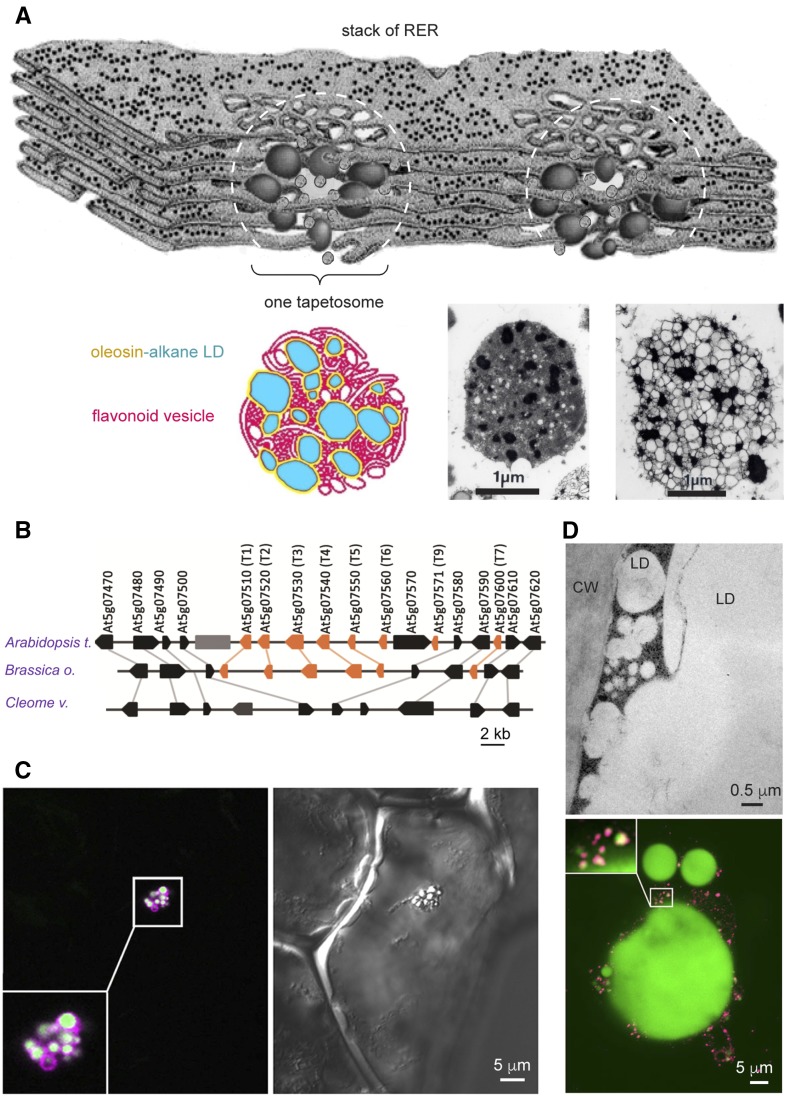
Specialized LDs in restricted tissues of specific plant phylogenies. A, T oleosin-containing LDs in tapetosomes being synthesized in rough ER in the tapetum of Brassica spp. In the model, a stack of rough ER produces alkane-containing, T oleosin- and PL-coated LDs and flavonoid-possessing vesicles at many locations. At each location (marked with a dotted white circle), numerous LDs and vesicles aggregate to form a tapetosome. The bottom shows a color model of a tapetosome having numerous alkane-containing (blue) LDs enclosed with a layer of oleosin-PL (yellow) associated with flavonoid-possessing vesicles (red). At right of the color model are electron micrographs of isolated tapetosomes without (middle) and with (right) osmotic swelling; after swelling of the tapetosome, internal LDs and vesicles can be seen. (A portion of the rough ER stack was traced from a drawing in a Trends in Cell Biology poster, 1998 [Hsieh and Huang, 2004, 2005]). B, T oleosin gene cluster in Brassicaceae and its absence in Cleomaceae in syntenic chromosome segments. Coding sequences of genes are indicated with colored arrows (orange for oleosin genes and black for nonoleosin genes) in genomic DNA from Arabidopsis, Brassica oleracea, and Cleome violacea. Orthologs among the genomes are linked with gray lines. The large gray box indicates a transposon (Huang et al., 2013a). C, U oleosin-containing LD cluster in vanilla leaf epidermis. Right, Differential interference contrast microscopy image shows the cell containing one LD cluster. Left, Immuno-CLSM image of the same cell reveals the LDs and oleosin. BODIPY-stained (in green) individual LDs in the cluster are visible. Antibodies against vanilla U oleosin reacted (in magenta) with the LDs. Oleosin appears more on the periphery of individual LDs, resulting in a magenta coat enclosing a white matrix (Huang and Huang, 2016). D, M oleosin-containing small LDs and oleosin-depleted large LD in avocado mesocarp. Top, Transmission electron microscopy image showing a portion of an avocado mesocarp cell containing large (10–50 μm) and small (less than 0.5 μm) LDs adjacent to the cell wall (CW). Bottom, Immuno-CLSM images show a large LD and numerous adjacent small LDs as well as a magnified junction between a large LD and numerous small LDs. BODIPY-stained (in green) large and small LDs are visible. Antibodies against avocado M oleosin reacted (in magenta) mostly with the small LDs. Oleosin appears more on the periphery of individual small LDs, resulting in a magenta coat enclosing a yellow matrix (Huang and Huang, 2016).
None
None

References

    1. Abell BM, Hahn M, Holbrook LA, Moloney MM (2004) Membrane topology and sequence requirements for oil body targeting of oleosin. Plant J 37: 461–470 - PubMed
    1. Abell BM, High S, Moloney MM (2002) Membrane protein topology of oleosin is constrained by its long hydrophobic domain. J Biol Chem 277: 8602–8610 - PubMed
    1. Alameldin H, Izadi-Darbandi A, Smith SA, Balan V, Jonese AD, Orhun GE, Sticklen M (2017) Metabolic engineering to increase the corn seed storage lipid quantity and change its compositional quality. Crop Sci 57: 1854–1864
    1. Alexander LG, Sessions RB, Clarke AR, Tatham AS, Shewry PR, Napier JA (2002) Characterization and modelling of the hydrophobic domain of a sunflower oleosin. Planta 214: 546–551 - PubMed
    1. Barbosa AD, Siniossoglou S (2017) Function of lipid droplet-organelle interactions in lipid homeostasis. Biochim Biophys Acta 1864: 1459–1468 - PubMed

Publication types