. 2017 Jun 6;2(5):924-932.
doi: 10.1016/j.ekir.2017.05.015. eCollection 2017 Sep.

Safety and Efficacy of Combination ACTHar Gel and Tacrolimus in Treatment-Resistant Focal Segmental Glomerulosclerosis and Membranous Glomerulopathy

Affiliations

Safety and Efficacy of Combination ACTHar Gel and Tacrolimus in Treatment-Resistant Focal Segmental Glomerulosclerosis and Membranous Glomerulopathy

James Tumlin et al. Kidney Int Rep. .

Abstract

Introduction: H.P. ACTHar gel is a preparation of melanocortin peptides that has been used to treat resistant forms of nephrotic syndrome. To determine whether combination therapy with ACTHar gel and tacrolimus reduces proteinuria and stabilizes renal function, we conducted a prospective, open-label trial in patients with treatment-resistant membranous glomerulopathy (MGN) and focal segmental glomerulosclerosis (FSGS).

Methods: Nine patients with treatment-resistant MGN and 13 with treatment-resistant FSGS received subcutaneous ACTHar gel for 6 months. Patients with no response or a partial response to ACTHar gel alone received an additional 6 months of therapy with combination ACTHar gel and oral tacrolimus. The study endpoint was the percentage of patients achieving a complete or partial remission after 6 months of combination therapy.

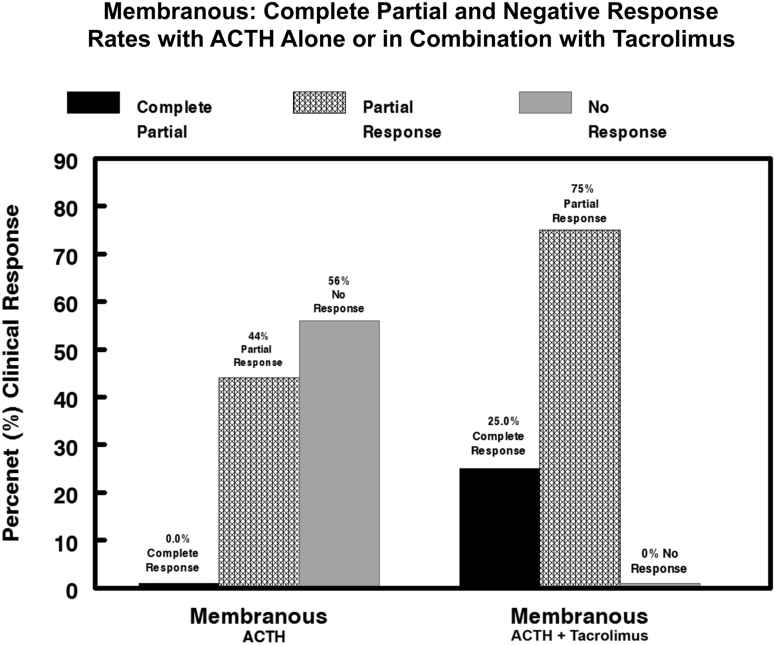
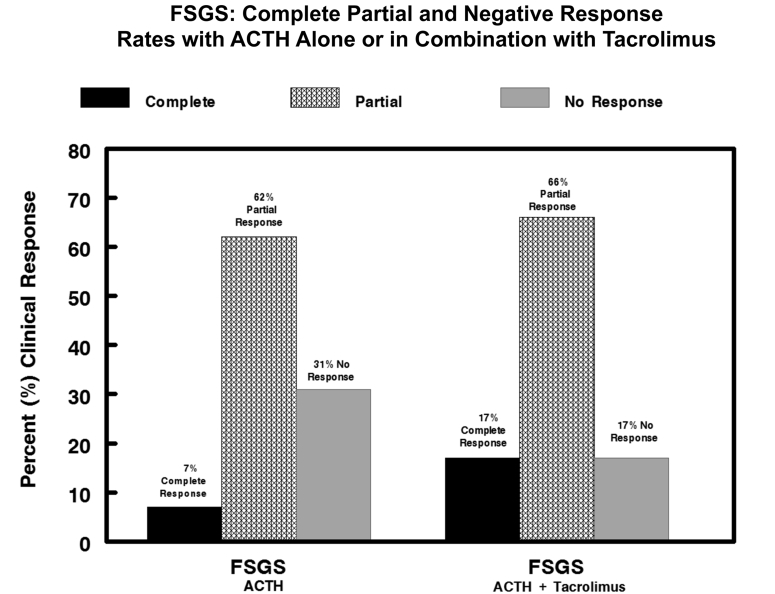
Results: Among patients with MGN, treatment with ACTHar gel alone achieved a partial remission in 44% and no response in 56% of patients. No patient achieved a complete response with ACTHar gel therapy alone. An additional 6 months of combination therapy with ACTHar gel and tacrolimus resulted in partial and complete response rates of 25% and 75%, respectively. Among patients with FSGS, ACTHar gel therapy alone resulted in complete and partial response rate of 7.7% and 62.0%. Combination therapy increased complete response rates to 17% and partial responses to 66%. Proteinuria (urinary protein-to-creatinine ratio) was significantly reduced in both patients with MGN and those with FSGS after 6 months of ACTHar gel alone and was further reduced among the patients with MGN with the addition of tacrolimus. There were no significant changes in estimated glomerular filtration rate during the treatment phase or long-term follow-up.

Discussion: Combination therapy with ACTHar gel and tacrolimus was well tolerated by patients with treatment-resistant MGN and FSGS and significantly reduced proteinuria and improved clinical response rates compared with ACTHar gel alone.

Keywords: ACTHar gel; focal segmental glomerulosclerosis; membranous glomerulopathy; proteinuria.


Figures
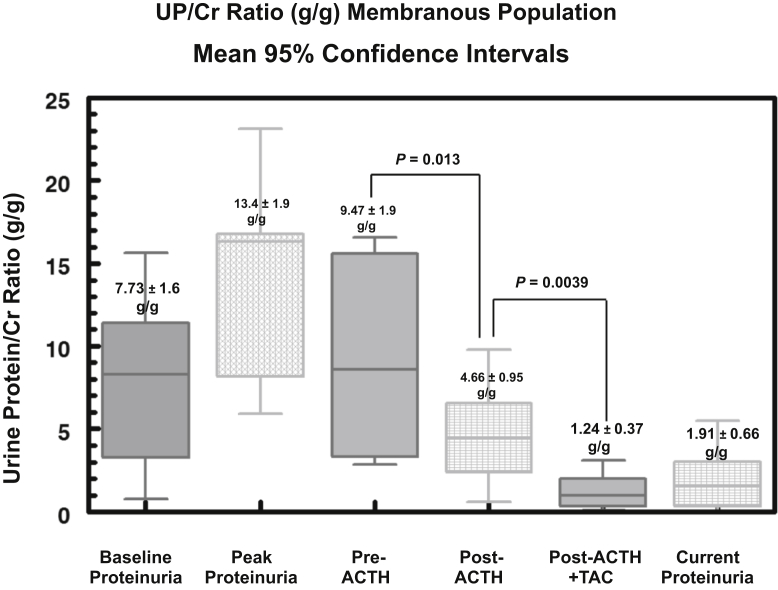
Figure 1
Figure 1
Box-whisker plots of urine protein-to-creatinine (UP/Cr) ratios (g/g) for the 9 patients with treatment-resistant membranous glomerulopathy are shown. Data include 5th and 95th percentiles about the median for UP/Cr ratios at baseline, peak levels, pre-ACTH, post-ACTH (6 months), post-ACTH (6 months) and tacrolimus, and current (last recorded data) levels. UP/Cr ratios fell significantly (P < 0.013) after 6 months of ACTHar with a further reduction after 6 months of combination ACTH and tacrolimus therapy (P < 0.0039). TAC, tacrolimus.
Figure 2
Figure 2
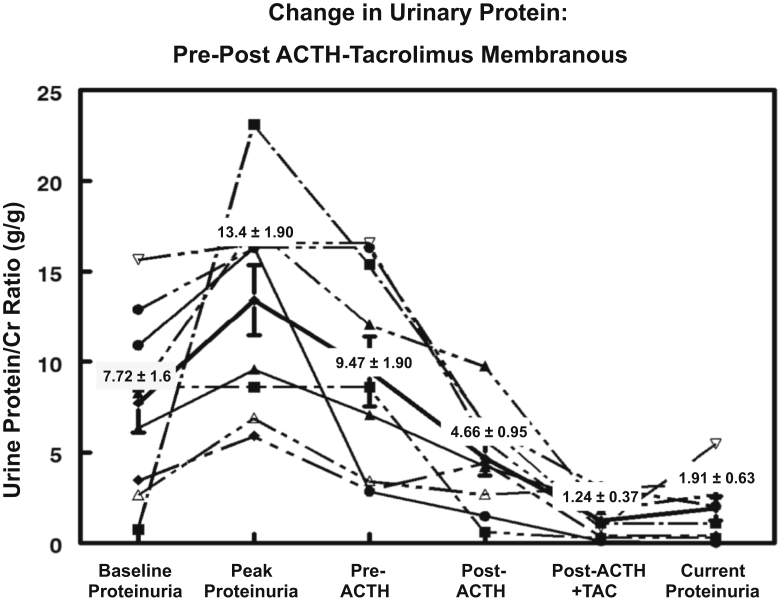
Individual urine protein-to-creatinine (UP/Cr) ratios (g/g) for patients with treatment-resistant membranous glomerulopathy are shown. Average UP/Cr fell significantly from 9.06 ± 1.7 to 4.66 ± 0.9 (P < 0.013) after ACTHar therapy alone and then was further reduced to 1.24 ± 0.4 (P < 0.021) after 6 months of combined ACTHar gel and tacrolimus.
Figure 3
Figure 3
Combined complete, partial, or no response rates for patients with treatment-resistant membranous glomerulopathy after 6 months of ACTHar alone and 6 months of combined ACTHar and tacrolimus. After 6 months of ACTHar gel therapy alone, 44% of patients achieved a partial response. No patient achieved a complete response with ACTHar alone. After 6 months of combined ACTHar and tacrolimus therapy, the complete response rate increased to 25% and the partial response rate increased to 75%.
Figure 4
Figure 4
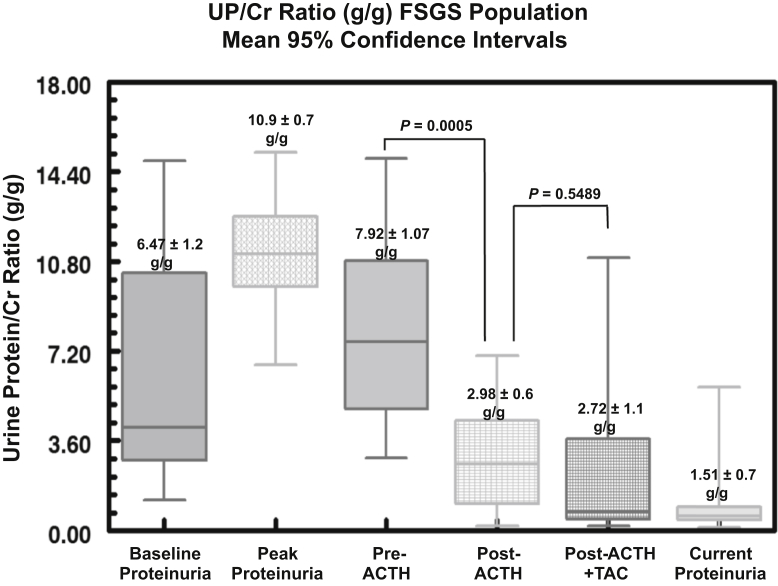
Box-whisker plots of urine protein-to-creatinine (UP/Cr) ratios (g/g) for 13 patients with treatment-resistant focal segmental glomerulosclerosis (FSGS) are shown. Data include 5th and 95th percentiles about the median for UP/Cr ratios at baseline, peak levels, pre-ACTH, post-ACTH (6 months), post-ACTH (6 months) and tacrolimus, and current (last recorded data) levels. UP/Cr ratios fell significantly (P < 0.0005) after 6 months of ACTHar gel. The addition of tacrolimus did not further reduce urinary protein levels in the population with FSGS (P < 0.550).
Figure 5
Figure 5
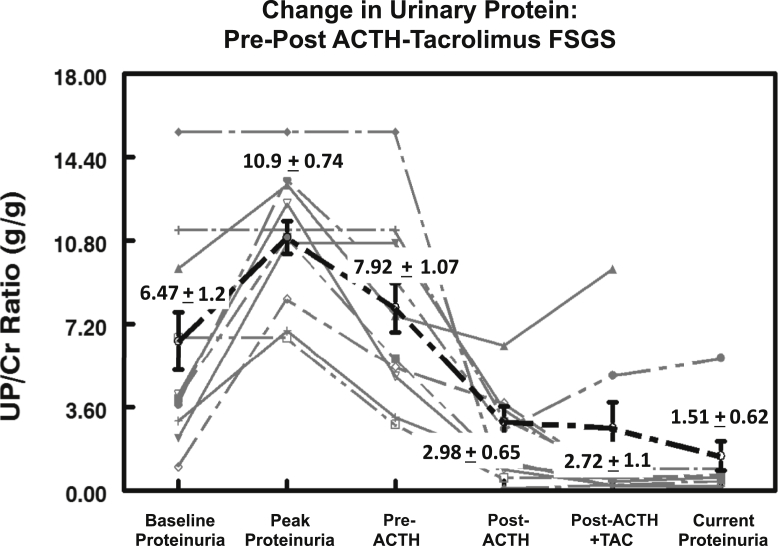
Individual urine protein-to-creatinine (UP/Cr) ratios (g/g) for patients with steroid-resistant focal segmental glomerulosclerosis (FSGS) are shown. Average UP/Cr fell significantly from 7.92 ± 1.1 to 2.98 ± 0.6 (P < 0.0005) but did not decline further after 6 months of therapy with the addition of tacrolimus (P < 0.550).
Figure 6
Figure 6
Combined complete, partial, or no response rates for patients with steroid-resistant focal segmental glomerulosclerosis (FSGS) after 6 months of ACTHar alone and 6 months of combined ACTHar and tacrolimus. After 6 months of ACTHar alone, 7.7% achieved a complete response, and 62% achieved a partial response. After 6 months of combination therapy with ACTHar and tacrolimus, the complete response rate rose to 17.0% and the partial response rate rose to 66%.
Figure 7
Figure 7
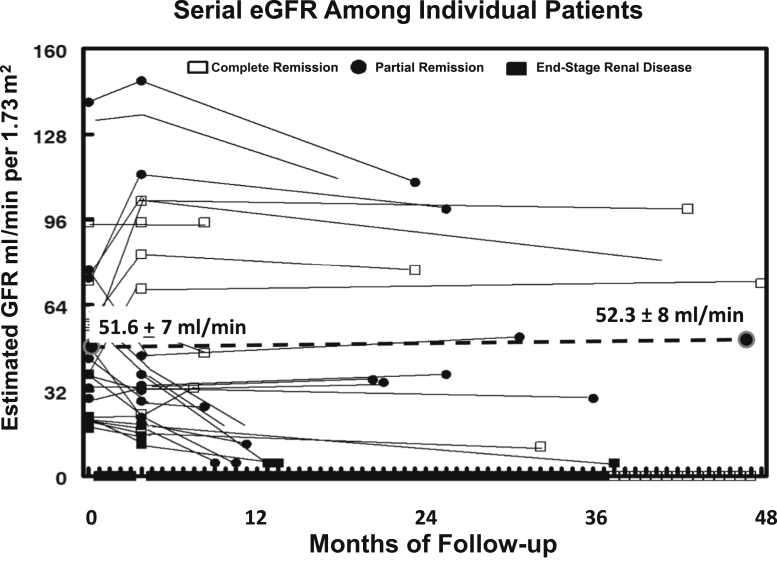
Individual changes in estimated glomerular filtration rate (eGFR) during treatment and follow-up. Twenty-one patients completed 4 years of follow-up. Mean eGFR did not change over the course of 4 years of follow-up. These data include eGFR values for 4 patients who progressed to end-stage renal disease.

References

    1. Korbet S.M. Treatment of primary FSGS in adults. J Am Soc Nephrol. 2012;23:1769–1776. - PubMed
    1. Moghadam-Kia S., Werth V.P. Prevention and treatment of systemic glucocorticoid side effects. Int J Dermatol. 2010;49:239–248. - PMC - PubMed
    1. Ponticelli C., Rizzoni, Edefonti A. A randomized trial of cyclosporine in steroid-resistant idiopathic nephrotic syndrome. Kidney Int. 1993;43:1377–1384. - PubMed
    1. Cattran D.C., Appel G.B., Hebert L.A. A randomized trial of cyclosporine in patients with steroid-resistant focal segmental glomerulosclerosis. Kidney Int. 1999;56:2220–2226. - PubMed
    1. Choudhry S., Bagga A., Hari P. Efficacy and safety of tacrolimus versus cyclosporine in children with steroid-resistant nephrotic syndrome: a randomized controlled trial. Am J Kidney Dis. 2009;53:760–769. - PubMed

LinkOut - more resources