


Individual and Combined Effects of Fumonisin B₁, Deoxynivalenol and Zearalenone on the Hepatic and Renal Membrane Lipid Integrity of Rats
- PMID: 29271890
- PMCID: PMC5793091
- DOI: 10.3390/toxins10010004
Individual and Combined Effects of Fumonisin B₁, Deoxynivalenol and Zearalenone on the Hepatic and Renal Membrane Lipid Integrity of Rats
Abstract
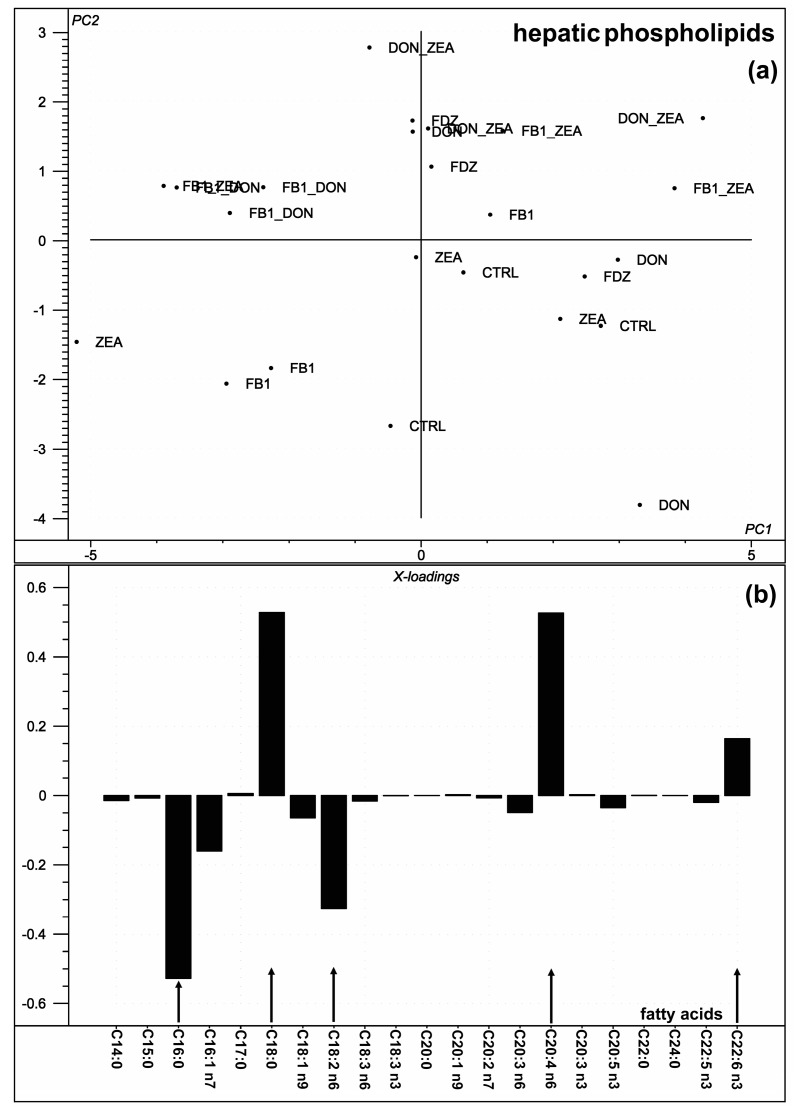
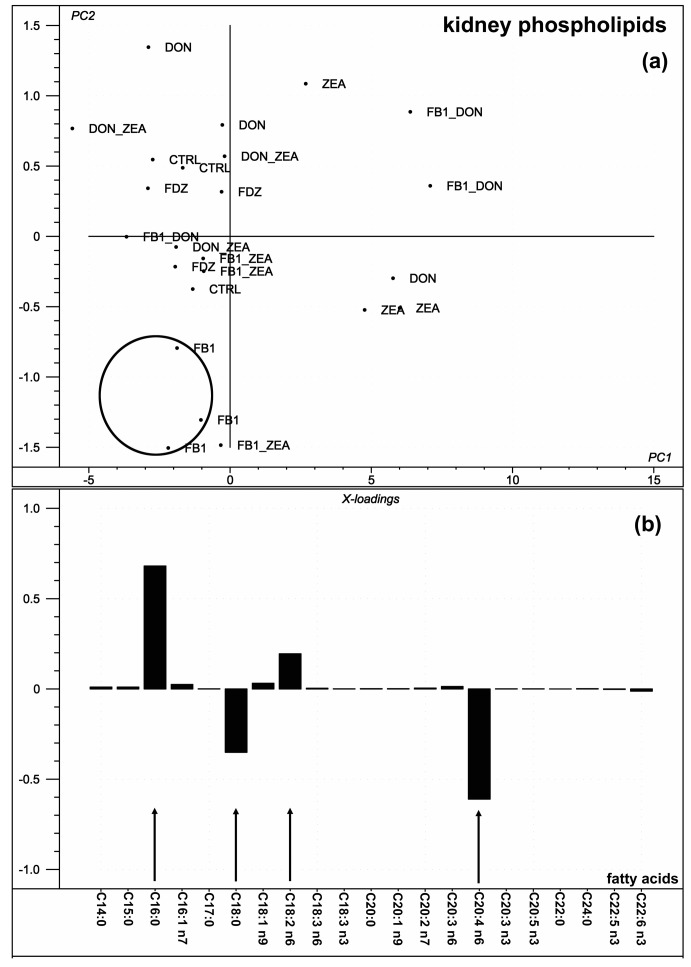
(1) Background and (2) Methods: A 14-day in vivo, multitoxic (pure mycotoxins) rat experiment was conducted with zearalenone (ZEA; 15 μg/animal/day), deoxynivalenol (DON; 30 μg/animal/day) and fumonisin B₁ (FB₁; 150 μg/animal/day), as individual mycotoxins, binary (FD, FZ and DZ) and ternary combinations (FDZ), via gavage in 1 mL water boluses. (3) Results: Body weight was unaffected, while liver (ZEA↑ vs. DON) and kidney weight (ZEA↑ vs. FDZ) increased. Hepatocellular membrane lipid fatty acids (FAs) referred to ceramide synthesis disturbance (C20:0, C22:0), and decreased unsaturation (C22:5 n3 and unsat. index), mainly induced by DON and to a lesser extent by ZEA. The DON-FB₁ interaction was additive on C20:0 in liver lipids. In renal phospholipids, ZEA had the strongest effect on the FA profile, affecting the saturated (C18:0) and many n6 FAs; ZEA was in an antagonistic relationship with FB₁ (C18:0) or DON (C18:2 n6, C20:1 n9). Hepatic oxidative stress was the most expressed in FD (reduced glutathione and glutathione peroxidase), while the nephrotoxic effect was further supported by lipid peroxidation (malondialdehyde) in the DON treatment. (4) Conclusions: In vivo study results refer to multiple mycotoxin interactions on membrane FAs, antioxidants and lipid peroxidation compounds, needing further testing.
Keywords: fusariotoxins; kidney; liver; multitoxic effects; phospholipids; rat.
Conflict of interest statement
The authors declare no conflict of interest.
Figures
References
-
- Griessler K., Rodrigues I., Handl J., Hofstetter U. Occurrence of mycotoxins in Southern Europe. World Mycotoxin J. 2010;3:301–309. doi: 10.3920/WMJ2009.1198. - DOI
-
- BIOMIN Mycotoxin Survey, 2015: BIOMIN Holding GmbH, Getzersdorf, Austria. [(accessed on 14 December 2017)]; Available online: http://info.biomin.net/acton/attachment/14109/f-018d/1/-/-/l-0009/l-0009....
-
- BIOMIN Mycotoxin Survey, 2016: BIOMIN Holding GmbH, Getzersdorf, Austria. [(accessed on 14 December 2017)]; Available online: https://info.biomin.net/acton/attachment/14109/f-0463/1/-/-/l-0009/l-000....
Publication types
MeSH terms
Substances
LinkOut - more resources
Full Text Sources
Other Literature Sources
Research Materials
Miscellaneous
