


Surveillance for and Discovery of Borrelia Species in US Patients Suspected of Tickborne Illness
- PMID: 29272385
- PMCID: PMC5985202
- DOI: 10.1093/cid/cix1107
Surveillance for and Discovery of Borrelia Species in US Patients Suspected of Tickborne Illness
Abstract
Background: Tick-transmitted Borrelia fall into 2 heterogeneous bacterial complexes comprised of multiple species, the relapsing fever (RF) group and the Borrelia burgdorferi sensu lato group, which are the causative agents of Lyme borreliosis (LB), the most common tickborne disease in the Northern Hemisphere. Geographic expansion of LB in the United States and discovery of emerging Borrelia pathogens underscores the importance of surveillance for disease-causing Borrelia.
Methods: De-identified clinical specimens, submitted by providers throughout the United States, for patients suspected of LB, anaplasmosis, ehrlichiosis, or babesiosis were screened using a Borrelia genus-level TaqMan polymerase chain reaction (PCR). Borrelia species and sequence types (STs) were characterized by multilocus sequence typing (MLST) utilizing next-generation sequencing.
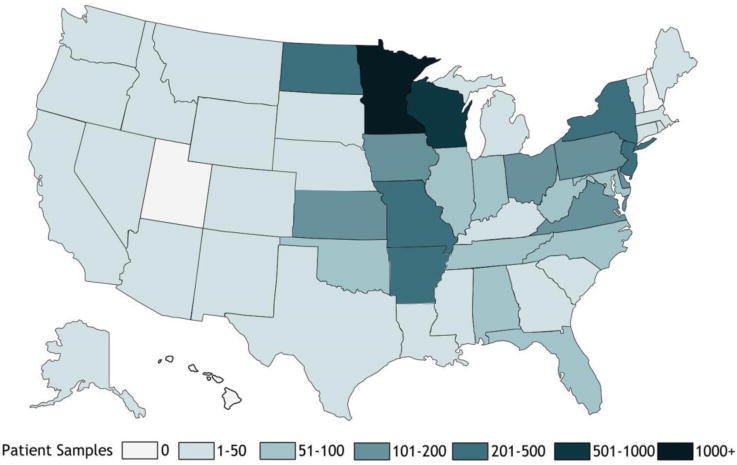
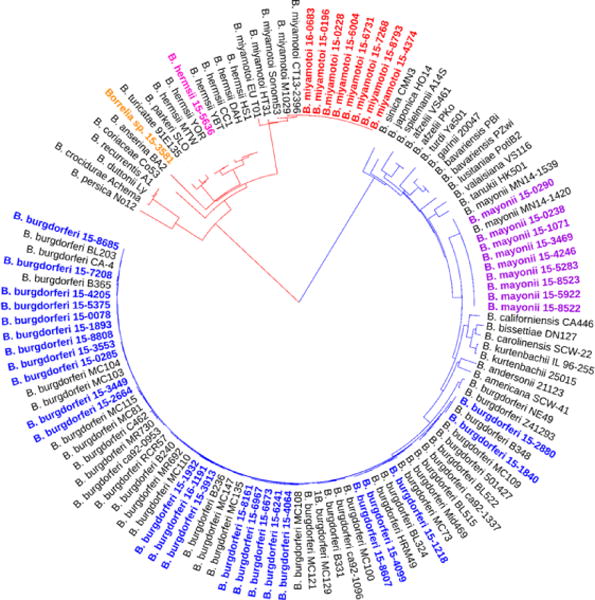
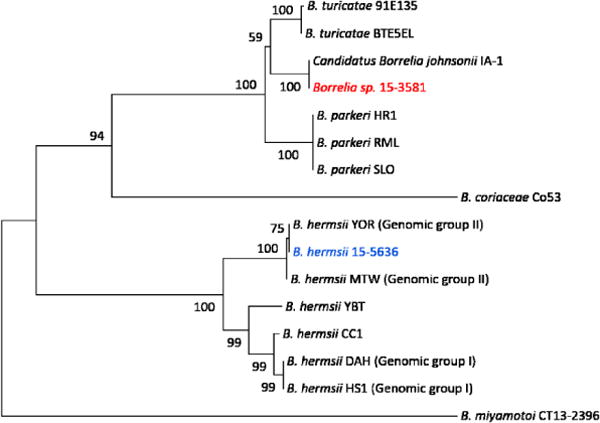
Results: Among 7292 specimens tested, 5 Borrelia species were identified: 2 causing LB, B. burgdorferi (n = 25) and B. mayonii (n = 9), and 3 RF borreliae, B. hermsii (n = 1), B. miyamotoi (n = 8), and Candidatus B. johnsonii (n = 1), a species previously detected only in the bat tick, Carios kelleyi. ST diversity was greatest for B. burgdorferi-positive specimens, with new STs identified primarily among synovial fluids.
Conclusions: These results demonstrate that broad PCR screening followed by MLST is a powerful surveillance tool for uncovering the spectrum of disease-causing Borrelia species, understanding their geographic distribution, and investigating the correlation between B. burgdorferi STs and joint involvement. Detection of Candidatus B. johnsonii in a patient with suspected tickborne disease suggests this species may be a previously undetected cause of illness in humans exposed to bat ticks.
Conflict of interest statement
All authors: No reported conflicts. All authors have submitted the ICMJE Form for Disclosure of Potential Conflicts of Interest.
Figures
References
-
- Cutler SJ. Relapsing Fever Borreliae: A Global Review. Clin Lab Med. 2015;35(4):847–65. - PubMed
-
- Schotthoefer AM, Frost HM. Ecology and Epidemiology of Lyme Borreliosis. Clin Lab Med. 2015;35(4):723–43. - PubMed
-
- Stanek G, Wormser GP, Gray J, Strle F. Lyme borreliosis. Lancet. 2012;379(9814):461–73. - PubMed
-
- Cutler SJ, Ruzic-Sabljic E, Potkonjak A. Emerging borreliae - Expanding beyond Lyme borreliosis. Mol Cell Probes. 2017;31:22–7. - PubMed
Publication types
MeSH terms
Grants and funding
LinkOut - more resources
Full Text Sources
Other Literature Sources
Medical
Molecular Biology Databases
