Review
. 2018 Sep 1;28(9):648-655.
doi: 10.1093/glycob/cwx105.

Selectins in cancer immunity

Affiliations
Review

Selectins in cancer immunity

Lubor Borsig. Glycobiology. .

Abstract

Selectins are vascular adhesion molecules that mediate physiological responses such as inflammation, immunity and hemostasis. During cancer progression, selectins promote various steps enabling the interactions between tumor cells and the blood constituents, including platelets, endothelial cells and leukocytes. Selectins are carbohydrate-binding molecules that bind to sialylated, fucosylated glycan structures. The increased selectin ligand expression on tumor cells correlates with enhanced metastasis and poor prognosis for cancer patients. While, many studies focused on the role of selectin as a mediator of tumor cell adhesion and extravasation during metastasis, there is evidence for selectins to activate signaling cascade that regulates immune responses within a tumor microenvironment. L-Selectin binding induces activation of leukocytes, which can be further modulated by selectin-mediated interactions with platelets and endothelial cells. Selectin ligand on leukocytes, PSGL-1, triggers intracellular signaling in leukocytes that are induced through platelet's P-selectin or endothelial E-selectin binding. In this review, I summarize the evidence for selectin-induced immune modulation in cancer progression that represents a possible target for controlling tumor immunity.


Figures
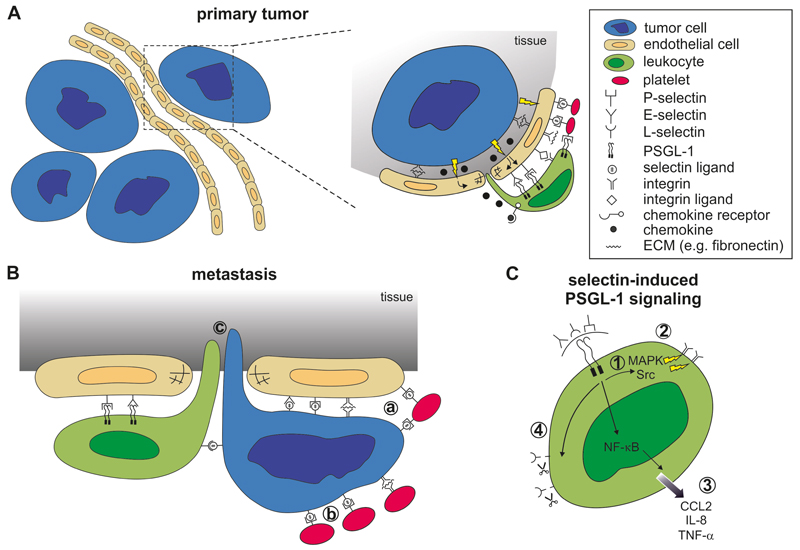
Figure 1
Figure 1. Selectin-dependent signaling during cancer progression.
A) Primary tumor sites: Tumor cells produce various cytokines leading to endothelial activation that result in a leaky vasculature. Tumor-derived chemokines facilitate leukocyte recruitment and their extravasation. Leukocytes expressing PSGL-1 infiltrate tumors through binding to vascular selectins (P- and E-selectin). Platelets further promote leukocyte adhesion through P-selectin-mediated interactions. B) Metastatic sites: Selectins promote tumor cell-endothelial interaction and the recruitment of leukocytes. a: Platelet binding to tumor cells and to the endothelium promote tumor cell adhesion; b: Platelet-tumor cell interactions are largely facilitated by P-selectin; c: Selectin-triggered endothelial activation leads to leukocyte-assisted tumor cell extravasation. C) The intracellular signaling in leukocytes is initiated through selectin-binding to PSGL-1 on leukocytes resulting in 1: activation of MAPK and src kinase pathways; 2: activation of integrins; 3: activation of NF-κB pathways and secretion of cytokines (e.g. CCL2, IL-8 or TNF-α; 4: shedding of cell surface L-selectin.
Figure 2
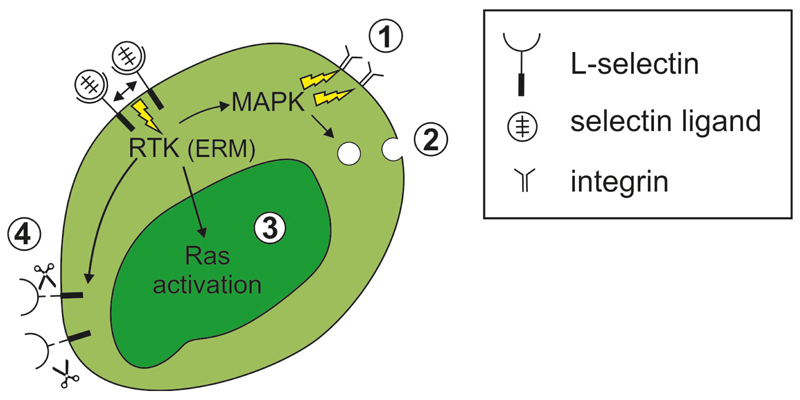
Figure 2. L-selectin-triggered intracellular signaling in leukocytes.
L-selectin binding to ligands causes selectin clustering, which induces receptor tyrosine and serine phosphorylation and activation of the ERM proteins. This leukocyte activation further results in: 1 integrin activation through MAPK kinase; 2 leukocyte degranulation, particularly by neutrophils; 3 activation of the ras pathway; 4 L-selectin shedding, which modulates immune responsiveness of leukocytes.

References

    1. Aigner S, Sthoeger ZM, Fogel M, Weber E, Zarn J, Ruppert M, Zeller Y, Vestweber D, Stahel R, Sammar M, et al. CD24, a mucin-type glycoprotein, is a ligand for P-selectin on human tumor cells. Blood. 1997;89:3385–3395. - PubMed
    1. Aviram R, Raz N, Kukulansky T, Hollander N. Expression of L-selectin and efficient binding to high endothelial venules do not modulate the dissemination potential of murine B-cell lymphoma. Cancer Immunol Immunother. 2001;50:61–68. - PMC - PubMed
    1. Barthel SR, Gavino JD, Descheny L, Dimitroff CJ. Targeting selectins and selectin ligands in inflammation and cancer. Expert Opin Ther Targets. 2007;11:1473–1491. - PMC - PubMed
    1. Boligan KF, Mesa C, Fernandez LE, von Gunten S. Cancer intelligence acquired (CIA): tumor glycosylation and sialylation codes dismantling antitumor defense. Cell Mol Life Sci. 2015;72:1231–1248. - PMC - PubMed
    1. Borsig L, Stevenson JL, Varki A. Heparin in Cancer: Role of Selectin Interactions. In: Khorana AA, Francis CW, editors. Cancer-Associated Thrombosis. New York: Informa Healthcare; 2007. pp. 97–113.

Publication types