Review
. 2017 Dec 22;8(1):288.
doi: 10.1186/s13287-017-0742-8.

Immunoprivileged no more: measuring the immunogenicity of allogeneic adult mesenchymal stem cells

Affiliations
Review

Immunoprivileged no more: measuring the immunogenicity of allogeneic adult mesenchymal stem cells

Alix K Berglund et al. Stem Cell Res Ther. .

Abstract

Background: Autologous and allogeneic adult mesenchymal stem/stromal cells (MSCs) are increasingly being investigated for treating a wide range of clinical diseases. Allogeneic MSCs are especially attractive due to their potential to provide immediate care at the time of tissue injury or disease diagnosis. The prevailing dogma has been that allogeneic MSCs are immune privileged, but there have been very few studies that control for matched or mismatched major histocompatibility complex (MHC) molecule expression and that examine immunogenicity in vivo. Studies that control for MHC expression have reported both cell-mediated and humoral immune responses to MHC-mismatched MSCs. The clinical implications of immune responses to MHC-mismatched MSCs are still unknown. Pre-clinical and clinical studies that document the MHC haplotype of donors and recipients and measure immune responses following MSC treatment are necessary to answer this critical question.

Conclusions: This review details what is currently known about the immunogenicity of allogeneic MSCs and suggests contemporary assays that could be utilized in future studies to appropriately identify and measure immune responses to MHC-mismatched MSCs.

Keywords: Allogeneic; Cytotoxicity; ELISPOT; Immunogenicity; Major histocompatibility complex; Mesenchymal stem cell; Microcytotoxicity; Mixed leukocyte reaction.


Conflict of interest statement

Ethics approval and consent to participate

Not applicable

Consent for publication

Not applicable

Competing interests

The authors declare that they have no competing interests.

Publisher’s Note

Springer Nature remains neutral with regard to jurisdictional claims in published maps and institutional affiliations.

Figures
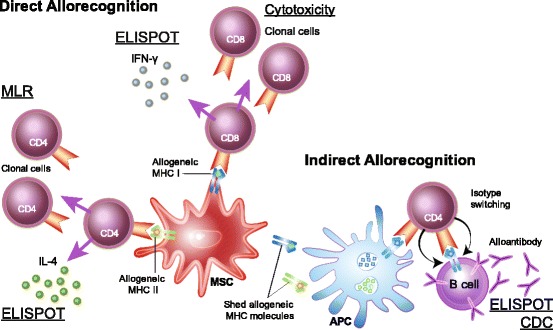
Fig. 1
Fig. 1
In-vivo immune responses to MHC-mismatched MSCs and corresponding assays. Following injection of MHC-mismatched MSCs in vivo, allogeneic MHC I molecules are directly recognized by alloreactive CD8+ T cells, which induces secretion of interferon (IFN)-γ and clonal expansion of cytotoxic T cells. IFN-γ secretion by T cells restimulated with donor allogeneic MHC I molecules can be measured using an ELISPOT. Effector function of cytotoxic T cells specific for donor allogeneic MHC I molecules can be measured using cytotoxicity assays. Allogeneic MHC II molecules are directly recognized by alloreactive CD4+ T cells, which induces secretion of IL-4 or IFN-γ and clonal expansion of helper T cells. IL-4 secretion by T cells restimulated with donor allogeneic MHC II molecules can be measured by ELISPOT. Expansion of MHC-specific CD4+ T cells can be detected using an ex-vivo MLR. Allogeneic MHC molecules can be shed into the environment where they are processed and presented to lymphocytes by APCs. Following activation by allogeneic MHC peptides, B cells can produce alloantibodies with the support of CD4+ T cells activated by indirect allorecognition. Alloantibodies can be detected by ELISPOT or complement-dependent cytotoxicity assays. APC antigen-presenting cell, CDC complement-dependent cytotoxicity, ELISPOT enzyme-linked immunospot, IL-4 interleukin-4, MHC major histocompatibility complex, MLR mixed leukocyte reaction, MSC mesenchymal stem cell

References

    1. Dominici M, Le Blanc K, Mueller I, Slaper-Cortenbach I, Marini F, Krause D, et al. Minimal criteria for defining multipotent mesenchymal stromal cells. The International Society for Cellular Therapy position statement. Cytotherapy. 2006;8:315–7. doi: 10.1080/14653240600855905. - DOI - PubMed
    1. Calloni R, Viegas GS, Türck P, Bonatto D, Pegas Henriques JA. Mesenchymal stromal cells from unconventional model organisms. Cytotherapy. 2014;16:3–16. doi: 10.1016/j.jcyt.2013.07.010. - DOI - PubMed
    1. Caplan AI. MSCs: the sentinel and safe-guards of injury. J Cell Physiol. 2016;231:1413–6. doi: 10.1002/jcp.25255. - DOI - PubMed
    1. de Souza LEB, Malta TM, Kashima Haddad S, Covas DT. Mesenchymal stem cells and pericytes: to what extent are they related? Stem Cells Dev. 2016;25:scd.2016.0109. doi: 10.1089/scd.2016.0109. - DOI - PubMed
    1. Caplan AI. Mesenchymal stem cells. J Orthop Res. 1991;9:641–50. doi: 10.1002/jor.1100090504. - DOI - PubMed

Publication types

MeSH terms
