. 2017 Dec 20;2(6):e00402-17.
doi: 10.1128/mSphere.00402-17. eCollection 2017 Nov-Dec.

Comparison of Zoonotic Bacterial Agents in Fleas Collected from Small Mammals or Host-Seeking Fleas from a Ugandan Region Where Plague Is Endemic

Affiliations

Comparison of Zoonotic Bacterial Agents in Fleas Collected from Small Mammals or Host-Seeking Fleas from a Ugandan Region Where Plague Is Endemic

Ying Bai et al. mSphere. .

Abstract

Fleas (n = 407) were collected from small mammals trapped inside huts and surroundings of homesteads in five villages within the Arua and Zombo districts of Uganda. The most common flea species were Dinopsyllus lypusus (26%) and Xenopsylla cheopis (50%). Off-host fleas (n = 225) were collected inside huts by using Kilonzo flea traps. The majority of the off-host fleas were Ctenocephalides felis (80%). All fleas were examined for the presence of Bartonella spp., Rickettsia spp., and Yersinia spp. Bartonella DNA was detected in 91 fleas, with an overall prevalence of 14%. Bartonella prevalence was significantly higher in rodent or shrew fleas than in off-host fleas (22% versus 1%). The majority of Bartonella-positive fleas were of the species D. lypusus (61%), X. cheopis (20%), and Ctenophthalmus calceatus (14%). Sequencing analysis identified 12 Bartonella genetic variants, 9 of which belonged to the zoonotic pathogen B. elizabethae species complex. Rickettsia DNA was detected in 143 fleas, giving an overall prevalence of 23%, with a significantly higher prevalence in off-host fleas than in rodent or shrew fleas (56% versus 4%). The majority (88%) of Rickettsia-positive fleas were C. felis and were collected from Kilonzo traps, while a small portion (10%) were X. cheopis collected from rodents. Sequencing analysis identified six Rickettsia genogroups that belonged either to zoonotic R. felis or to the closely related "Candidatus Ricksettia asemboensis" and "Candidatus Ricksettia sengalensis." Yersinia DNA was not detected in the fleas tested. These observations suggested that fleas in northwestern Uganda commonly carry the zoonotic agents B. elizabethae and R. felis and potentially play an important role in transmitting these infections to humans. IMPORTANCE Fleas play critical roles in transmitting some infections among animals and from animals to humans. Detection of pathogens in fleas is important to determine human risks for flea-borne diseases and can help guide diagnosis and treatment. Our findings of high prevalence rates of B. elizabethae and R. felis in fleas in the Arua and Zombo districts of Uganda implicate these agents as potential causative agents of undiagnosed febrile illnesses in this area.

Keywords: Bartonella; Rickettsia; Uganda; Yersinia; fleas; off-host; rodents.


Figures
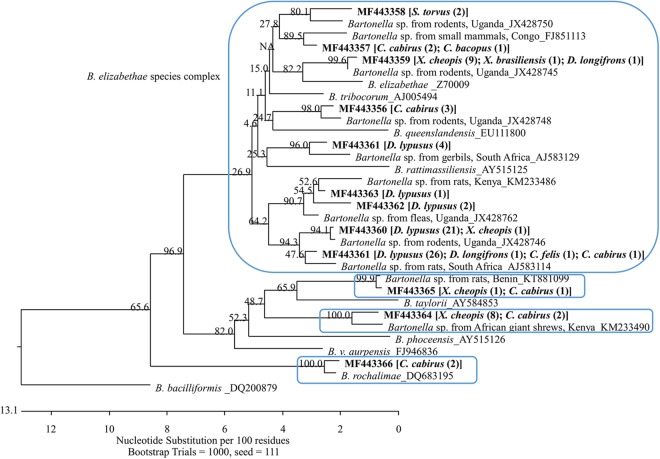
FIG 1
FIG 1
Phylogenetic relationships of the 12 Bartonella genetic variants, identified from 91 Bartonella sequences obtained from fleas collected from small mammals or Kilonzo traps in the West Nile region of Uganda, with other Bartonella species based on partial sequences of gltA. Each genetic variant is indicated by its GenBank accession number in boldface, followed by flea species and number of identical sequences obtained from the flea species in brackets and parentheses. The Bartonella variants formed four phylogroups (boxed clades). Nine of the 12 variants fell into the so-called B. elizabethae species complex. The phylogenetic tree was constructed by the neighbor-joining method, and bootstrap values were calculated with 1,000 replicates.
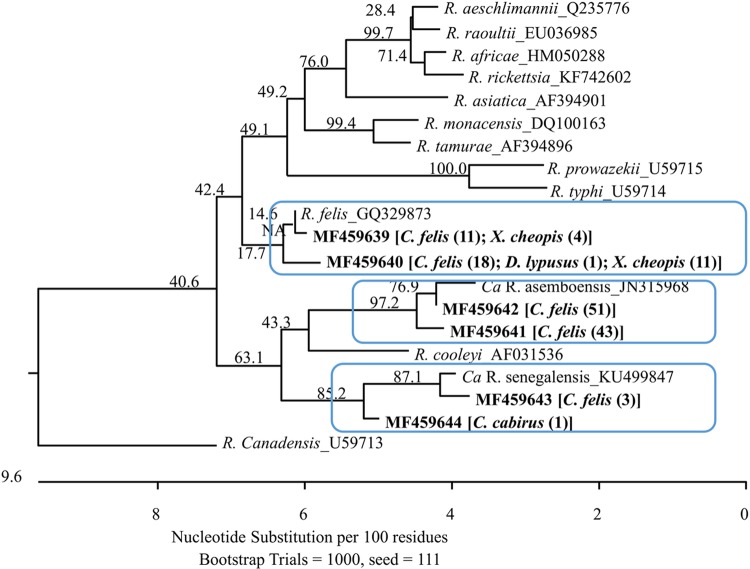
FIG 2
FIG 2
Phylogenetic relationships of the six Rickettsia genetic variants identified from 143 Rickettsia sequences, obtained from the fleas collected from small mammals or Kilonzo traps in the West Nile region of Uganda, with some other Rickettsia species based on partial sequences of gltA. Each genetic variant is indicated by its GenBank accession number in boldface, followed by the flea species and number of identical sequences obtained from the flea species in brackets and parentheses. The Rickettsia variants formed three phylogroups (boxed clades). Two variants fell into the cluster of R. felis; other variants clustered with either “Candidatus R. asemboensis” or “Candidatus R. sengalensis.” The phylogenetic tree was constructed by the neighbor-joining method, and bootstrap values were calculated with 1,000 replicates.

References

    1. Moore SM, Monaghan A, Griffith KS, Apangu T, Mead PS, Eisen RJ. 2012. Improvement of disease prediction and modeling through the use of meteorological ensembles: human plague in Uganda. PLoS One 7:e44431. doi: 10.1371/journal.pone.0044431. - DOI - PMC - PubMed
    1. Amatre G, Babi N, Enscore RE, Ogen-Odoi A, Atiku LA, Akol A, Gage KL, Eisen RJ. 2009. Flea diversity and infestation prevalence on rodents in a plague-endemic region of Uganda. Am J Trop Med Hyg 81:718–724. doi: 10.4269/ajtmh.2009.09-0104. - DOI - PubMed
    1. Eisen RJ, MacMillan K, Atiku LA, Mpanga JT, Zielinski-Gutierrez E, Graham CB, Boegler KA, Enscore RE, Gage KL. 2014. Identification of risk factors for plague in the West Nile region of Uganda. Am J Trop Med Hyg 90:1047–1058. doi: 10.4269/ajtmh.14-0035. - DOI - PMC - PubMed
    1. Jones RT, Borchert J, Eisen R, MacMillan K, Boegler K, Gage KL. 2015. Flea-associated bacterial communities across an environmental transect in a plague-endemic region of Uganda. PLoS One 10:e0141057. doi: 10.1371/journal.pone.0141057. - DOI - PMC - PubMed
    1. Eisen RJ, Borchert JN, Mpanga JT, Atiku LA, MacMillan K, Boegler KA, Montenieri JA, Monaghan A, Gage KL. 2012. Flea diversity as an element for persistence of plague bacteria in an East African plague focus. PLoS One 7:e35598. doi: 10.1371/journal.pone.0035598. - DOI - PMC - PubMed

LinkOut - more resources