Review
. 2017 Dec 26;11(1):30.
doi: 10.3390/ma11010030.

Tribochemical Characterization and Tribocorrosive Behavior of CoCrMo Alloys: A Review

Affiliations
Review

Tribochemical Characterization and Tribocorrosive Behavior of CoCrMo Alloys: A Review

Wei Quan Toh et al. Materials (Basel). .

Abstract

Orthopedic implants first started out as an all-metal hip joint replacement. However, poor design and machinability as well as unsatisfactory surface finish subjected the all-metal joint replacement to being superseded by a polyethylene bearing. Continued improvement in manufacturing techniques together with the reality that polyethylene wear debris can cause hazardous reactions in the human body has brought about the revival of metal-on-metal (MOM) hip joints in recent years. This has also led to a relatively new research area that links tribology and corrosion together. This article aims at reviewing the commonly used tribochemical methods adopted in the analysis of tribocorrosion and putting forward some of the models and environmental factors affecting the tribocorrosive behavior of CoCrMo alloys, a widely-used class of biomaterial for orthopedic implants.

Keywords: CoCrMo alloy; additive manufacturing; micro/nanoscale; tribochemistry; tribocorrosion.


Conflict of interest statement

The authors declare no conflict of interest.

Figures
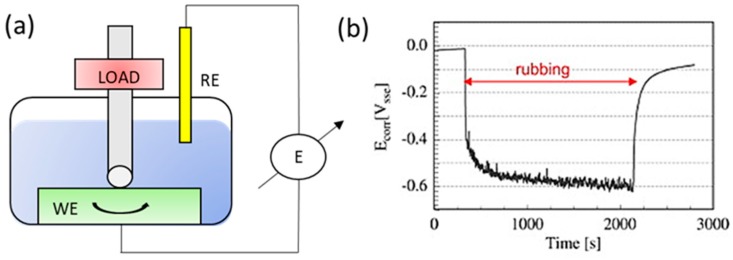
Figure 1
Figure 1
(a) Schematic illustration of a typical ball-on-disc (rotating) tribocorrosion experimental set-up that allows the measurement of corrosion potential (RE: standard silver/silver chloride or Ag/AgCl reference electrode); (b) Measurement of the corrosion potential of Ti6Al4V alloy rubbing against an alumina ball in a 0.9% NaCl solution (adapted from references [21,22], with permission from © Elsevier), where Ecorr = potential difference between working electrode (WE) and RE.
Figure 2
Figure 2
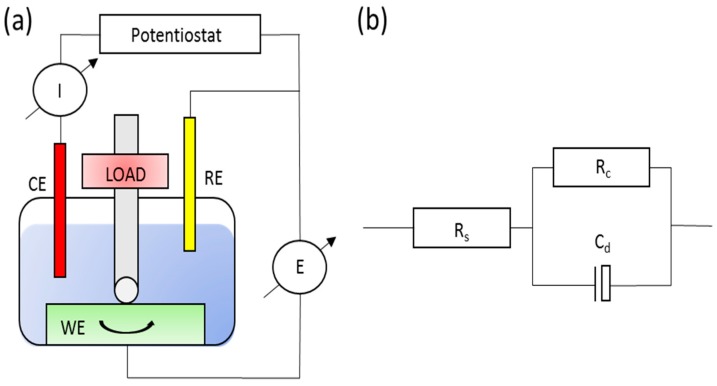
(a) A schematic illustration of a typical ball-on-disc (rotating) tribocorrosion experimental set-up that allows for potentiodynamic and potentiostatic measurements; (b) a typical Randles circuit used to represent experimental data through electrochemical impedance (EIS) measurement for a tribocorrosion test.
Figure 3
Figure 3
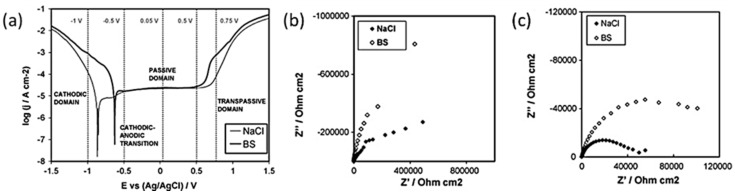
(a) Potentiodynamic curves obtained for HC CoCrMo alloy in NaCl and bovine serum [31]; (b,c) Nyquist diagrams showing the impedance characteristics in NaCl and bovine solution at (b) 0.05 VAg/AgCl and (c) 0.5 VAg/AgCl (adapted from reference [31], with permission from © Elsevier).
Figure 4
Figure 4
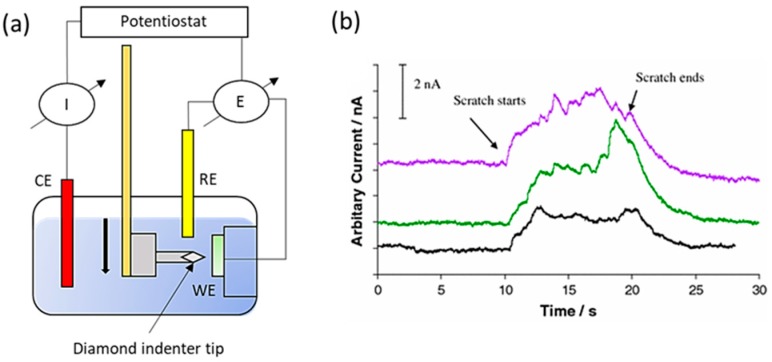
(a) A schematic showing the set-up for well-cell nano-scratching experiments; (b) Current profiles induced by 3 independent single scratches in NaCl (adapted from reference [37], with permission from © Springer Nature).
Figure 5
Figure 5
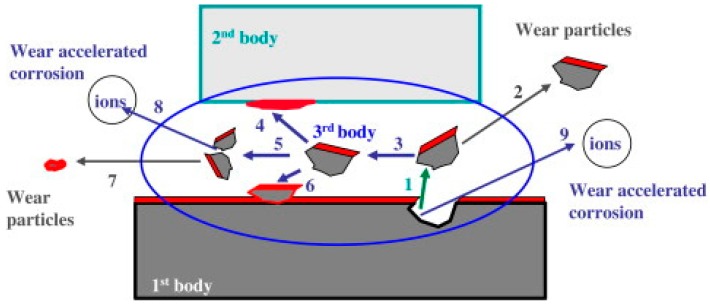
Schematic illustration of material flows and reactions occurring in a tribocorrosion system, with the first body: a passive metal; second body: an inert counter-body and third body: generated from the resulting process. In a tribocorssoion process, the wearing process causes the detachment of the wear particles from the metal (1), which would either be ejected (2) or transferred to a third body (3); Subsequently, the third body can adhere to the counter body (4); or fragment into smaller particles (5); or the metal (6); Upon reaching a critical size, the third body can be ejected from the contact (7); In addition, wear accelerated corrosion can be observed in two locations: third body (8) and exposed metal (9) (occurring immediately after the wear particle detaches) (adapted from reference [21], with permission from © Elsevier).
Figure 6
Figure 6
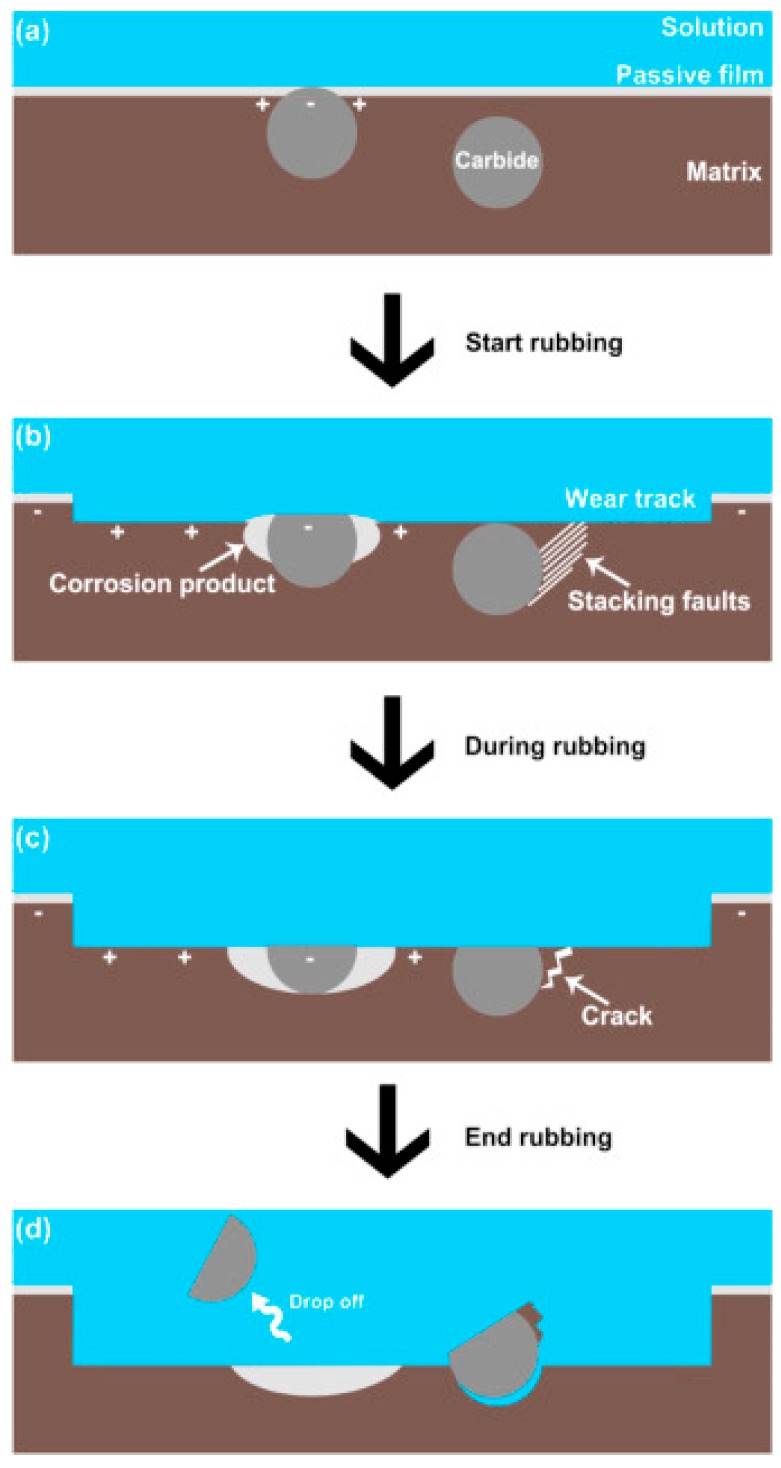
Schematic diagrams showing the proposed tribocorrosion mechanism of HC CoCrMo alloy with time from the start to the end of rubbing (adapted from reference [53], with permission from © Elsevier).
Figure 7
Figure 7
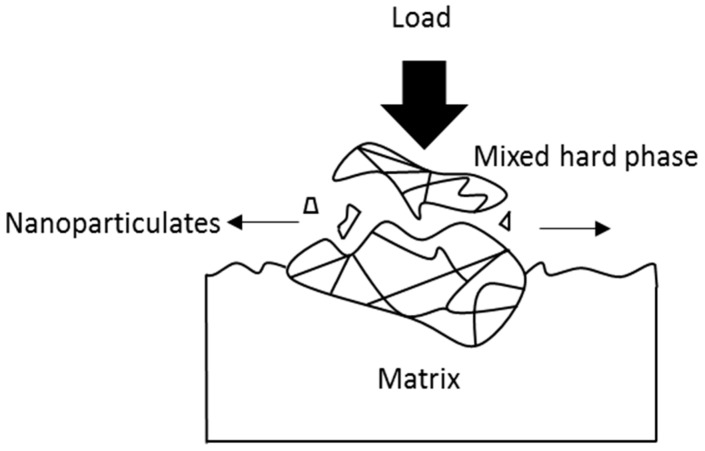
Schematic illustration of nanoparticulates that are generated from the mixed hard phases under a high load.
Figure 8
Figure 8
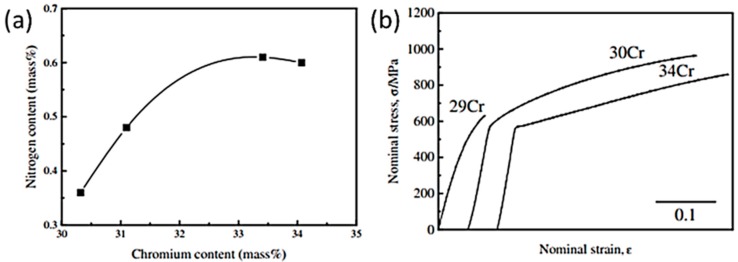
(a) The relationship between N and Cr contents and (b) the corresponding nominal stress-strain curves of the tested CoCrMo alloys (adapted from reference [63], with permission from © The Japan Institute of Metals and Materials).
Figure 9
Figure 9
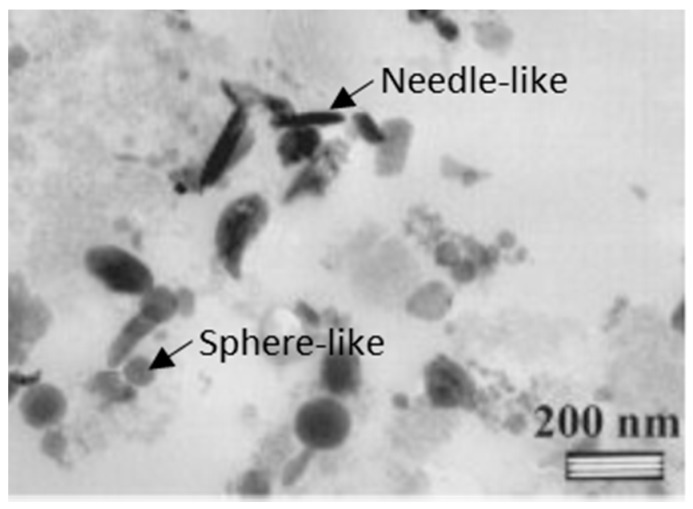
Transmission electron microscopy (TEM) micrograph of different shapes of the wear particles generated from a metal-on-metal (MOM) implant pair of HC-CoCrMo alloy in 95% bovine serum (adapted from reference [85], with permission from © John Wiley and Sons).
Figure 10
Figure 10
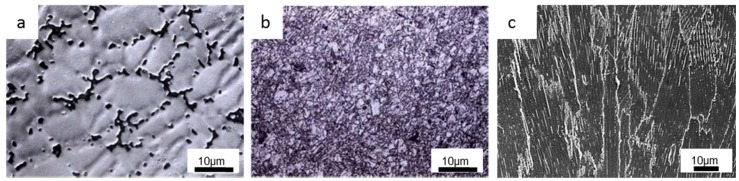
(a,b) Optical images on the typical microstructure of the (a) cast and (b) forged CoCrMo alloys (adapted from reference [51], with permission from © Elsevier) and (c) SEM image of selective electron beam melting (SEBM)-built CoCrMo alloy.
Figure 11
Figure 11
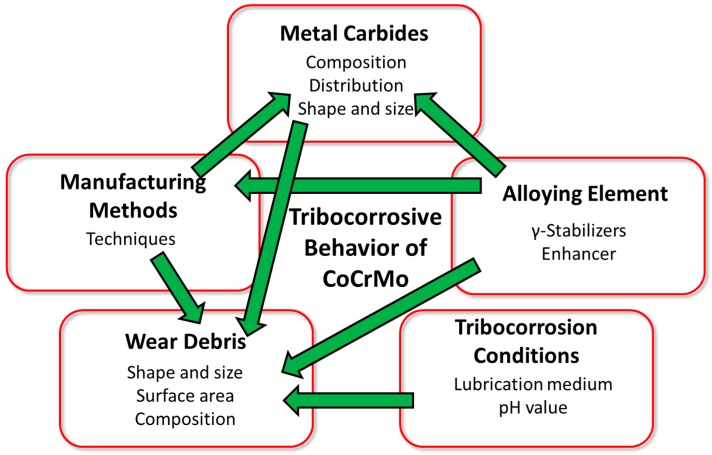
Schematic illustration of the five types of influence affecting the tribocorrosive behavior of CoCrMo alloys.

References

    1. Landolt D., Mischler S. Tribocorrosion of Passive Metals and Coatings. Elsevier; Amsterdam, The Netherlands: 2011.
    1. Yan Y. Bio-Tribocorrosion in Biomaterials and Medical Implants. Elsevier; Amsterdam, The Netherlands: 2013.
    1. Zhang S., Zhao D. Aerospace Materials Handbook. CRC Press; Boca Raton, FL, USA: 2012.
    1. Yan Y. Ph.D. Thesis. University of Leeds; Leeds, UK: Mar, 2006. Corrosion and Trib-Corrosion Behaviour of Metallic Orthopaedic Implant Materials.
    1. Anaee R.A.M., Abdulmajeed M.H. Advances in Tribology. InTech; Vienna, Austria: 2016. Tribocorrosion.

LinkOut - more resources