


Bacillus subtilis, the model Gram-positive bacterium: 20 years of annotation refinement
- PMID: 29280348
- PMCID: PMC5743806
- DOI: 10.1111/1751-7915.13043
Bacillus subtilis, the model Gram-positive bacterium: 20 years of annotation refinement
Abstract
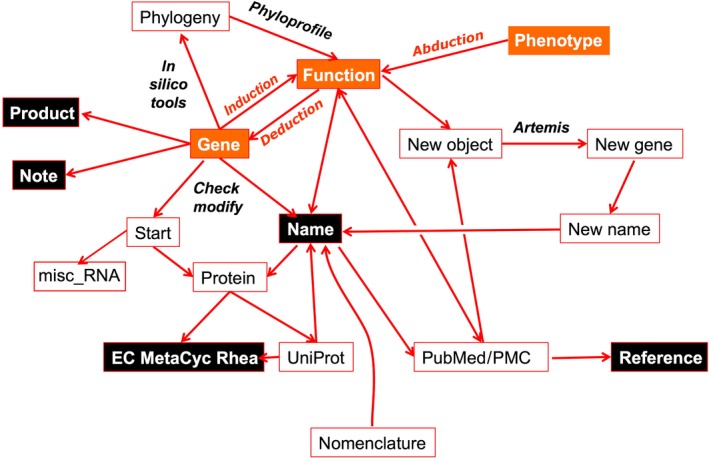
Genome annotation is, nowadays, performed via automatic pipelines that cannot discriminate between right and wrong annotations. Given their importance in increasing the accuracy of the genome annotations of other organisms, it is critical that the annotations of model organisms reflect the current annotation gold standard. The genome of Bacillus subtilis strain 168 was sequenced twenty years ago. Using a combination of inductive, deductive and abductive reasoning, we present a unique, manually curated annotation, essentially based on experimental data. This reveals how this bacterium lives in a plant niche, while carrying a paleome operating system common to Firmicutes and Tenericutes. Dozens of new genomic objects and an extensive literature survey have been included for the sequence available at the INSDC (AccNum AL009126.3). We also propose an extension to Demerec's nomenclature rules that will help investigators connect to this type of curated annotation via the use of common gene names.
© 2017 The Authors. Microbial Biotechnology published by John Wiley & Sons Ltd and Society for Applied Microbiology.
Figures
References
-
- Abdallah, J. , Mihoub, M. , Gautier, V. , and Richarme, G. (2016) The DJ‐1 superfamily members YhbO and YajL from Escherichia coli repair proteins from glycation by methylglyoxal and glyoxal. Biochem Biophys Res Commun 470: 282–286. - PubMed
-
- Abe, K. , Takamatsu, T. and Sato, T. (2017) Mechanism of bacterial gene rearrangement: SprA‐catalyzed precise DNA recombination and its directionality control by SprB ensure the gene rearrangement and stable expression of spsM during sporulation in Bacillus subtilis . Nucleic Acids Res 45, 6669–6683. - PMC - PubMed
-
- Abriata, L.A. , Albanesi, D. , Dal Peraro, M. , and de Mendoza, D. (2017) Signal sensing and transduction by histidine kinases as unveiled through studies on a temperature sensor. Acc Chem Res 50: 1359–1366. - PubMed
Publication types
MeSH terms
Grants and funding
LinkOut - more resources
Full Text Sources
Other Literature Sources
Molecular Biology Databases
