


Reported Incidence and Survival of Fallopian Tube Carcinomas: A Population-Based Analysis From the North American Association of Central Cancer Registries
- PMID: 29281053
- PMCID: PMC6037124
- DOI: 10.1093/jnci/djx263
Reported Incidence and Survival of Fallopian Tube Carcinomas: A Population-Based Analysis From the North American Association of Central Cancer Registries
Erratum in
-
Corrigendum to "Reported Incidence and Survival of Fallopian Tube Carcinomas: A Population-Based Analysis From the North American Association of Central Cancer Registries".J Natl Cancer Inst. 2018 Jun 1;110(6):682. doi: 10.1093/jnci/djy078. J Natl Cancer Inst. 2018. PMID: 29635459 Free PMC article. No abstract available.
Abstract
Background: Recognition that serous tubal intraepithelial carcinoma (STIC) may represent the first manifestation of many high-grade cancers that were once considered ovarian primary tumors has led to changes in diagnostic practices that could dramatically increase the reporting of tubal carcinomas in US population-based cancer registries. Further, increased detection of early-stage tubal carcinomas through increased recognition coupled with meticulous pathology processing protocols raises important unanswered questions about the clinical behavior of such lesions, which can only be answered using large data sets. However, rates of tubal carcinomas have not been recently analyzed. Accordingly, we analyzed population-based incidence and survival data for fallopian tube carcinoma in situ (CIS; an imperfect surrogate of STIC), tubal carcinomas, and for comparison, ovarian carcinomas, in the North American Association of Central Cancer Registries (NAACCR) registries.
Methods: Total counts, standardized incidence rates, and stage-specific survival were computed using 30 NAACCR registries (1999-2012). Temporal incidence rate patterns were analyzed by joinpoint regression with estimates of annual percentage change (APC). All statistical tests were two-sided.
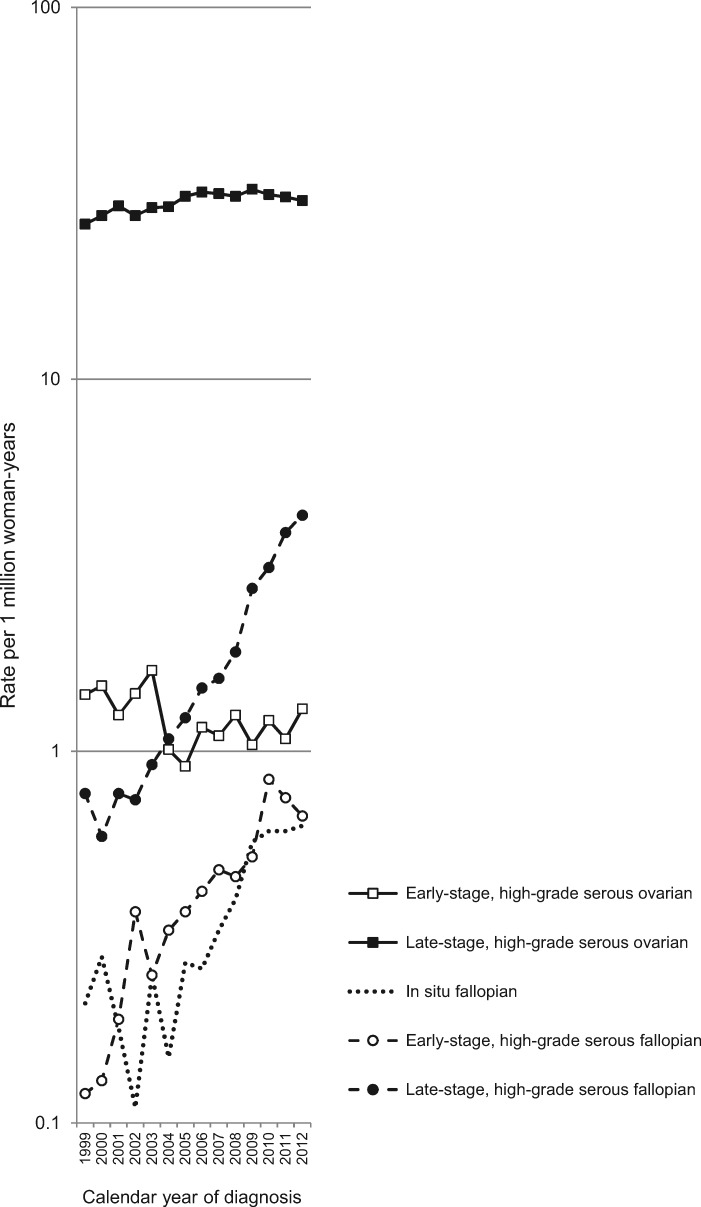
Results: Fallopian tube CIS incidence rates were stable from 1999 to 2002, then increased from 2002 to 2012 (APC = 16.2%, 95% confidence interval [CI] = 10.9% to 21.7%, P < .001). Rates of early- and late-stage tubal carcinomas showed similar patterns, whereas high-grade serous ovarian carcinoma rates were relatively stable. Five-year cause-specific survival was 97.9% (95% CI = 93.7% to 99.3%) for tubal CIS and 83.2% (95% CI = 77.3% to 87.7%) for early-stage high-grade serous tubal carcinoma.
Conclusions: Reporting of tubal CIS and tubal carcinoma have increased in recent years, likely reflecting changes in pathology processing of specimens and diagnosis. Developing standardized reporting for tubal neoplasms is needed to enable analysis of outcomes for these comparatively uncommon but increasingly recognized tumors.
Figures
Comment in
-
Precancerous Lesions of Ovarian Cancer-A US Perspective.J Natl Cancer Inst. 2018 Jul 1;110(7):692-693. doi: 10.1093/jnci/djx269. J Natl Cancer Inst. 2018. PMID: 29281080 No abstract available.
References
-
- Crum CP, McKeon FD, Xian W.. BRCA, the oviduct, and the space and time continuum of pelvic serous carcinogenesis. Int J Gynecol Cancer. 2012;22:S29–S34. - PubMed
Publication types
MeSH terms
LinkOut - more resources
Full Text Sources
Other Literature Sources
Medical
