


Protein-protein conjugate nanoparticles for malaria antigen delivery and enhanced immunogenicity
- PMID: 29281708
- PMCID: PMC5744994
- DOI: 10.1371/journal.pone.0190312
Protein-protein conjugate nanoparticles for malaria antigen delivery and enhanced immunogenicity
Abstract
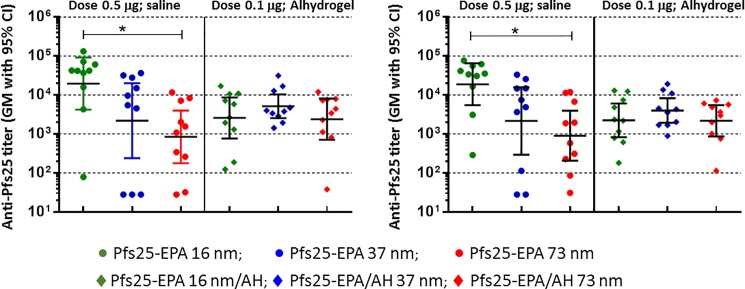
Chemical conjugation of polysaccharide to carrier proteins has been a successful strategy to generate potent vaccines against bacterial pathogens. We developed a similar approach for poorly immunogenic malaria protein antigens. Our lead candidates in clinical trials are the malaria transmission blocking vaccine antigens, Pfs25 and Pfs230D1, individually conjugated to the carrier protein Exoprotein A (EPA) through thioether chemistry. These conjugates form nanoparticles that show enhanced immunogenicity compared to unconjugated antigens. In this study, we examined the broad applicability of this technology as a vaccine development platform, by comparing the immunogenicity of conjugates prepared by four different chemistries using different malaria antigens (PfCSP, Pfs25 and Pfs230D1), and carriers such as EPA, TT and CRM197. Several conjugates were synthesized using thioether, amide, ADH and glutaraldehyde chemistries, characterized for average molecular weight and molecular weight distribution, and evaluated in mice for humoral immunogenicity. Conjugates made with the different chemistries, or with different carriers, showed no significant difference in immunogenicity towards the conjugated antigens. Since particle size can influence immunogenicity, we tested conjugates with different average size in the range of 16-73 nm diameter, and observed greater immunogenicity of smaller particles, with significant differences between 16 and 73 nm particles. These results demonstrate the multiple options with respect to carriers and chemistries that are available for protein-protein conjugate vaccine development.
Conflict of interest statement
Figures
References
-
- Nunes JK, Woods C, Carter T, Raphael T, Morin MJ, Diallo D, et al. Development of a transmission-blocking malaria vaccine: progress, challenges, and the path forward. Vaccine. 2014;32(43):5531–9. doi: 10.1016/j.vaccine.2014.07.030 . - DOI - PubMed
-
- Duffy PE, Sahu T, Akue A, Milman N, Anderson C. Pre-erythrocytic malaria vaccines: identifying the targets. Expert Rev Vaccines. 2012;11(10):1261–80. doi: 10.1586/erv.12.92 ; PubMed Central PMCID: PMCPMC3584156. - DOI - PMC - PubMed
-
- Miura K. Progress and prospects for blood-stage malaria vaccines. Expert Rev Vaccines. 2016;15(6):765–81. doi: 10.1586/14760584.2016.1141680 ; PubMed Central PMCID: PMCPMC4915341. - DOI - PMC - PubMed
-
- Olotu A, Fegan G, Wambua J, Nyangweso G, Leach A, Lievens M, et al. Seven-Year Efficacy of RTS,S/AS01 Malaria Vaccine among Young African Children. N Engl J Med. 2016;374(26):2519–29. doi: 10.1056/NEJMoa1515257 ; PubMed Central PMCID: PMCPMC4962898. - DOI - PMC - PubMed
-
- Richie TL, Billingsley PF, Sim BK, James ER, Chakravarty S, Epstein JE, et al. Progress with Plasmodium falciparum sporozoite (PfSPZ)-based malaria vaccines. Vaccine. 2015;33(52):7452–61. doi: 10.1016/j.vaccine.2015.09.096 ; PubMed Central PMCID: PMCPMC5077156. - DOI - PMC - PubMed
Publication types
MeSH terms
Substances
LinkOut - more resources
Full Text Sources
Other Literature Sources
Research Materials
