Survival and Functional Outcome after Treatment for Primary Base of Tongue Cancer: A Comparison of Definitive Chemoradiotherapy versus Surgery Followed by Adjuvant Radiotherapy
- PMID: 29281874
- PMCID: PMC6192900
- DOI: 10.4143/crt.2017.498
Survival and Functional Outcome after Treatment for Primary Base of Tongue Cancer: A Comparison of Definitive Chemoradiotherapy versus Surgery Followed by Adjuvant Radiotherapy
Abstract
Purpose: The purpose of this study was to compare the clinical and functional outcomes in patients with primary base of tongue (BOT) cancer who received definitive radiotherapy (RT) or surgery followed by radiotherapy (SRT).
Materials and methods: Between January 2002 andDecember 2016, 102 patientswith stage I-IVB primary BOT cancer underwent either definitive RT (n=46) or SRT (n=56), and treatment outcomeswere compared between two groups. The expression of p16 was also analyzed.
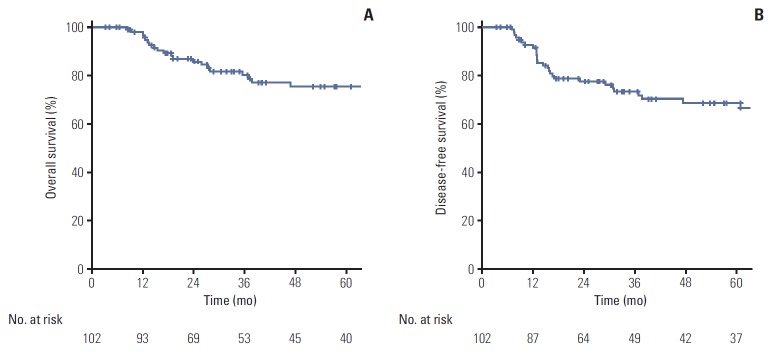
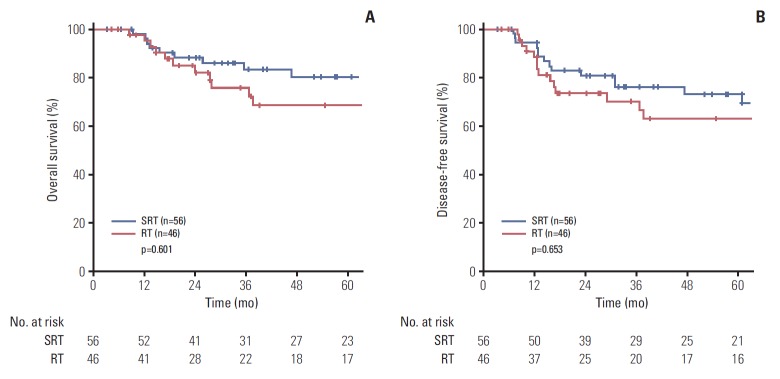
Results: The RT group had more patients with advanced T stage (T3-4) disease (58.7% vs. 35.7%, p=0.021) and who received chemotherapy (91.3% vs. 37.5%, p < 0.001) than the SRT group. At a median followup of 36.9 months (range, 3.3 to 181.5 months), the 5-year overall survival (OS) and disease-free survival (DFS) were 75.5% and 68.7%, respectively. With respect to treatment group, the 5-year OS and DFS in the RT and SRT groups did not differ significantly (OS, 68.7% vs. 80.5%, p=0.601; DFS, 63.1% vs. 73.1%, p=0.653). In multivariate analysis, OS differed significantly according to p16 expression (p16-negative vs. p16- positive; hazard ratio [HR], 0.145; 95% confidence interval [CI], 0.025 to 0.853; p=0.033). Regarding DFS, p16 expression (p16-negative vs. p16-positive; HR, 0.164; 95% CI, 0.045 to 0.598; p=0.006) showed a significant effect in multivariate analysis. Functional defects (late grade ≥ 3 dysphagia or voice alteration) were more frequently reported in the SRT than in the RT group (16.1% vs. 2.2%, p=0.021).
Conclusion: Despite advanced disease, patients in the RT group showed comparable survival outcomes and better functional preservation than those in the SRT group.
Keywords: Base of tongue cancer; Organ preservation; Radiotherapy; Surgery; Treatment outcome.
Conflict of interest statement
Conflict of interest relevant to this article was not reported.
Figures
References
-
- Karakoyun-Celik O, Norris CM, Jr, Tishler R, Mahadevan A, Clark JR, Goldberg S, et al. Definitive radiotherapy with interstitial implant boost for squamous cell carcinoma of the tongue base. Head Neck. 2005;27:353–61. - PubMed
-
- Sessions DG, Lenox J, Spector GJ, Chao C, Chaudry OA. Analysis of treatment results for base of tongue cancer. Laryngoscope. 2003;113:1252–61. - PubMed
-
- Machtay M, Perch S, Markiewicz D, Thaler E, Chalian A, Goldberg A, et al. Combined surgery and postoperative radiotherapy for carcinoma of the base of radiotherapy for carcinoma of the base of tongue: analysis of treatment outcome and prognostic value of margin status. Head Neck. 1997;19:494–9. - PubMed
-
- Fein DA, Lee WR, Amos WR, Hinerman RW, Parsons JT, Mendenhall WM, et al. Oropharyngeal carcinoma treated with radiotherapy: a 30-year experience. Int J Radiat Oncol Biol Phys. 1996;34:289–96. - PubMed
-
- Lorincz BB, Jowett N, Knecht R. Decision management in transoral robotic surgery: Indications, individual patient selection, and role in the multidisciplinary treatment for head and neck cancer from a European perspective. Head Neck. 2016;38 Suppl 1:E2190–6. - PubMed
Publication types
MeSH terms
LinkOut - more resources
Full Text Sources
Other Literature Sources