


An investigation of factors predicting the type of bladder antimuscarinics initiated in Medicare nursing homes residents
- PMID: 29282013
- PMCID: PMC5745609
- DOI: 10.1186/s12877-017-0690-2
An investigation of factors predicting the type of bladder antimuscarinics initiated in Medicare nursing homes residents
Abstract
Background: To examine factors predicting type of bladder antimuscarinics (BAM) initiated in nursing home (NH) residents.
Methods: Incident BAM initiators following NH admission were identified by constructing a retrospective cohort from Medicare files and Minimum Data Set (MDS). Participants included all residents 65 years and older admitted in Medicare-certified NH between January 1, 2007 and December 31, 2008 who were prescribed BAM and had continuous Medicare (Part A, B, and D) enrollment. Patient characteristics, medications, and comorbidities were derived from Medicare enrollment and claims. NH characteristics and health status were derived from MDS assessments. The outcome was defined as type of BAM initiated after admission (selective, non-selective extended release, non-selective immediate release). Multinomial logistic regression using generalized estimating equation methodology determined which factors predicted the type of BAM initiated.
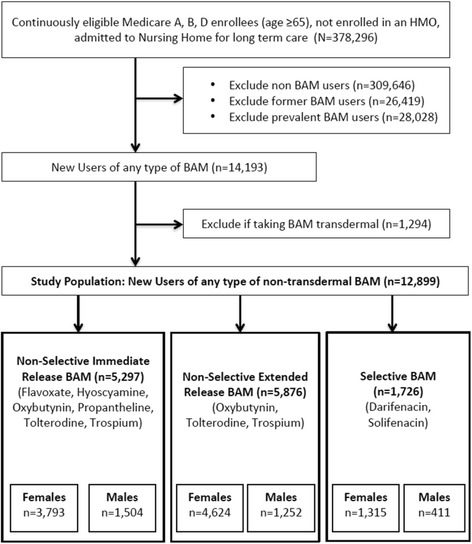
Results: Twelve thousand eight hundred ninety-nine NH residents initiating BAM therapy were identified; 13.38% of new users were prescribed selective BAM, 45.56% non-selective extended release, and 41.07% non-selective immediate release medications. In both sexes, significant predictors of BAM included region of nursing home, body mass index, cognitive performance score, frailty measures, activities of daily living, and measures of bladder continence. In women, history of fracture and fall-related injuries were significant predictors of type of BAM use, while race and indicators of balance were significant predictors of type of BAM use in men. Non-pharmacological continence management strategies were not predictive of type of BAM initiation.
Conclusions: Several factors are important in predicting type of BAM initiation in both women and men, but other factors are sex-specific. Some observed factors predicting the type of BAM initiated, such as other medications use, body mass index, or provider-related factors are potentially modifiable and could be used in targeted interventions to help optimize BAM use in this population.
Trial registration: Not applicable.
Keywords: Bladder antimuscarinics; Elderly incontinence; Nursing homes.
Conflict of interest statement
Ethics approval and consent to participate
Study design and all of the analyses were conducted based on an a priori specified protocol approved by the Institutional Review Board at the University of Kentucky. Due to the retrospective nature of the design, the Institutional Review Board granted the investigators waiver of informed consent.
Consent for publication
Not applicable.
Competing interests
The authors declare that they have no competing interests.
Publisher’s Note
Springer Nature remains neutral with regard to jurisdictional claims in published maps and institutional affiliations.
Figures
References
-
- Charalambous S, Trantafylidis A. Impact of urinary incontinence on quality of life. Pelviperineology. 2009;28:51–55.
Publication types
MeSH terms
Substances
Grants and funding
LinkOut - more resources
Full Text Sources
Other Literature Sources
Medical
Research Materials
Miscellaneous
